Personalized U.S. Travel Map Store: 2026 Business Guide
How to build a personalized U.S. travel memories & map store in 2026: products, pricing, production, marketing, and the gifting psychology that sells.

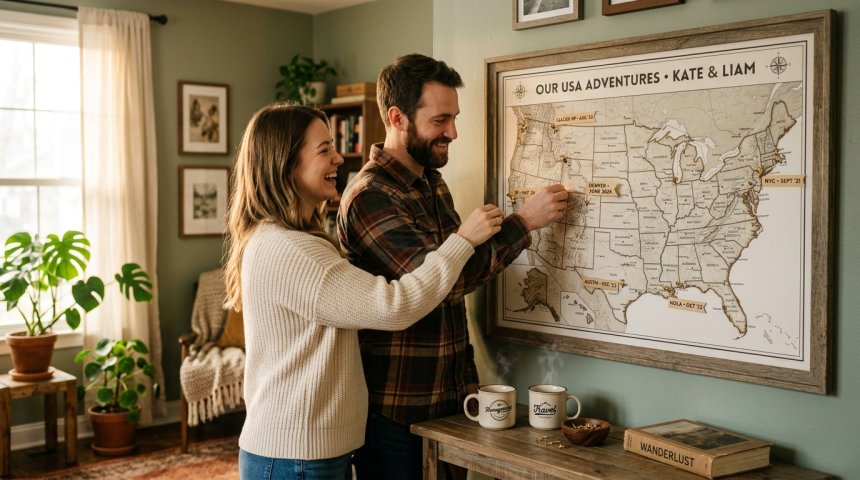
A few years ago I was at a friend's apartment for the first time, doing that polite new-guest thing of wandering around looking at their walls, when I stopped dead in front of a framed map of the United States. It was covered in tiny brass pins, and next to a few of them were little handwritten flags with dates. "Oh, that one," my friend said, noticing me, and then for the next twenty minutes I did not look at anything else, because every single pin had a story. The pin in Montana was a blown tire and a stranger who helped. The pin in Maine was the week her dad retired. The pin in New Mexico was where she'd cried in a good way.
I left that apartment thinking about paper and ink and pins, and then I stopped, because that's not what I'd been looking at. I'd been looking at a memory museum, a conversation starter, a family archive, and a piece of identity hanging on a wall. And I'd been told, implicitly, the entire business model in one sentence: people don't buy the map. They buy the feeling of someone pointing at a pin and saying, "Wait. Tell me about this one."
That's the business we're talking about today — a personalized U.S. travel memories and map store. Custom push-pin maps, scratch-off maps, trip-route posters, photo maps, engraved coordinates, memory books. And we're going to look at it the way an operator should: honestly, with numbers that are rough but real, and with the emotional mechanics front and center, because in this niche the emotion is the unit economics.
What You're Actually Selling (It's Not Paper)
Let's get this straight before we talk about anything practical, because founders who miss this point build a printing business and wonder why their ads don't convert. You are selling four invisible things wrapped around a physical object.
One: identity. "We're a traveling family" is not a hobby description; for a lot of households it's a core part of who they are. Your map lets them hang that identity on the wall. Two: evidence. In a life that increasingly happens on screens, a pin you can touch is proof the trip was real. Three: storytelling. The map is a prop that invites the best stories a household owns to be told again, to guests, to kids, to themselves on a random Tuesday. Four: recognition — and this is the gifting superpower. A personalized map says to the receiver, "I know who you are and what you love, and I paid attention." That is why these things produce the tears-at-unwrapping reviews that every gift seller dreams of.
Here's the business magic: personalization multiplies perceived value far faster than it multiplies cost. Adding a family name, three dates, and a short line of text might cost you nothing in production, but it moves the product from "a map" (worth $30 in a customer's head) to "our map" (worth $180 without blinking). That gap — between the cost of personalization and the value of personalization — is where this entire business lives.
Why This Moment Is Kind to This Business
You could have started this store ten years ago, but 2026 is genuinely a friendly window, and here's why. First, the experiences-over-things generation has grown up and discovered a twist: people who collect experiences still want artifacts of them. The concert ticket stub, the trailhead photo, the pin. Your store sells the artifact.
Second, personalization has become the default expectation. Custom sneakers, custom pet portraits, custom everything — customers now assume a product can have their name on it, and they've stopped finding that strange. Third, the American travel boom keeps feeding you inventory of memories: the national parks surge, the RV and vanlife movement, the road-trip culture, the "work from anywhere" weeks that turned into mountain months. Every one of those trips is a future pin waiting for a map.
And fourth — the practical part — the tools have gotten cheap. Print-on-demand means you can launch without a warehouse, AI-assisted design means you can produce new artwork without hiring a studio, and modern storefront personalizer apps mean a customer can build their custom map in minutes on a phone. The barrier to entry has never been lower, which is good news and a warning at the same time, and we'll get to the warning later.
The Catalog: Build a Price Ladder, Not a Product List
New stores make the mistake of launching one hero product and hoping. What you actually want is a ladder, so that every budget can climb onto your brand and every customer has a next rung.
At the bottom, entry products in the ten-to-twenty-five-dollar range: die-cut state stickers, luggage tags, digital download prints, small scratch cards. These are not profit centers; they are first dates. They let a customer test your quality and your vibe for the price of a lunch.
The middle rungs, forty to ninety dollars: minimalist custom trip posters (a line-art route with names and dates), scratch-off U.S. maps, photo-strip prints, single-state line art. This is where browsing traffic converts, and where gift-buyers with a "nice but not extravagant" budget land.
The core premium, one-twenty to two-twenty: the framed canvas push-pin map with personalized title, legend, and pin set. This is your hero, your ad face, your review-generator. Protect its quality with your life.
The luxury rung, three-hundred to six-hundred: laser-engraved wood maps, oversized formats, multi-layer 3D wood pieces, "family legacy" editions meant to be inherited. Few will buy these, but they raise the perceived value of everything below them and they make glorious content.
And never forget the add-ons, because add-ons are margin: extra pin sets (people love buying new pins for new trips — that's repeat revenue hiding in plain sight), story cards, gift wrap, a "pin of the year" ornament. The ornament, by the way, is a quietly brilliant product: one per year, per family, forever. Do the math on that habit.
The Personalization Engine: Where the Magic (and the Headaches) Live
The customization flow is your checkout experience, and it will make or break your conversion rate. The golden rule: start minimal, allow depth. Ask for the three things every customer knows — a title (usually a family name), the places, and the dates — and make the preview update live, instantly, beautifully. Then offer optional depth: a short dedication line, color themes, photo corners, a legend style. Optional. Never force a customer to fill twelve fields to buy a gift at 11 p.m.
The live preview is not a feature; it's the sale. Watching "The Ramirez Family" appear over the map in their chosen style is the moment the customer stops evaluating a product and starts recognizing their thing. Invest there first.
Then the unglamorous part: proofs and typos. Decide your policy before your first customer decides it for you. My advice: auto-generate a proof, require a confirmation click ("I've checked spelling and dates"), and state plainly that personalized items can't be returned for customer typos but that you'll fix your errors free and fast, forever. And build a tiny internal habit that saves reputations: a human eye scans every order's text before production. You will catch "Seatle." You will catch a wedding date entered as the divorce year (yes, that kind of thing happens). That two-minute scan is the cheapest insurance in your business.
Field note: include a "story intake" option at checkout — a free-text box where the buyer can tell you, in one sentence, what the map celebrates. You don't have to use it in production. But when you do — a handwritten note back, a small design flourish — you create the review that sells the next hundred maps.
Production: Print-on-Demand, In-House, or the Honest Hybrid
Let's talk about who actually makes the thing, because this choice defines your margins, your quality, and your sleep.
Print-on-demand is the right starting point for almost everyone. No inventory, no equipment, no warehouse; you upload designs, the partner prints and ships, you keep the spread. The costs are real, though: thinner margins, less control over color and materials, packaging that isn't yours, and the occasional quality surprise that arrives at a customer's door with your brand on it. Choose your POD partner the way you'd choose a co-founder, and order test products monthly, forever.
In-house production is where margins and control live: your own large-format printer, your own framing bench, your own packaging with your own note inside. The catch is capital, space, labor, and the learning curve of print craft (color profiles, canvas tension, frame corners — small arts, brutally learned).
The honest path is the hybrid. Launch on POD. Watch your sales data for the two or three configurations that sell eighty percent of your volume — it's usually one size, one frame, one style. Bring exactly those in-house, or move them to a dedicated print partner with negotiated rates and your packaging. Stay POD for the long tail. This is how you get in-house margins where volume is, without in-house risk where volume isn't.
And packaging deserves its own paragraph, because in this business the box is part of the gift. Corner protection, rigid backing, a printed "how to add your first pin" card, and a handwritten note. Damaged-in-transit rates on framed goods typically run two to five percent; budget for it, replace fast without interrogation, and understand that a graceful replacement is worth more marketing than the ad that got the order.
The Numbers: Rough, Honest Unit Economics
Do your own math for your market, but here's a realistic shape so you know what healthy looks like. Take a framed push-pin map at $189. Production through a good partner might run $40–55 including the pin kit; shipping in a proper box, $15–20; packaging and inserts, $4. Payment processing around $6. That leaves a gross margin near $110 before marketing. If your blended customer acquisition cost sits around $30–45 — achievable with strong organic and UGC content, painful with pure paid ads — you're contributing $60+ per order toward fixed costs and profit. That's a real business.
Now the levers. Average order value goes up with bundles (map + extra pin set + ornament), with the luxury rung pulling some buyers upward, and with gift add-ons at checkout. Lifetime value is the quiet star: a family that buys a map in 2026 buys pins in 2027, an ornament every December, a second map for the grandparents, a poster for the office. Your email list of map owners is an asset that appreciates as they travel. Price with that in mind: the first map doesn't need to carry the whole relationship.
Where the Customers Come From
This product is unusually lucky in how it markets itself, if you let it. Start with the channels that reward visual, emotional, gift-able products.
Pinterest is a gift-search engine wearing a social network's clothes, and maps are pin catnip — publish every design variant, every room-styling shot, every "gift for the couple who has everything" angle. Etsy is the other search engine: a huge share of personalized-gift intent starts there, and many smart operators run Etsy as a discovery storefront while building their own site for brand and margin. TikTok and Instagram Reels do the emotional heavy lifting: the unboxing, the gift reaction, the "adding this year's pin" ritual, the five-years-of-pins timelapse. These formats are not ads; they're small stories, and stories are what sell this product.
SEO is your compound interest: long-tail pages like "personalized national parks map," "push pin map for RV owners," "anniversary gift for couples who travel." Nobody famous is fighting you for these phrases, and the buyer arriving from them is already holding a credit card.
Then the calendar. This is a gifting business, and gifting has seasons: Christmas (the giant one), anniversaries year-round, weddings in late spring, graduations in early summer, retirements whenever a career ends, Father's Day as a rising star. Plan your creative and your capacity around the calendar, and publish your "order by" dates loudly — deadline guarantees convert anxious gift-buyers like nothing else.
And partnerships, the underrated channel: travel bloggers and park-challenge accounts, RV communities, military spouse networks (PCS moves make a map of stations deeply meaningful), wedding planners, corporate HR teams buying retirement gifts. One good partner with an engaged audience can outperform a month of ads.
The Gifting Psychology: Design for the Unwrapping Moment
Here's the lens I want you to hold every decision up to: what happens at the unwrapping? Because that moment — the paper coming off, the name appearing, the hand going to the mouth — is your real product, and everything should be designed backward from it.
The story card tucked in the box ("This map celebrates five years of the Andersons' road trips") gives the giver words and the receiver chills. The gift message option, handwritten or printed beautifully, removes friction for the buyer. The "order by" guarantee removes fear. The packaging that opens like a present, not a shipment, adds ten perceived dollars for one real dollar. And the follow-up email six months later — "Where will your next pin go?" — is not spam; it's an invitation to continue a story they love telling.
Collect the reaction content, with permission, and let it become your advertising. A fifteen-second clip of a grandfather seeing his retirement map will outperform any studio creative you ever pay for. Treat every five-star "she cried" review as a company asset, because functionally, it is one.
Niches That Win: Don't Sell to "Travelers"
"Travelers" is not a niche; it's everybody. The stores that break through pick a somebody and design like they're in that somebody's living room. A few that genuinely work:
RV and full-time travelers — they want big maps, lots of pins, campground icons, and a community that celebrates mileage. National park chasers — the 63-parks crowd loves a map that lists the parks as checkboxes; this niche is passionate, organized, and loud online. Military families — a map of duty stations is a map of sacrifice and resilience; handle it with respect and it becomes a movement, not a product. Honeymooners and anniversary couples — dates and coordinates, elegant minimalism. Retirees — the "finally time" crowd, often gifted by adult children. New Americans and immigrant families — a map of the journey to a new home, handled tenderly, is one of the most meaningful products this format can become.
Each niche wants its own design language, its own words on the product page, and its own corners of the internet. Pick one to start. Be the obvious choice for that somebody. Expand when the first somebody loves you.
Brand, Unboxing, and the Pin Ceremony
Name, voice, and design language should feel like one person with taste. Whether you go vintage national-poster warmth or modern gallery minimalism, commit, and make every touchpoint — site, box, note, pins, email — speak that language.
And consider giving your customers a ritual. The "first pin ceremony" card in the box suggests it: when the map goes up, add the first pin together, and say the story out loud. Brands that hand customers small rituals get remembered; brands that hand customers a product get replaced. Similarly, a "Pin Your Year" campaign every December — inviting customers to share where their year's pins went — turns your audience into a community and your community into next year's content.
The Boring Stuff That Saves You
Every operator skips this section and every operator regrets it, so here it is in one breath. Build a proofing workflow with a human scan. Write your typo and return policy in plain language and put it where buyers can see it before purchase, not after the mistake. Stress-test your packaging by dropping it from waist height onto concrete, because delivery drivers will do worse. Plan Q4 capacity in September — personalization businesses live or die in the six weeks before Christmas, and your production partner's slots fill early. Answer customer service like a human within one business day, and when something goes wrong, fix it generously and quickly; in a review-driven, gift-emotional category, service is the brand.
The Tech Stack, Briefly
A modern lean build looks like this: Shopify as the storefront; a product personalizer app (or a custom builder once volume justifies it) for live previews; a POD integration for the long tail; Klaviyo or similar for the email and SMS flows (welcome series, proof confirmation, shipping updates, six-month "next pin" nudge, holiday deadline reminders); a reviews app configured to request photo reviews specifically; and simple analytics watching the three numbers that matter — conversion on personalized products, average order value, and repeat purchase rate. Don't buy more stack than that until the numbers tell you to.
The Honest Risks (and the Defenses)
Let's not pretend this is easy money. The low barrier to entry means copycats and a race to the bottom on marketplaces; you'll see your designs imitated, and it will sting the first time and then bore you. Ad costs in gifting categories are real. POD quality variance can bite you at the worst moment. Seasonality means cash flow discipline matters. And personalization means every order carries a tiny bespoke risk of a wrong name or a wrong date.
The defenses are all the same shape: go upmarket on meaning, not just price. A copycat can steal your map layout in a week; they cannot steal your niche's trust, your review wall of unwrapping videos, your story-card habit, your community's inside jokes, or your six-year archive of customer pins. Build those. That's the moat.
A 12-Month Roadmap, Plainly Spoken
Months one and two: pick your niche, name and design the brand, launch three to five products on a ladder, all on POD. Months three and four: open the Etsy discovery channel, start the content engine — three short videos a week, unboxings and pin rituals — and publish your first SEO gift pages. Months five through seven: double down on whichever channel and product the data likes; collect photo reviews aggressively; test one partnership per month. Months eight and nine: bring your hero configuration in-house or to a dedicated partner; add bundles and the ornament; build the holiday flows. Months ten through twelve: run the Q4 surge with published deadlines and extra service staffing; then, in the January quiet, launch the "Pin Your Year" campaign and plan year two's lines from your own sales data.
That's not a fantasy; it's a rhythm. Follow it and you'll end year one with a brand, an audience, and data — the three things money can't buy quickly.
A Balanced View
Some people will read this and think "it's just maps." They're right, and they're wrong, in the way that people who say "it's just coffee" are right and wrong. The product is simple; the meaning is not. This business rewards operators who respect the meaning — who understand they're handling family stories, retirements, honeymoons, homecomings. If that sounds like a burden, pick another niche. If it sounds like a privilege, you're already halfway there.
Conclusion
A personalized U.S. travel memories and map store is one of those rare businesses where the marketing is true: you really are helping people keep their stories. The economics work because personalization creates value far cheaper than it charges. The timing works because a traveling culture wants artifacts. And the moat works because trust, community, and a wall of tears-at-unwrapping reviews cannot be copied at the speed a design can be stolen. Start small, pick a somebody, protect the quality, design for the unwrapping, and let the pins accumulate — yours and theirs.
FAQs
How much does it cost to start this business? A lean POD-based start can begin in the low thousands: storefront, personalizer app, design work, test products, and modest ad or content budget. In-house production later is a five-figure decision. The beautiful part is you can validate demand before buying a single machine.
Should I use print-on-demand or print in-house? Start POD, always. Move your top one or two configurations in-house or to a dedicated partner when volume is predictable, and keep the long tail on POD. Hybrid is not a compromise; it's the strategy.
Which products are most profitable? Framed push-pin maps carry the best margin-to-effort at premium prices, and add-ons (pin sets, ornaments, gift wrap) carry the best pure margin. Luxury wood pieces carry margin and marketing value both.
How do I handle customer typos on personalized orders? Require a confirmation click on the proof, state the policy plainly before purchase, scan orders with human eyes anyway, and when your error happens — fix it free, fast, and cheerfully. Grace handled well becomes a review that sells.
Is this market saturated? The generic middle is crowded; the meaningful edges are wide open. "Another USA map" struggles. "The definitive map for national park chasers" or "the duty-station map for military families" still has room, because niches reward specialists.
How seasonal is the business, and how do I smooth it? Q4 is the peak, with anniversaries and weddings providing spring and summer volume. Smooth it with ornaments and "Pin Your Year" campaigns in the quiet months, corporate and retirement gifting outreach, and evergreen SEO gift pages that work year-round.
Beyond the Map: Where the Brand Can Grow
When the map business is healthy, the brand can stretch into the wider "travel memory" shelf without losing its soul: memory journals that pair a page with each pin, photo books organized by route, "trip of the year" annual prints that families collect like plates, and framed coordinate art of single beloved places. The rule for every new line is the same test as the first product: would this make someone point and say, "Wait. Tell me about this one"? If yes, build it. If no, skip it, no matter the margin.
The Data Advantage Nobody Talks About
After a year or two, you'll own something quietly valuable: a dataset of what Americans celebrate. Which states get pinned most, which trips become framed stories, which words people write in their dedications, which niches buy twice. Let that data design your next products, your next niches, and your next ad angles. Your customers are telling you, in purchases and pins, exactly what meaning sells. Listen.
A Final Word
I think about my friend's map sometimes — the blown tire in Montana, the retirement in Maine — and I remember that every order in this business is someone's version of that wall. A couple's first year married. A kid's first ocean. A father's last big trip before the knees said no. You're not shipping canvas; you're shipping the place where those stories will live, get told, and get told again.
Run it that way. Charge fairly for real quality. Fix mistakes generously. Celebrate your customers' pins like they're your own — because in a very real sense, they are your company's map, and it's getting more beautiful every season. Now go build the store, hang a sample on your own wall, and start adding pins. The first one's the hardest, and the most fun.
Share
What's Your Reaction?
 Like
0
Like
0
 Dislike
0
Dislike
0
 Love
0
Love
0
 Funny
0
Funny
0
 Angry
0
Angry
0
 Sad
0
Sad
0
 Wow
0
Wow
0