Balancing Soundboard & Crowd Audio: Live Video Mixing Techniques
Learn how to balance soundboard and crowd audio in live performance videos with phase alignment, dynamic blending, spatial processing, and genre-specific mixing techniques.

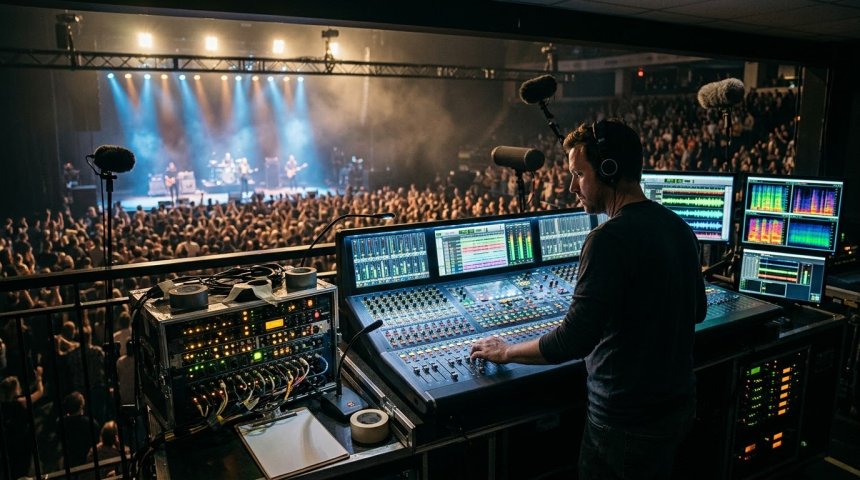
The paradox of live performance video audio is that perfection sounds fake. A pristine soundboard feed captured directly from the front-of-house console delivers clarity, separation, and fidelity that studio recordings envy—yet when paired with video footage showing a roaring crowd in an echoing venue, that same pristine feed feels sterile, disconnected, and fundamentally dishonest to the documented experience. Conversely, raw crowd microphone captures brimming with atmosphere, room resonance, and audience energy lack the definition, intelligibility, and tonal balance necessary for viewers to actually hear the performance they're watching. The art and science of live performance video audio lies not in choosing between these sources but in synthesizing them into a coherent whole that honors both musical accuracy and experiential authenticity—a mix that sounds like being there rather than either a sanitized studio reproduction or an indistinct ambient recording.
This synthesis is deceptively complex. Soundboard feeds and crowd microphones arrive at your DAW with fundamentally different acoustic signatures, temporal alignments, frequency distributions, and dynamic behaviors. Naively combining them produces phase cancellation hollowing out low-end energy, comb filtering creating metallic tonal coloration, dynamic imbalance where crowd noise drowns quiet passages or disappears during loud sections, and spatial confusion where the perceived acoustic environment contradicts visual evidence. Solving these problems requires understanding the physics of multi-source audio capture, the psychoacoustics of spatial perception, the signal processing tools available for alignment and integration, and the aesthetic judgment determining what "authentic" means for each specific performance context.
This guide provides comprehensive technical methodology for achieving professional live performance video audio mixes. We'll examine signal flow architectures from capture through post-production, phase alignment techniques preventing destructive interference, dynamic blending strategies maintaining balance across varying performance intensities, spatial processing creating convincing acoustic environments, genre-specific approaches recognizing that jazz club intimacy differs fundamentally from arena rock spectacle, workflow optimization for efficient post-production, and quality validation protocols ensuring translation across playback systems. Whether you're a touring FOH engineer adding video deliverables to your responsibilities, a dedicated live recording specialist, a content creator documenting performances, or a post-production mixer receiving multitrack live captures, this guide delivers the technical depth and practical frameworks needed to produce live video audio that satisfies both audiophile scrutiny and emotional authenticity.
Let's begin by understanding why this balance is so technically challenging—and why getting it right matters more than most engineers initially appreciate.
Chapter 1: The Fundamental Tension — Why Soundboard and Crowd Audio Conflict
Understanding the inherent conflicts between soundboard and crowd sources prevents naive mixing approaches and informs every subsequent technical decision.
Acoustic Signature Mismatch
Soundboard Feed Characteristics: Direct console output represents close-miked, individually processed channel strips summed to stereo or multitrack stems. This signal path minimizes room acoustics, audience noise, and stage bleed producing high direct-to-reverberant ratios with exceptional transient clarity and frequency extension. However, this cleanliness is precisely what makes it sound unnatural in video context; no human ear in the venue hears this isolated directness. The soundboard feed is an abstraction of the performance optimized for PA reinforcement or recording, not an accurate document of the acoustic event as experienced.
Crowd Microphone Characteristics: Ambient microphones capture the venue's acoustic response including early reflections, reverberant tail, audience reaction, stage wash, and environmental noise. This signal embodies the experiential reality but suffers from poor source separation, limited frequency bandwidth (especially low-end definition), inconsistent level relative to performance dynamics, and significant time-of-arrival differences versus soundboard feed. Crowd mics document truthfully but incompletely; they provide context without content.
The Integration Challenge: Combining these sources means merging signals with opposing virtues and complementary deficiencies. The soundboard provides content lacking context; crowd mics provide context lacking content. Successful integration preserves each source's strengths while compensating for weaknesses through processing and blending—not merely adjusting fader levels but actively reshaping both signals to occupy compatible acoustic spaces. This reshaping is where technical skill determines outcome quality.
Phase Relationship Complexity
Time-of-Arrival Differences: Sound travels approximately 1 foot per millisecond. Crowd microphones positioned 30-100 feet from stage receive sound 30-100ms after direct sound reaches stage microphones feeding the soundboard. This delay creates comb filtering when sources combine: constructive and destructive interference at frequencies determined by delay time producing characteristic metallic coloration and bass cancellation. At 50ms delay, first null occurs at 10Hz with subsequent nulls at 30Hz, 50Hz, 70Hz—devastating low-end integrity critical to live music impact. Phase misalignment isn't subtle degradation; it's catastrophic frequency response distortion audible on any playback system.
Multiple Path Interference: Venues contain numerous reflective surfaces creating multiple arrival paths for each sound source. Crowd mics capture these reflections superimposed on direct sound creating complex impulse responses differing from soundboard's clean direct signal. When combined, these differing impulse responses interact unpredictably producing frequency-dependent phase shifts varying across stereo field and changing with source position. Simple delay compensation aligns primary arrivals but cannot fully resolve multipath complexity. Residual phase issues require additional processing beyond time alignment.
Stereo Image Phase Correlation: Soundboard stereo feeds typically exhibit strong center correlation from mono-compatible PA mixing practices. Crowd microphone pairs often capture decorrelated ambient information with wide stereo dispersion and lower correlation coefficients. Combining highly correlated and decorrelated sources creates phase relationship inconsistencies across frequency spectrum causing mono compatibility problems and unstable stereo imaging. Mono fold-down may collapse crowd ambience or create destructive cancellations absent in stereo monitoring. Phase correlation metering throughout mixing process identifies problematic regions requiring correction.
Dynamic Range Incompatibility
Opposing Dynamic Behaviors: Soundboard feeds maintain relatively consistent level controlled by FOH engineer's fader movements and compression. Crowd audio exhibits extreme dynamic variation: quiet during soft musical passages (revealing HVAC noise, distant traffic, handling noise), explosive during audience reactions, and variable during moderate passages depending on crowd engagement. Static fader positions cannot accommodate this divergence; crowd audio either overwhelms quiet sections or vanishes during loud ones. Dynamic blending requires automated or sidechain-driven level management responding to performance intensity in real-time.
Signal-to-Noise Ratio Disparity: Soundboard feeds typically exhibit 60-80dB SNR reflecting professional preamp quality and close-miking techniques. Crowd microphones operate at 20-40dB SNR due to distance, ambient noise floor, and lower-gain positioning. Boosting crowd mics to audibly useful levels elevates noise floor proportionally creating hiss, rumble, and environmental contamination absent from soundboard. Noise reduction processing helps but introduces artifacts at aggressive settings. Managing this SNR disparity requires strategic EQ, gating, spectral editing, and acceptance that crowd audio will always be noisier than soundboard—the goal is managing rather than eliminating this difference.
Key Insight: For diagnosing and visualizing phase relationships between soundboard and crowd audio sources, iZotope Ozone Imager Stereo Width and Phase Analysis Tool provides free professional-grade phase correlation metering and stereo width analysis enabling precise identification of phase cancellation issues before they compromise your mix.
Chapter 2: Capture Architecture — Setting Up Success Before Post-Production
Post-production can fix many problems but cannot create information never captured. Capture decisions determine the ceiling of achievable quality.
Soundboard Feed Acquisition Best Practices
Multitrack Versus Stereo Capture: Stereo board feed limits post-production flexibility to global EQ, compression, and level adjustment. Multitrack capture (via Dante, MADI, USB, or analog splits) enables individual instrument/vocal rebalancing, targeted phase correction, selective processing, and stem-level crowd blending. Multitrack requires more storage, interface channels, and setup time but dramatically expands creative options. For professional results, multitrack is strongly preferred; stereo acceptable only for quick-turnaround or resource-constrained projects. If stereo is unavoidable, request pre-fader aux send rather than master bus output preserving independence from FOH mix decisions made for PA optimization rather than recording balance.
Sample Rate and Bit Depth Alignment: Match sample rate and bit depth across all capture devices preventing sample rate conversion artifacts and synchronization drift. 48kHz/24-bit represents professional standard balancing quality and file size; 96kHz provides extended frequency headroom for processing at cost of doubled storage. Confirm clock synchronization across all digital devices via word clock, ADAT sync, or network timing protocol. Clock mismatches cause clicks, pops, and gradual drift corrupting long-form recordings. Test synchronization before performance; discovering clock issues mid-show is catastrophic.
Headroom Management: Live performances exhibit unpredictable transient peaks exceeding nominal levels. Set input gain conservatively targeting -18dBFS average with peaks not exceeding -6dBFS preserving 6dB safety margin. Digital clipping is irreversible; analog saturation is forgiving. When in doubt, reduce gain; boosting clean signals in post is preferable to recovering distorted transients. Monitor levels throughout performance adjusting for unexpected dynamic excursions. Soundcheck levels don't guarantee show levels; adrenaline and audience energy elevate performance intensity.
Documentation and Labeling: Label every track clearly and consistently: "Kick In," "Snare Top," "Lead Vox," "Gtr L," etc. Document channel list, patching, sample rate, bit depth, and any processing applied pre-capture (EQ, compression, limiting). Note FOH engineer's name and contact for clarification questions. Create session template matching documentation accelerating post-production setup. Undocumented multitracks become archaeological puzzles consuming hours of identification time; documentation investment pays exponential returns.
Crowd Microphone Deployment Strategies
Microphone Selection Criteria: Crowd mics serve different purposes requiring different characteristics:
- Wide ambience: Small-diaphragm condensers with cardioid or subcardioid patterns capturing balanced room response without excessive proximity effect. Matched pairs ensure consistent stereo imaging. Examples: Schoeps CMC6, Neumann KM184, DPA 4011.
- Audience reaction: Dynamic or condenser mics with tighter cardioid patterns positioned closer to crowd sections isolating vocal reactions from stage wash. Examples: Shure SM57, Sennheiser MD421, Audio-Technica AT4050.
- Stage wash/room tone: Boundary/PZM microphones mounted on walls or ceilings capturing diffuse field with minimal direct sound coloration. Useful for natural reverb capture without crowd vocal dominance. Examples: Crown PCC-160, Audio-Technica U853A.
- Spot effects: Shotgun microphones for isolated crowd sections, sing-alongs, or specific ambient elements. Highly directional pickup rejects off-axis stage bleed. Examples: Sennheiser MKH 416, Rode NTG3.
Select microphones based on intended function; one type rarely serves all purposes optimally. Budget constraints may necessitate compromise; prioritize wide ambience pair as foundation supplementing with spot mics as resources allow.
Positioning Geometry and Phase Coherence: Stereo crowd mic placement follows established techniques:
- ORTF: 17cm spacing, 110° angle providing natural stereo width with good mono compatibility. Balanced direct/ambient ratio suitable for mid-field positioning.
- XY: Coincident capsules at 90-120° angle providing excellent mono compatibility with narrower stereo image. Ideal when mono fold-down is critical.
- Spaced Pair: 30-100cm spacing with parallel or angled orientation providing wide immersive image with potential mono phase issues. Requires careful distance calculation relative to sound source.
- Blumlein: Figure-8 coincident pair at 90° capturing rich ambient information with natural front-back differentiation. Demands good room acoustics; problematic in reflective or noisy venues.
Height positioning significantly affects direct/ambient balance: ear-level captures crowd vocals prominently; elevated positioning (8-15 feet) increases room ambience relative to direct crowd sound; floor-level emphasizes low-frequency rumble and stage wash. Experiment during soundcheck documenting positions yielding best balance for your specific venue and performance type. Measure distances to stage for delay calculation in post-production.
Redundancy and Coverage: Deploy minimum two stereo crowd mic pairs at different positions providing blending options and redundancy against individual mic failure or unfavorable positioning. Front-of-house position captures balanced overall perspective; rear balcony or side-wall positions capture different reflection patterns and crowd proximity. Multiple perspectives enable post-production selection and blending optimizing final result beyond single-position limitations. Redundancy costs additional channels and setup time but insures against irreplaceable capture loss.
Synchronization and Timecode Infrastructure
Timecode Distribution: Professional multi-device capture requires shared timecode reference ensuring sample-accurate synchronization across soundboard recorder, crowd mic recorder, and camera systems. LTC (Linear Time Code) distributed via cable or wireless sync boxes (Tentacle Sync, Deity W.Lav Pro, Ambient Lockit) provides frame-accurate alignment. Jam-sync all devices before performance and verify sync periodically during long shows. Timecode drift accumulates imperceptibly becoming obvious only during post-production alignment; prevention vastly superior to correction.
Clap Slate Backup: Always record visual and audio clap slate at session start and after any device interruption providing manual sync reference if timecode fails. Clap should be visible in all camera angles and audible on all audio recorders. Verbal slate announcing date, venue, artist, set number, and take provides metadata backup. Slate takes 10 seconds and prevents hours of manual sync work; never skip this elementary precaution regardless of timecode confidence.
Frame Rate Consistency: Confirm all video cameras and audio recorders share identical frame rate and timecode frame rate. Mismatched frame rates (29.97 vs. 30fps, 23.976 vs. 24fps) cause gradual sync drift accumulating to seconds over hour-long performances. Frame rate discrepancies are notoriously difficult to diagnose and correct in post; verify alignment during pre-production equipment check. Document confirmed frame rates in session notes.
Chapter 3: Phase Alignment and Temporal Correction — Foundation of Coherent Blending
Phase alignment is non-negotiable prerequisite to successful blending. No amount of EQ, compression, or fader adjustment compensates for fundamental temporal misalignment.
Delay Calculation and Measurement
Distance-Based Calculation: Measure physical distance from stage center (or primary sound source) to each crowd microphone position. Calculate delay: distance (feet) ÷ 1.13 = delay (milliseconds) at standard temperature/humidity. Apply calculated delay to crowd mic tracks aligning primary wavefront arrivals with soundboard feed. This calculation provides starting point but rarely achieves perfect alignment due to reflection complexity and measurement imprecision.
Impulse Response Analysis: Generate or capture impulse response at crowd mic position using starter pistol, balloon pop, or sine sweep played through PA. Analyze impulse response identifying direct sound arrival time versus soundboard reference. Measured arrival time accounts for actual acoustic path including reflections and diffraction effects that distance calculation ignores. Impulse response measurement provides more accurate delay value than geometric calculation alone. Tools: Room EQ Wizard, FuzzMeasure, or DAW impulse response plugins.
Cross-Correlation Alignment: DAW cross-correlation functions (VocAlign, ReaAlign, built-in correlation meters) analyze waveform similarity between soundboard and crowd tracks identifying optimal delay offset maximizing correlation coefficient. Automated correlation works well for percussive sources with clear transient markers; less reliable for sustained tones or dense mixes. Use correlation as verification of manual alignment rather than sole determination method. Visual waveform inspection confirms correlation results preventing algorithmic errors.
Iterative Refinement Process: Initial alignment provides baseline; refinement achieves precision. Solo soundboard and crowd sources together listening for comb filtering artifacts: hollow bass, metallic midrange, smeared transients. Adjust delay in 0.1ms increments while monitoring low-frequency response and transient clarity. Optimal alignment produces fullest bass response, clearest transients, and most natural tonal balance. Trust ears over numbers; calculated delays provide starting points but acoustic reality determines optimal alignment. Document final delay values for recall and future reference.
Phase Rotation and All-Pass Filtering
Residual Phase Correction: Even after optimal delay alignment, residual phase issues persist due to multipath propagation, microphone frequency-dependent phase response, and processing-induced phase shift. All-pass filters and phase rotation tools adjust phase without affecting magnitude response correcting residual cancellations at specific frequencies. Tools: Little Labs IBP, Sound Radix Auto-Align, Waves Phase, UAD Little Labs IBP. Apply surgically to problematic frequency regions identified through spectrum analysis and critical listening; broadband phase rotation often creates new problems while solving others.
Frequency-Selective Alignment: Different frequency ranges may require different delay offsets due to wavelength-dependent propagation characteristics. Low frequencies (long wavelengths) tolerate greater misalignment before audible cancellation; high frequencies (short wavelengths) demand precise alignment. Multi-band delay tools enable frequency-dependent alignment optimizing coherence across spectrum. Complex technique requiring advanced understanding but yields superior results for challenging acoustic environments. Reserve for situations where single-delay alignment proves insufficient despite thorough optimization.
Mid-Side Phase Processing: Convert crowd audio to mid-side representation separating center (sum) and side (difference) information. Mid component typically correlates better with soundboard center image; side component carries ambient width with lower correlation risk. Process mid and side independently: align mid component precisely to soundboard, apply gentler alignment or none to side component preserving ambient width. Reconvert to stereo after processing. M/S approach maintains stereo width while improving center coherence; particularly valuable when mono compatibility is required.
Verification and Validation Protocols
Mono Compatibility Check: Regularly monitor mix in mono throughout alignment and mixing process. Phase issues invisible in stereo become obvious in mono as cancellations and level changes. Mono check should occur at multiple stages: initial alignment, after major processing changes, and before final export. Mono-incompatible mixes fail on single-speaker playback systems common in mobile viewing, retail environments, and public spaces. Mono compatibility isn't optional professional standard; it's delivery requirement.
Phase Correlation Metering: Continuous phase correlation metering during mixing identifies problematic frequency regions and stereo image stability. Correlation values consistently below 0 indicate significant phase cancellation requiring attention; values above 0.7 indicate healthy correlation; values near +1 suggest excessive mono content reducing stereo width. Target correlation range 0.3-0.8 balancing width and compatibility. Metering supplements but doesn't replace critical listening; meters indicate potential issues but ears confirm actual audibility.
Multi-System Translation Testing: Verify aligned mix translates across playback systems: studio monitors, headphones, laptop speakers, smartphone, car stereo, and consumer soundbar. Phase issues manifest differently across systems; some reveal problems masked on others. Translation testing catches issues missed in controlled monitoring environment. Document system-specific observations informing final adjustments. If mix sounds good only on studio monitors, alignment or processing needs revision regardless of meter readings.
Chapter 4: Dynamic Blending Strategies — Maintaining Balance Across Performance Intensity
Static fader positions cannot accommodate live performance's dynamic nature. Intelligent automation and sidechain processing maintain appropriate balance throughout varying intensities.
Sidechain-Driven Crowd Level Management
Soundboard-Sidechained Crowd Compression: Route soundboard feed as sidechain input to compressor on crowd mic bus. When soundboard level increases (loud performance sections), compressor reduces crowd mic level proportionally; when soundboard decreases (quiet passages), crowd mic level rises maintaining ambient presence. Threshold, ratio, attack, and release settings determine blending character: fast attack/release creates responsive ducking following performance dynamics; slower settings create smoother transitions avoiding pumping artifacts. Typical starting points: threshold -20dBFS, ratio 2:1-4:1, attack 50-200ms, release 200-1000ms adjusted by ear.
Frequency-Selective Sidechaining: Full-bandwidth sidechain compression affects entire crowd mic spectrum uniformly often over-ducking desirable ambient frequencies while under-controlling problematic ones. Multi-band or frequency-selective sidechaining targets specific frequency ranges: duck low-mid crowd mud (200-500Hz) competing with instruments while preserving high-frequency crowd sparkle and air; compress crowd low-end rumble sidechained to kick/bass without affecting upper ambience. Frequency-selective approach maintains ambient texture while controlling masking; requires more setup but yields superior transparency.
Upward Compression and Expansion: Traditional compression reduces loud signals; upward compression amplifies quiet signals. Apply upward compression to crowd mics during loud performance sections raising ambient detail that would otherwise disappear beneath soundboard level. Conversely, expansion gates crowd mics during silent or near-silent moments reducing noise floor intrusion. Combined downward compression (controlling peaks) and upward compression (revealing detail) maintains consistent crowd presence across extreme dynamic range. Advanced technique requiring careful threshold setting but dramatically improves dynamic consistency.
Volume Automation Approaches
Section-Based Automation: Map performance structure identifying verses, choruses, bridges, solos, intros, outros, and between-song banter. Create automation lanes adjusting crowd level per section: higher during audience participation moments, lower during intricate instrumental passages, elevated during applause and sing-alongs, reduced during quiet intimate moments. Section-based automation respects musical intent rather than reacting mechanically to level changes. Requires familiarity with performance structure but produces musically intelligent blends.
Phrase-Level Detail Automation: Within sections, automate crowd level responding to specific musical phrases: boost crowd reaction following vocal hook, dip during guitar solo exposing instrumental nuance, swell during crescendo supporting emotional build, fade during decrescendo allowing space for resolution. Phrase-level automation requires detailed performance knowledge and significant time investment but achieves broadcast-quality dynamic storytelling. Reserve for featured performances justifying premium effort; section-level automation sufficient for most applications.
Transition Smoothing: Abrupt automation changes create audible level jumps drawing attention to mixing rather than performance. Smooth all automation transitions using curve shapes (logarithmic, exponential, S-curve) rather than linear ramps. Transition duration should match musical tempo and phrase length: faster transitions for uptempo energetic passages, slower transitions for ballads and atmospheric sections. Audition transitions in context verifying smoothness; solo'd automation curves may appear smooth but sound abrupt in musical context.
Spectral Balancing Across Dynamics
Dynamic EQ Application: Crowd mic frequency balance shifts with level: quiet moments emphasize noise floor and room modes; loud moments emphasize crowd vocals and broadband excitement. Static EQ cannot address this shifting balance. Dynamic EQ applies frequency-specific gain changes triggered by input level: cut low-mid mud only when crowd gets loud, boost air frequencies only during quiet passages, attenuate harsh resonances only when excited. Dynamic EQ maintains consistent tonal balance across dynamic range without static EQ compromises. Tools: FabFilter Pro-Q3, TDR Nova, Waves F6.
Adaptive Noise Reduction: Crowd mic noise floor becomes problematic during quiet passages when crowd level drops near noise threshold. Adaptive noise reduction (iZotope RX, Waves Clarity Vx, Cedar DNS) adjusts reduction amount based on signal level: aggressive reduction during quiet moments, transparent bypass during loud moments. Unlike static noise reduction applying constant processing regardless of need, adaptive approaches preserve natural ambience during energetic passages while cleaning quiet sections. Essential for maintaining professional noise floor across dynamic live recordings.
Chapter 5: Spatial Processing and Environmental Integration
Convincing live video audio requires spatial coherence between soundboard directness and crowd ambience creating unified acoustic environment matching visual evidence.
Reverb Matching and Enhancement
Convolution Reverb from Venue IRs: Capture impulse responses from actual venue during setup or soundcheck using sine sweep or starter pistol at stage position recorded at crowd mic locations. Convolve soundboard feed with venue IRs placing direct signals within authentic acoustic space. Matched reverb eliminates perceptual disconnect between dry soundboard and wet crowd mics creating seamless integration. IR capture adds setup time but dramatically improves spatial authenticity. For detailed guidance on convolution reverb implementation and plate reverb emulation techniques applicable to live venue simulation, Waves Abbey Road Reverb Plates Documentation (nofollow) provides comprehensive technical documentation on reverb matching methodologies used in professional post-production.
Algorithmic Reverb Supplementation: Venue IRs capture specific positions but may lack desired density, decay character, or early reflection pattern. Supplement convolution with algorithmic reverb shaping overall ambience: plate reverb adds smooth density to vocals and snare, hall reverb extends decay for orchestral or atmospheric passages, room reverb adds intimacy for small-venue aesthetics. Blend algorithmic and convolution reverbs balancing authenticity with controllability. Algorithmic reverb parameters adjustable in real-time; IRs fixed post-capture. Hybrid approach leverages both strengths.
Pre-Delay Alignment: Reverb pre-delay controls gap between direct sound and reverb onset affecting perceived source distance and clarity. Match reverb pre-delay to measured early reflection arrival time from venue IR analysis maintaining temporal coherence between artificial and captured ambience. Excessive pre-delay separates source from space; insufficient pre-delay smears transients reducing intelligibility. Pre-delay typically 10-40ms for medium venues; adjust by ear referencing crowd mic early reflection timing. Pre-delay alignment is subtle but significant factor in spatial believability.
Stereo Width and Depth Positioning
Soundboard Width Adjustment: Soundboard stereo feeds often exhibit narrow imaging optimized for PA coverage rather than headphone/stereo listening. Gentle stereo widening enhances immersion without compromising mono compatibility. M/S processing enables independent mid/side level adjustment: boost side component 2-6dB widening image while preserving center anchor. Avoid excessive widening creating artificial spaciousness contradicting venue visuals or causing mono collapse. Width adjustment should enhance not fabricate; reference crowd mic natural width as authenticity benchmark.
Crowd Mic Depth Layering: Multiple crowd mic positions create depth layers: close mics provide immediate audience presence, mid-field mics capture balanced room response, far mics contribute diffuse reverberant tail. Blend layers creating depth gradient from near to far matching visual perspective. Close crowd mics panned narrower maintaining localization; far mics panned wider enveloping listener. Depth layering creates three-dimensional acoustic space versus flat two-dimensional presentation. Layer balance adjusts per performance moment: intimate moments favor close mics, epic moments favor far ambience.
Center Image Anchoring: Lead vocals, bass, kick drum, and snare should maintain stable center image anchoring mix regardless of stereo width processing. Excessive center widening or phase manipulation destabilizes foundation elements creating disorienting listening experience. Verify center stability through mono monitoring and correlation metering. Center anchor provides reference point around which width and depth elements organize; without anchor, spaciousness becomes disorientation.
Panning and Localization Strategies
Crowd Mic Panning Philosophy: Crowd mic panning should reflect actual venue geometry and camera perspective. Wide ORTF pair panned full L/R provides immersive wrap-around ambience suitable for wide shots. Spot crowd mics panned to match visual position of crowd sections visible in current shot maintaining audiovisual correspondence. Panning automation following camera cuts enhances realism but requires significant effort; static panning matching primary camera angle sufficient for most applications. Panning decisions should support visual narrative not contradict it.
Instrument Localization Preservation: Soundboard panning typically reflects stage positioning: guitars L/R, keyboards centered or slightly offset, drums spread across panorama. Preserve this localization in final mix maintaining spatial correspondence with video stage layout. Avoid collapsing soundboard stereo image to mono or excessively narrowing panning; spatial information contributes to realism. However, extreme hard-panning suitable for PA reinforcement may feel unnatural in stereo video mix; moderate pan positions (70-90% rather than 100%) often translate better to headphone and stereo speaker playback.
Audience Reaction Localization: Cheering, singing, and clapping should appear to emanate from crowd areas visible on screen. Spot crowd mics positioned in specific audience sections enable localized reaction placement matching camera framing. Localized reactions enhance immersion versus omnidirectional ambient wash. Localization particularly important for sing-along moments, call-and-response sections, and audience interaction segments where visual-audio correspondence strengthens emotional impact.
Chapter 6: Genre-Specific Mixing Approaches
Universal mixing principles apply across genres but aesthetic priorities vary significantly. Understanding genre expectations prevents misapplied techniques producing technically correct but stylistically inappropriate results.
Rock and Metal: Power and Aggression
Priority Hierarchy: Impact > Clarity > Ambience. Crowd energy supports aggression; excessive polish undermines genre authenticity.
Crowd Integration Strategy: Higher crowd mic blend during choruses and breakdowns emphasizing collective energy. Lower during verses maintaining lyrical intelligibility. Aggressive sidechain compression creating punchy crowd ducking synchronized to kick/snare hits enhancing rhythmic drive. Distorted crowd textures acceptable甚至desirable; pristine ambience sounds wrong. Guitar wall-of-sound benefits from crowd mic mid-range filling spectral gaps between instruments. Bass and kick require meticulous phase alignment; low-end cancellation destroys genre foundation.
Spatial Approach: Moderate stereo width preserving center punch. Reverb shorter and denser than other genres; excessive wash blurs aggression. Parallel compression on crowd bus adding grit and sustain without sacrificing transient impact. Mono compatibility critical for club/festival playback systems.
Jazz and Acoustic: Intimacy and Nuance
Priority Hierarchy: Detail > Space > Dynamics. Audience quietness is feature not bug; ambient noise floor must be exceptionally low.
Crowd Integration Strategy: Minimal crowd mic blend during performance; elevated only during applause and between-song atmosphere. Gentle upward compression revealing subtle room tone without noise intrusion. Extensive dynamic EQ carving crowd mic around instrument fundamentals preserving acoustic timbre accuracy. Reverb longer and more natural than amplified genres; convolution reverb from venue IRs essential for authentic acoustic space representation.
Spatial Approach: Wider stereo image reflecting intimate venue acoustics. Careful depth layering placing instruments within believable acoustic space. Minimal processing preserving natural timbre; heavy compression or EQ destroys acoustic authenticity. Mono compatibility less critical than stereo fidelity for this genre's typical playback contexts.
Electronic and DJ Sets: Immersion and Continuity
Priority Hierarchy: Groove > Atmosphere > Fidelity. Continuous energy flow matters more than individual element clarity.
Crowd Integration Strategy: Crowd mics integral to mix not supplementary element. Higher sustained blend creating continuous energy bed. Sidechain compression keyed to kick drum creating rhythmic crowd pumping synchronized to beat. Crowd vocal samples and chants treated as musical elements mixed prominently during peak moments. Sub-bass phase alignment critical; electronic low-end demands absolute coherence.
Spatial Approach: Wide immersive stereo field enveloping listener. Extended reverb tails blending into crowd ambience creating continuous sonic environment. Creative effects (delay throws, filtered sweeps) incorporating crowd audio as effect source. Mono compatibility essential for club systems; verify sub-bass mono summation.
Pop and Contemporary: Polish and Vocal Presence
Priority Hierarchy: Vocal Clarity > Energy > Sheen. Lead vocal intelligibility paramount; everything serves vocal presentation.
Crowd Integration Strategy: Crowd mics ducked aggressively during vocal passages preserving lyric clarity. Elevated during instrumental hooks, dance breaks, and audience participation moments. Bright, polished crowd tone complementing pop production aesthetics. De-essing and dynamic EQ controlling crowd sibilance competing with vocal presence. Sing-along moments feature crowd vocals prominently mixed nearly equal to lead vocal creating communal experience.
Spatial Approach: Controlled stereo width with strong center vocal anchor. Glossy reverb tailored to pop aesthetic; venue IRs supplemented with polished algorithmic reverbs. Crowd ambience brightened and smoothed fitting contemporary production standards. Mono compatibility mandatory for radio/streaming delivery.
Classical and Orchestral: Authenticity and Dynamic Range
Priority Hierarchy: Naturalism > Dynamic Integrity > Ensemble Balance. Processing should be invisible; captured acoustic reality is the product.
Crowd Integration Strategy: Minimal processing preserving natural concert hall acoustics. Crowd mics blended subtly providing audience presence without distracting from musical content. Extreme dynamic range preserved; compression avoided except safety limiting. Silence between movements treated as musical content not noise to be eliminated. Applause captured naturally without enhancement or suppression.
Spatial Approach: Stereo width and depth reflecting actual hall acoustics. Convolution reverb from hall IRs if additional ambience needed; often unnecessary in well-captured classical recordings. Minimal artificial processing; authenticity is genre expectation. Mono compatibility secondary to stereo fidelity for classical audience playback preferences.
Chapter 7: Post-Production Workflow Optimization
Efficient workflow enables creative focus rather than technical troubleshooting. Structured processes accelerate delivery while maintaining quality.
Session Organization and Template Development
Track Layout Standardization: Consistent track ordering across projects accelerates navigation: soundboard stems grouped left, crowd mics grouped center, processing buses right, master outputs far right. Color coding by source type (blue=soundboard, green=crowd, yellow=buses, red=master). Marker tracks identifying song starts, sections, and notable moments. Standardized layout reduces cognitive load enabling faster creative decisions. Develop personal template reflecting your workflow preferences; template investment pays dividends across projects.
Bus Routing Architecture: Hierarchical bus structure enabling efficient global processing: individual tracks → subgroup buses (drums, bass, guitars, vocals, crowd) → mix bus → master bus. Parallel processing buses (compression, saturation, reverb sends) routed appropriately. Bus routing documented in session notes or visually through color-coded signal flow diagrams. Logical routing simplifies automation, processing adjustments, and stem exports. Ad-hoc routing creates debugging nightmares during time-sensitive revisions.
Preset and Macro Libraries: Save frequently used processing chains as presets: crowd mic EQ curves, sidechain compression settings, reverb configurations, dynamic EQ profiles. Create macros combining multiple operations into single controls for common tasks. Preset libraries accelerate setup for recurring venue types, genres, or artists. Custom presets reflecting your accumulated expertise outperform generic factory presets. Library maintenance ensures presets remain current with evolving techniques and tool updates.
Processing Chain Sequencing
Signal Flow Order Matters: Processing order significantly affects outcome. Recommended sequence for crowd mic bus: gain staging → high-pass filter → noise reduction → corrective EQ → phase alignment → dynamic EQ → compression → saturation/coloration → reverb send → stereo width → limiting. Each stage prepares signal for subsequent processing; reordering creates different results. For example, EQ before compression shapes compressor response; EQ after compression shapes already-compressed signal. Understand causal relationships between processing stages; don't arrange arbitrarily.
Gain Staging Discipline: Maintain consistent levels throughout signal chain preventing cumulative gain changes causing noise floor elevation or headroom exhaustion. Target -18dBFS average at each processing stage with peaks below -6dBFS. Use trim/gain plugins between processors normalizing levels. Proper gain staging preserves dynamic range, maintains processor headroom, and ensures predictable plugin behavior. Gain staging errors compound through chain creating mysterious noise, distortion, or inconsistent processing response.
Parallel Processing Integration: Parallel processing preserves original signal while blending processed version adding character without destruction. Parallel compression adds density without squashing transients. Parallel saturation adds harmonics without distorting fundamentals. Parallel reverb adds space without washing direct signal. Blend parallel channels to taste maintaining control over processed/unprocessed balance. Parallel processing particularly valuable for crowd audio where natural character must be preserved while enhancing specific qualities.
Quality Control and Delivery Preparation
Reference Track Comparison: Import professionally mixed live recordings in similar genre/venue as reference tracks. A/B compare your mix against references checking tonal balance, dynamic range, stereo width, crowd integration, and overall polish. References calibrate perception preventing monitoring environment bias. Don't copy references; use them as reality checks ensuring your mix occupies professional quality neighborhood. Multiple references spanning quality range prevent over-reliance on single aesthetic.
Multi-Format Export Strategy: Deliver multiple formats serving different distribution channels: high-resolution master (48kHz/24-bit WAV) for archival and premium platforms, compressed deliverables (AAC, MP3) for streaming and social media, stem exports for remix/future-proofing, and mono fold-down for compatibility verification. Each format requires specific mastering adjustments; don't simply bounce same master to multiple codecs. Loudness normalization per platform specifications (EBU R128 for broadcast, -14 LUFS for Spotify, -16 LUFS for Apple Music) ensures competitive loudness without excessive limiting.
Metadata and Documentation: Embed metadata including artist, title, venue, date, engineer credits, ISRC codes, and copyright information. Create technical documentation noting processing decisions, known limitations, and revision history. Documentation enables future revisions, remastering, and troubleshooting. Metadata ensures proper attribution and rights management across distribution platforms. Metadata and documentation are professional deliverables not optional extras.
Conclusion: Balance as Artistic Interpretation, Not Technical Formula
Balancing soundboard and crowd audio ultimately transcends technical methodology entering artistic interpretation territory. Technical skills enable execution but aesthetic judgment determines success. What constitutes "correct" balance varies by performance, genre, venue, audience, and intended viewer experience. Two equally skilled engineers mixing identical source material will produce different valid balances reflecting different artistic interpretations of the same event.
Technical proficiency provides vocabulary; artistic vision provides poetry. Master the techniques presented here until they become intuitive freeing cognitive resources for aesthetic decisions. Listen critically to live recordings you admire analyzing how they achieved their balance. Develop personal aesthetic preferences informed by technical understanding rather than arbitrary taste. Trust your ears validated through systematic verification protocols. Accept that perfect balance is asymptotic goal approached but never definitively reached; each mix teaches lessons informing the next.
Your audience experiences your mix as unified emotional communication not technical demonstration. They feel the performance's energy, hear the music's nuance, and sense the venue's atmosphere through your balancing decisions. Technical excellence serves emotional truth; never reverse that priority. When technique and artistry align, the result transcends documentation becoming transportation—carrying viewers into the moment as if present, feeling the bass in their chest, hearing the crowd's collective breath, experiencing the performance not as recorded artifact but as living memory.
That's the goal. Build the technical foundation. Cultivate the artistic sensibility. Pursue the balance that serves the moment. Every performance deserves that dedication.
Frequently Asked Questions (FAQs)
What is the ideal ratio between soundboard and crowd audio in a live mix?
There is no universal ideal ratio; optimal balance depends entirely on genre, venue, performance style, and artistic intent. General starting ranges: rock/metal 70-80% soundboard / 20-30% crowd during performance sections; jazz/acoustic 85-95% soundboard / 5-15% crowd; electronic/DJ 60-75% soundboard / 25-40% crowd; pop 75-85% soundboard / 15-25% crowd. These are starting points requiring adjustment based on specific performance dynamics, crowd engagement level, and desired experiential quality. Use your ears guided by genre expectations and visual context rather than preset ratios. The correct ratio is whatever makes the mix feel authentically present for that specific performance; trust your judgment validated through reference comparison and multi-system testing. Ratios change dynamically throughout performance via automation; static ratios rarely serve entire shows optimally.
How do I fix phase cancellation between soundboard and crowd mics without making the crowd sound artificially delayed?
Phase cancellation correction requires delay alignment but perceived artificiality comes from excessive or poorly implemented delay. Solutions: (1) Align to primary wavefront arrival not average energy; impulse response analysis identifies true direct sound arrival minimizing perceived delay. (2) Apply delay only to crowd mics never to soundboard; delaying direct source creates unnatural precedence effect violation. (3) Use frequency-selective alignment addressing problematic bands without affecting entire spectrum; low frequencies tolerate more misalignment than highs. (4) Employ all-pass filters or phase rotation for residual issues after delay alignment avoiding additional delay. (5) Consider M/S processing aligning mid component precisely while leaving side component less processed preserving natural ambience width. (6) Accept that perfect phase coherence is unachievable in complex acoustic environments; optimize for perceptual coherence rather than mathematical perfection. Critical listening in mono reveals actual cancellation severity; meter readings indicate potential issues but ears confirm audibility. Sometimes slight residual phase interaction sounds more natural than clinically perfect alignment; trust perception over measurement.
Should I use the venue's house recording or bring my own recording rig?
Bring your own rig whenever possible. House recordings serve FOH engineer's priorities (PA reinforcement, broadcast feed) not video audio optimization. House feeds often lack multitrack capability, use pre-fader taps colored by FOH processing, omit crowd mics entirely, or employ suboptimal gain staging for recording purposes. Your own rig ensures capture optimized for post-production flexibility: multitrack soundboard access, dedicated crowd mic deployment, independent gain staging, proper synchronization, and documentation. Exceptions: venues with dedicated recording infrastructure and experienced staff producing broadcast-quality captures; budget/resource constraints making own rig impractical; one-off documentation where perfection isn't required. If using house feed, request pre-fader direct outs or matrix outputs, confirm channel list and patching, test levels during soundcheck, and deploy your own crowd mics regardless of house capture. Hybrid approach (house soundboard + your crowd mics) balances resource constraints with quality control. Never assume house recording meets your needs without verification; assumptions discovered mid-show are irrecoverable.
How much crowd noise is too much, and how do I know when I've crossed the line?
"Crowd noise" encompasses desirable ambience and undesirable contamination; distinguishing them requires contextual judgment. Desirable: audience reactions synchronized to musical moments, natural room acoustics, collective energy enhancing performance emotion, sing-alongs and call-and-response participation. Undesirable: unrelated conversations, phone notifications, coughing fits, HVAC rumble, traffic bleed, handling noise, persistent feedback or ringing, crowd vocals obscuring lyrical intelligibility. Threshold indicators: if you're straining to hear lyrics or instrumental detail, crowd is too loud; if the mix sounds sterile and disconnected from visible audience energy, crowd is too quiet; if crowd noise draws attention to itself rather than supporting performance, balance is off. Reference professional live recordings in similar genre as calibration; develop internal benchmark through active listening. When uncertain, err toward slightly less crowd; viewers tolerate clean mixes more readily than muddy ones. Use dynamic processing maintaining crowd presence without overwhelming; static fader positions rarely achieve optimal balance across varying performance intensities. Trust your ears but validate through reference comparison and fresh-ear review after breaks; fatigue desensitizes to imbalance.
Can AI tools effectively automate soundboard/crowd balancing, or is manual mixing still necessary?
AI tools assist but don't replace manual mixing for professional results. Current AI capabilities excel at: noise reduction (iZotope RX, Waves Clarity), spectral repair, basic level matching, and preliminary phase alignment suggestions. AI struggles with: musical intent interpretation, genre-appropriate aesthetic judgment, dynamic automation responding to emotional arc, spatial decisions matching visual context, and creative balancing reflecting artistic vision. AI serves as powerful assistant accelerating tedious technical tasks freeing time for creative decisions; it doesn't make those creative decisions competently. Practical workflow: use AI for noise cleanup, initial alignment suggestions, and spectral analysis; apply manual judgment for blending decisions, automation shaping, spatial positioning, and aesthetic balancing. AI-generated starting points require human refinement; accepting AI output uncritically produces technically plausible but artistically hollow results. Technology evolves rapidly; reassess AI capabilities periodically but maintain manual skills as foundation. AI augments expertise; it doesn't substitute for it.
Share
What's Your Reaction?
 Like
0
Like
0
 Dislike
0
Dislike
0
 Love
0
Love
0
 Funny
0
Funny
0
 Angry
0
Angry
0
 Sad
0
Sad
0
 Wow
0
Wow
0