Kauai, Hawaii: The Ultimate 2026 Travel Guide
A human guide to Kauai, Hawaii: Na Pali Coast hikes, Hanalei sunsets, muddy trails, shave ice, and honest tips for the Garden Isle that demands you slow down.

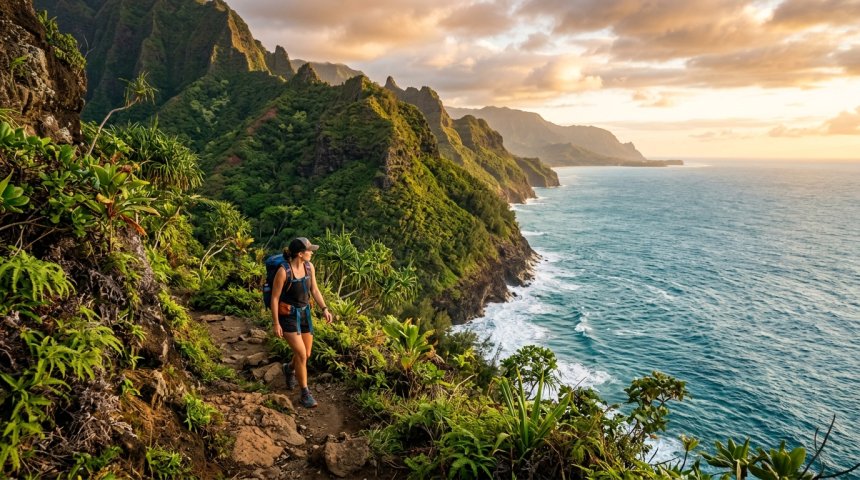
The first thing you notice when the plane banks over Lihue isn’t the ocean. It’s the green. It is a violent, aggressive, almost impossible shade of emerald that seems to swallow everything it touches. The ridges look like they were carved by giants with dull knives, plunging straight down into valleys so deep the sunlight struggles to reach the bottom. As the wheels hit the tarmac at Lihue Airport—an open-air terminal where the trade winds immediately hit your face, carrying the scent of salt, plumeria, and wet earth—you realize very quickly that you haven't just arrived at a beach resort. You have arrived at the edge of the wild.
Kauai is the oldest of the main Hawaiian islands, and it shows. While Oahu pulses with the neon heartbeat of Honolulu, and Maui caters to the luxury honeymoon crowd with its perfectly manicured resort corridors, Kauai feels like it barely tolerates human existence. They call it the "Garden Isle," which sounds like a polite marketing term for a botanical garden. It’s not. It’s a Jurassic jungle that spent millions of years perfecting the art of growing things, and humans are just temporary guests walking on its paved paths.
I remember my first drive up the Kuhio Highway toward the North Shore. I had an itinerary. I had a spreadsheet. I had reservations for a luau and a sunset catamaran cruise. By day three, the spreadsheet was abandoned in the glovebox. Kauai doesn't care about your schedule. The island operates on a rhythm dictated by the trade winds, the afternoon rain squalls, and the ancient concept of Aloha—which, contrary to mainland souvenir shirts, isn't just a greeting. It’s a philosophy of mutual respect, presence, and moving at the speed of nature. If you try to force Kauai into a fast-paced vacation, the island will humble you. Usually with a flash flood, a washed-out road, or a rooster blocking your rental car at 4:00 AM. But if you surrender to it? If you let the mud get on your boots and the rain ruin your hair? It will ruin every other vacation for the rest of your life.
This guide isn't a brochure. I’m not going to tell you to "experience the magic of paradise." I’m going to tell you which trails will destroy your calves, why you need to stop buying reef-toxic sunscreen, how to navigate the legendary traffic on the one highway that matters, and where to get a shave ice that justifies the flight across the Pacific. Let’s walk the Garden Isle.
The Geography of the Wild: Understanding the Island
To understand Kauai, you have to understand its layout, because it dictates everything about how you travel. The island is essentially a massive, eroded shield volcano (Mount Waialeale) surrounded by a thin ribbon of civilization.
Waialeale is one of the wettest spots on planet Earth, receiving upwards of 400 inches of rain a year. All that water has to go somewhere, so over millions of years, it has carved massive, fluted canyons into the volcanic rock. Because the center of the island is a jagged, impassable mountain range, there is no road that circles the entire island.
You have the East Side (the Coconut Coast), where Lihue and Kapaa are located. This is the most populated area, relatively flat, lined with coconut palms, and home to most of the grocery stores, big-box retail (like Costco), and mid-range hotels.
You have the South Shore (Poipu), which sits in the rain shadow of the central mountains. Because the clouds dump their moisture on the north and east sides, the South Shore is generally drier, sunnier, and heavily developed with luxury resorts and golf courses.
You have the West Side (Waimea and Kekaha), which is arid, dusty, and rugged. This is cowboy country, leading up to the massive Waimea Canyon.
And then you have the North Shore (Hanalei, Princeville, and Haena). This is the spiritual heart of modern Kauai. It’s lush, dramatic, artistic, and frequently soaked in rain. It is also where the paved road literally ends.
Because you cannot drive from the North Shore to the West Side, you are forced to pick a basecamp and commit to it, or spend a significant portion of your vacation driving back and forth over the central mountain passes. Choose your lodging based on the vibe you want, because crossing the island takes longer than the map suggests.
The Roosters, The Mud, and The Unwritten Rules
Before we get into the itineraries, we need to establish the ground rules of Kauai. If you ignore these, you will annoy the locals, and you might genuinely get hurt.
1. The Roosters are the True Owners: You will see them everywhere. In the parking lots of ABC Stores, wandering across four-lane highways, perched on the balconies of five-star resorts, and crowing directly outside your hotel window at 3:17 AM. Legend says they escaped during the hurricanes of the 1980s and interbred with wild jungle fowl. There are no natural predators, so they have multiplied into the tens of thousands. Do not feed them. Do not try to pet them. Do not complain about them to locals (they view them as a protected cultural nuisance). Just buy earplugs. It’s part of the tax you pay for paradise.
2. The Mud is Inevitable: Kauai is wet. Even in the "dry" season, a micro-climate rain squall can drop half an inch of water in ten minutes. If you plan on hiking—and you should—the trails will be slick, red volcanic mud. It looks like clay and acts like ice. Leave the white sneakers in the suitcase. Bring trail runners with aggressive lugs, or rent actual hiking boots in Kapaa. Embrace the mud. Washing red dirt out of your socks in the hotel sink is a core Kauai memory.
3. The Ocean is Not a Swimming Pool: The Pacific Ocean around Kauai is incredibly powerful. There are no protective coral reefs on the North Shore, meaning massive winter swells roll straight in from Alaska and smash into the beaches. People die here every year because they turned their backs on the ocean to take a selfie, or they thought they could swim past a rip current. Never turn your back on the water. If the lifeguard stand has a red flag, do not go past your knees. If there is no lifeguard, assume the ocean wants to keep you.
4. Reef Safe Sunscreen is Non-Negotiable: Hawaii banned the sale of sunscreens containing oxybenzone and octinoxate because they bleach and kill coral reefs. But don't just look for the "Reef Safe" label on mainland brands, as that term is largely unregulated. Buy mineral sunscreens (Zinc Oxide or Titanium Dioxide) locally on the island. Brands like Kokua Sun Care or Raw Love are made in Hawaii, actually protect your skin, and won't destroy the marine ecosystem you came to look at.
Getting Around: The Reality of Kauai Traffic
Rent a car. You absolutely need one. Rideshares exist but are wildly expensive and unreliable outside of Lihue. Public transit (The Bus) is meant for locals commuting to work, not for tourists trying to catch a sunset in Poipu.
But renting a car comes with a caveat: Kauai traffic is notorious. Because there is essentially only one major highway wrapping around the eastern and northern parts of the island (Kuhio Highway, Route 56), everyone funnels into the same two lanes.
From 7:00 AM to 9:00 AM, the drive from Princeville to Lihue can take over an hour due to commuters, school buses, and slow-moving agricultural trucks. From 3:30 PM to 6:00 PM, the reverse happens.
The Strategy: Wake up early. I mean it. If you want to hike the Kalalau Trail or see Waimea Canyon without sitting in a line of brake lights, leave your hotel by 6:30 AM. You’ll beat the traffic, you’ll beat the tour buses, and you’ll see the island in the soft, golden morning light before the afternoon clouds roll in. When driving, practice extreme patience. If a local is driving 35 mph in a 45 mph zone, they aren't doing it to spite you; they are driving cautiously on winding roads they’ve navigated for forty years. Just enjoy the view and wait for a safe passing zone.
The North Shore: Where the Road Ends and the Magic Begins
If Kauai has a soul, it lives on the North Shore. The drive up the Kuhio Highway from Kapaa is one of the great coastal drives in the world. The road hugs the cliffs, offering sweeping views of the Pacific, before dropping down into the valley of Hanalei.
Hanalei Town and the Bay
Hanalei is a postcard that somehow got real. A sleepy, one-road town backed by the towering, waterfall-streaked Makana Mountain (often called Bali Hai). The Hanalei Pier juts out into a massive, crescent-shaped bay framed by golden sand and swaying palms.
During the summer, the bay is a glassy, turquoise swimming hole perfect for paddleboarding and learning to surf. In the winter, it transforms into a mecca for massive, terrifying, world-class surfing.
Walk the pier at sunset. It’s a cliché for a reason. Watch the locals throw cast nets off the side, kids jumping into the water, and the sky turning shades of bruised purple and burnt orange. Afterward, grab a slice of pizza at Hanalei Gourmet Pizza Co. (eat it standing up in the parking lot) or get a massive acai bowl at Tahiti Nui Juice.
The Kalalau Trail: The Holy Grail
You cannot talk about Kauai without talking about the Kalalau Trail. It is an 11-mile, one-way trek along the legendary Na Pali Coast, ending at Kalalau Beach. It is widely considered one of the most beautiful, and most dangerous, hikes in America.
The trail clings to the side of sheer, fluted sea cliffs. You will cross narrow ridges with thousand-foot drops to the ocean on one side and vertical walls of green on the other. You will ford streams that can turn into raging torrents if it rains upstream.
The Day Hike (Hanakapiai Beach): Unless you have secured a highly coveted camping permit months in advance, you will be doing the day hike. The legal limit for day hikers is Hanakapiai Beach, which is 2 miles in (4 miles round trip). It’s steep, it’s muddy, and your legs will burn. But when you drop down into the cove of Hanakapiai, with its black sand and pounding surf, you feel like you’ve discovered a lost world. A brutal warning: Do not swim at Hanakapiai Beach. The rip currents are lethal. People drown here regularly. Take your photos, eat your sandwich, and hike back out. If you are strong, you can push another mile inland to Hanakapiai Falls (8 miles round trip total), which requires crossing the river multiple times and climbing up slippery rocks.
The Permits: The state limits access to the trailhead at Haena State Park to manage overcrowding. You need a reservation just to park your car or take the shuttle, and a separate permit to hike. Book these exactly 30 days in advance online, at 12:00 AM HST. They sell out in minutes. If you can't get one, don't despair. The shuttle bus from Hanalei is actually a great option—it drops you right at the trailhead and saves you the parking headache.
Haena State Park and Ke'e Beach
If the Kalalau Trail is too intense, or you didn't get permits, Ke'e Beach at the very end of the road is spectacular. Protected by a massive offshore reef, the water here is often calm and crystal clear, making it the best snorkeling spot on the North Shore. You can see the start of the Na Pali coast rising dramatically right from the sand. The facilities are new, the bathrooms are clean, and the views of the mountains plunging into the sea are unmatched.
The East Side (Coconut Coast): The Beating Heart
The East Side is where most people stay because it’s central. Kapaa is a long, sprawling strip of shopping plazas, food trucks, and mid-tier condos. It’s not the prettiest part of the island, but it is undeniably convenient.
The Wailua River and Fern Grotto
The Wailua River is the only navigable river in Hawaii, and taking a boat up it is a classic Kauai experience. The standard tourist move is the Fern Grotto tour—a cheesy, musical boat ride up the river to a lava rock cave covered in ferns. It’s kitschy, but the journey up the river, surrounded by towering jungle walls, is genuinely beautiful.
If you want to skip the commercial tour, rent a kayak from one of the outfitters near the river mouth. Paddling up the Wailua River under your own power is magical. You can paddle all the way to the base of Secret Falls (Ula’ula Falls). You’ll have to pull your kayak onto the mudbank and hike a short, very slippery trail through the jungle to reach the falls. It’s crowded by 10:00 AM, so get on the water by 7:30 AM to have the waterfall mostly to yourself.
The Sleeping Giant (Nounou Mountain)
For a fantastic workout with a massive payoff, hike the Nounou Mountain Trail (either the East or West trailhead). The ridge looks like a giant sleeping on his back, hence the name. The trail is a steady, lung-busting climb through a canopy of ironwood trees. When you reach the top, you get a 360-degree view of the entire East Side, the ocean, and the interior mountains. Go early, bring water, and watch your step on the descent.
Kapa’a Town and the Coastal Path
While Kapaa can feel a bit commercial, the Kapa’a Coastal Path is a gem. It’s a paved, 4-mile multi-use path that hugs the shoreline. Rent a beach cruiser bike from one of the dozens of shops in town and ride the path at sunrise. You’ll pass coconut groves, rocky tide pools, local fishermen casting lines, and eventually reach the Kealia Beach overlook, where you can often spot humpback whales in the winter or dolphins year-round.
For food in Kapaa, skip the sit-down restaurants and hit the food trucks. The Kapaa Food Court area has incredible options. Get fresh coconut water straight out of the husk, grab a plate of garlic shrimp, or find a poke bowl made with fish caught that morning.
The South Shore: Sun, Sand, and Luxury
When the North Shore is getting rained on, the South Shore is usually basking in sunshine. Poipu is the epicenter of the South Shore, a carefully planned resort community that feels distinctly different from the rustic, hippie vibe of Hanalei.
Poipu Beach Park
This is arguably the best family beach on the island. It’s actually two coves separated by a sandbar (Nukumoi Point). The eastern cove is protected and gentle, perfect for kids and beginner snorkelers. The western cove gets bigger waves for bodyboarding.
But the real draw is the wildlife. Poipu is famous for its Hawaiian Green Sea Turtles (Honu). They frequently haul themselves out of the surf to sleep on the sand. You will also likely see Hawaiian Monk Seals, one of the most endangered marine mammals on earth, resting on the beach. The Rule: Stay 10 feet away from turtles and 50 feet away from seals. If a volunteer in a bright vest is standing there with a rope, listen to them. These animals are wild, they bite, and harassing them is a federal offense.
Spouting Horn
Just down the road from Poipu Beach is Spouting Horn, a massive lava tube where the ocean forces water through a narrow opening, creating a geyser that shoots up to 50 feet in the air, accompanied by a loud, echoing moan. Ancient Hawaiians believed the sound was a giant lizard named Kaikapu crying out in pain. It’s a quick stop, highly photogenic, and surrounded by a surprisingly good craft market.
Old Koloa Town
A few miles inland from Poipu is Koloa, the birthplace of Hawaii’s sugar industry. Today, it’s a beautifully preserved historic town centered around a large banyan tree. It’s quiet, shaded, and full of excellent local shops, art galleries, and some of the best food on the island. Grab a coffee at Kauai Coffee Company’s visitor center nearby (they are the largest coffee grower in the US), or get lunch at the Poi Dog Cafe.
The West Side: Canyons, Cowboys, and Red Dirt
Drive past the airport, past the sugarcane fields, and the landscape changes drastically. The lush green gives way to arid, red dirt, scrub brush, and massive, sweeping vistas. The West Side gets far fewer tourists, which is exactly why you should go.
Waimea Canyon: The Grand Canyon of the Pacific
Mark Twain called it the Grand Canyon of the Pacific, and while it’s smaller than Arizona’s canyon, it is arguably more dramatic because of the contrast. You have this massive, mile-wide chasm of rust-red and burnt-orange volcanic rock, slashed through the middle of a tropical, emerald-green island. Waterfalls cascade down the sheer walls, and the clouds constantly roll through the gorge, revealing and hiding the cliffs in a mesmerizing dance.
Drive up Waimea Canyon Drive (Route 550). Stop at the Waimea Canyon Lookout and the Puu Hinahina Lookout. But don't just stay in the parking lot.
The Ridge Trail: If you only do one hike on the West Side, do this one. It starts near the Puu Ka Pele lookout. It’s a relatively moderate, 2-mile round-trip hike along a narrow ridgeline that offers uninterrupted, vertigo-inducing views down into the canyon on one side and out toward the coast on the other. The red dirt here stains everything permanently. Wear shoes you don't mind ruining.
Kalalau Lookout
Keep driving past the end of Waimea Canyon until the road literally stops at Kalalau Lookout (elevation 4,000 feet). On a clear day, you can look straight down the barrel of the Na Pali Coast. You can see the Kalalau Valley—the exact beach the Kalalau Trail leads to—nestled 4,000 feet below you, ringed by towering sea cliffs. It is one of the most humbling views on planet Earth. The weather up here changes by the minute; you might be in bright sunshine and suddenly be enveloped in a freezing, misty cloud.
Polihale State Park
If you want to feel like you are at the absolute edge of the world, drive out to Polihale Beach. Past the town of Waimea, the paved road turns into a rough, sandy, deeply rutted dirt track for the last few miles. You absolutely need a 4x4 or a Jeep with high clearance to get out here safely (and check your rental car agreement, as many forbid this road).
But if you make it, you are rewarded with a 15-mile stretch of empty, massive white sand beach backed by towering sand dunes and the start of the Na Pali cliffs. There are no lifeguards, no facilities, and the currents are deadly. You don't come here to swim. You come here to camp under the stars, build a bonfire (where permitted), and watch the sun set into the Pacific with zero light pollution. It is raw, desolate, and profoundly beautiful.
Eating Your Way Through the Garden Isle
Kauai’s food scene is a reflection of its history: Native Hawaiian traditions mixed with the plantation era, where Japanese, Filipino, Chinese, Portuguese, and Korean workers brought their cuisines to the sugarcane fields. The result is a food culture that is casual, deeply flavorful, and heavily reliant on what grows locally and what swims offshore.
Poke: The Real Deal
Forget the mainland versions of poke with mango, sriracha mayo, and crispy onions. In Kauai, poke is a religion. It’s cubed, raw ahi (yellowfin tuna) or tako (octopus), marinated simply in shoyu (soy sauce), sesame oil, limu (seaweed), and sweet Maui onion. Skip the grocery store counters. Go to a dedicated poke shop. Poke Akai in Kapaa or Lihue is legendary among locals. Order the shoyu ahi, get a side of hot white rice, and eat it out of the container sitting on a tailgate overlooking the ocean.
Plate Lunches and Musubi
The "Plate Lunch" is the quintessential Hawaiian meal. Two scoops of white rice, a scoop of macaroni salad (which is basically just mayonnaise and elbow pasta, and it’s amazing), and a main protein—usually Kalua pork, teriyaki chicken, or Loco Moco (a burger patty topped with a fried egg and smothered in brown gravy). For a quick breakfast, you need a Spam Musubi. It’s a block of sticky rice wrapped in nori (seaweed) with a slice of grilled, soy-glazed Spam on top. You can get them at any 7-Eleven or ABC store, but the ones from local cafes like Mark's Place in Kapaa are superior. Mark's Place is a tiny, unassuming takeout spot that serves massive, cheap, incredibly flavorful plate lunches. Expect a line out the door.
Shave Ice: The Great Debate
Shave ice (no "d" at the end, please) is not a snow cone. Snow cones are crunchy ice cubes with syrup dumped on top. Shave ice is a block of pure ice shaved so finely it feels like fresh powder snow, allowing the flavored syrups to absorb completely into the ice. The two heavyweights are on opposite sides of the island. In Hanalei, you have Wishing Well Shave Ice. They use organic, locally sourced syrups, and the vibe is pure North Shore hippie. In Hanapepe (on the West Side), you have Aunty Lilikoi’s, famous for using real fruit purees rather than artificial syrups. Order it with a scoop of vanilla ice cream or azuki beans at the bottom. When you hit the bottom of the cup, the melted syrup and ice cream create a secondary dessert.
Fine Dining and Farm-to-Table
Because Kauai is so isolated, importing food is incredibly expensive. This forced the island to embrace farm-to-table dining long before it was a mainland trend. If you want a splurge dinner, book a table at The Beach House in Poipu. It’s pricey, but eating macadamia-crusted mahi-mahi on an open-air deck directly overlooking the ocean as the sun sets is a peak Kauai experience. For something more grounded but equally brilliant, Tavola in Poipu offers incredible Italian food with a Hawaiian twist, utilizing local ingredients in ways that will blow your mind.
Where to Stay: Choosing Your Basecamp
Your experience of Kauai will be entirely dictated by where you sleep.
The Luxury Seeker (South Shore/Poipu): If you want pristine pools, spas, golf courses, and guaranteed sunshine, stay in Poipu. The Grand Hyatt Kauai and the Koa Kea Resort are the titans here. They are expensive, immaculate, and offer a very polished, resort-style vacation. You are close to the best swimming beaches, but far from the jungle hikes.
The Jungle Romantic (North Shore/Princeville & Hanalei): If you want drama, rain, waterfalls, and proximity to the Kalalau trail, stay North. Princeville is a master-planned community on a cliff overlooking Hanalei Bay. The St. Regis Princeville is the pinnacle of luxury here, but there are hundreds of VRBO condos available. Down in Hanalei, lodging is older, smaller, and more rustic. The Hanalei Colony Resort is tucked away at the end of a one-lane dirt road near Ke'e Beach—no TVs, no phones in the rooms, just pure immersion in nature.
The Budget-Conscious / Central Hub (Kapaa/Lihue): If you want to save money on lodging to spend on helicopters and luaus, stay in Kapaa. The Sheraton Kauai Coconut Beach Resort or the myriad of condo rentals along the Coconut Coast offer kitchens (saving you money on groceries) and central access. You won't have the million-dollar views of the North or South shores, but you’ll have a grocery store and a dozen food trucks within walking distance.
The Alternative: Camping Kauai is one of the few Hawaiian islands that still embraces county camping. You can get a permit from the County of Kauai for incredibly cheap (around $3 per person per night) to camp at places like Anini Beach, Haena, or Salt Pond. You will need to rent gear, and you need to be prepared for rain and roosters, but falling asleep to the sound of the Pacific crashing against the reef for the price of a coffee is unbeatable.
The Splurge: Helicopters over the Forbidden Island
I am generally opposed to tourist traps. I prefer slow travel, walking, and breathing the air. But I will tell you right now: Book the helicopter tour.
It is expensive (usually around $300-$400 per person). But Kauai has terrain that is physically inaccessible to humans. The interior valleys, the hidden waterfalls that drop thousands of feet into craters no human has ever stepped foot in, and the sheer, fluted cliffs of the Na Pali coast can only be truly comprehended from the air.
Doors-off flights are available if you want the wind in your face and unobstructed photos (though you will be strapped in securely). When the pilot banks the chopper sideways into a massive, emerald-green crater, hovering next to a waterfall that looks like a silver thread against the rock, the scale of the island will make you speechless. Book the first flight of the morning (usually around 7:00 AM) for the clearest air and the least amount of cloud cover over the mountains. Companies like Blue Hawaiian or Jack Harter are the established operators.
A Realistic 7-Day Kauai Itinerary
Assuming you are staying somewhere central or splitting your time between the North and South shores, here is how to tackle the island without burning out.
Day 1: Arrival and Decompression Land in Lihue. Pick up the rental car. Stop at Costco or Kmart in Lihue to buy water, snacks, reef-safe sunscreen, and beer/wine (liquor stores close early and are expensive). Drive to your lodging. Do not plan a massive activity. Go to the nearest beach (like Lydgate Beach Park, which has a protected rock pool), dip your toes in the water, get a poke bowl for dinner, and go to sleep early. You are on island time now.
Day 2: The North Shore Awakening Leave by 7:00 AM to beat the Kapaa traffic. Drive up to Hanalei. Get coffee and a pastry in town. Hike the first two miles of the Kalalau Trail to Hanakapiai Beach. Eat your packed lunch on the sand. Hike back out. Wash the mud off your legs at Ke'e Beach, snorkel for an hour, and watch the sunset from the Hanalei Pier. Dinner at a food truck in Hanalei.
Day 3: The River and The Ridge Head to the Wailua River early. Kayak up to Secret Falls before the tour boats arrive. Spend the late morning swimming at the base of the falls. Head back down, shower, and drive up to the Sleeping Giant (Nounou Mountain) trailhead for an afternoon ridge hike. Dinner in Kapaa at Mark's Place or a fresh seafood spot on the coastal path.
Day 4: The Grand Canyon of the Pacific Drive west early. Stop at the Kauai Coffee Company for a caffeine boost. Drive up into Waimea Canyon. Hike the Ridge Trail. Eat a picnic lunch at the Kalalau Lookout while staring down the Na Pali coast. Drive down into Waimea town for a late lunch, then head out to Polihale Beach for a remote, wild sunset (if your rental car allows the dirt road).
Day 5: The Sunny South Shore Cross over to Poipu. Spend the morning snorkeling with turtles at Poipu Beach Park. Walk over to Spouting Horn. Have a nice, sit-down lunch in Old Koloa Town. In the afternoon, do something purely indulgent: a spa treatment, lounging by a resort pool, or a catamaran snorkel cruise departing from Poipu harbor. Dinner at The Beach House for the splurge.
Day 6: The Sky and The Sea Take the early morning helicopter tour over the island. Spend the rest of the day completely unscheduled. This is the day you go back to your favorite beach, read a book under a palm tree, or try a surfing lesson in Hanalei (summer only). Get shave ice from Wishing Well or Aunty Lilikoi's.
Day 7: The Slow Goodbye Pack up. Drive the coastal path in Kapaa one last time. Return the rental car. Sit at the open-air Lihue airport, order a Mai Tai at the terminal bar, and watch the planes take off over the green mountains.
The Cultural Weight of Aloha
It is easy to treat Hawaii as a theme park. Mainland media has spent a century reducing the islands to grass skirts, mai tais, and friendly natives waiting to serve tourists. But Kauai holds onto its Native Hawaiian roots fiercely.
When you are here, you are a malihini (a guest/newcomer). The land you are hiking on, the beaches you are swimming in, and the mountains you are staring at are deeply sacred to the Kanaka Maoli (Native Hawaiians).
Take a moment to learn about the history. Learn about the illegal overthrow of the Hawaiian Kingdom in 1893. Notice the Hawaiian language (Olelo Hawaii) on the street signs and listen to it spoken by locals. When you visit a Heiau (an ancient Hawaiian temple or sacred site, which you will find scattered across the island, often looking like simple stone walls), do not climb on them. Do not move the stones. Do not take "souvenir" rocks or sand from the beaches. There is a legend about Pele’s Curse—that anyone who removes native lava rocks from Hawaii will suffer misfortune until they return them. Whether you believe in the curse or not, the principle stands: Take nothing but photos, leave nothing but footprints, and tread lightly on land that does not belong to you.
True Aloha isn't just a word; it's the sharing of breath and life force. It means approaching the island with humility, gratitude, and respect. If you do that, Kauai will welcome you in a way a resort never could.
FAQs
What is the best time of year to visit Kauai? Kauai is a year-round destination, but the weather patterns shift. April, May, September, and October are the "shoulder seasons"—the weather is generally stable, the summer crowds have left, and the winter rains haven't started. Summer (June-August) is the driest and busiest (and most expensive). Winter (November-March) brings the biggest surf to the North Shore and the highest chance of prolonged rain, but it's also when the waterfalls are roaring and the humpback whales are in the channel.
Do I really need a 4x4 / Jeep? For 90% of the island, no. A standard sedan or small SUV is perfectly fine for the paved highways. However, if you absolutely want to drive out to Polihale Beach on the West Side, or access some of the deeper, unparked trailheads in the mountains, a vehicle with high clearance is necessary. Check your rental agreement carefully; many companies explicitly void your insurance if you take their standard cars onto unpaved roads like the one to Polihale.
Is Kauai safe? Generally, yes. Violent crime against tourists is exceedingly rare. The biggest dangers on Kauai are entirely environmental: rip currents, flash floods in the canyons, falling coconuts, and slippery hiking trails. Treat the ocean and the jungle with immense respect, secure your valuables in your car (petty theft from unlocked rental cars at trailheads does happen), and you will be fine.
How expensive is Kauai? Very. Because almost everything has to be shipped or flown across the Pacific, groceries and gas are significantly more expensive than on the mainland. Dining out, especially in Poipu or Princeville, carries a premium. To save money, stay in a place with a kitchen, shop at Costco in Lihue, eat plate lunches and food trucks for lunch, and limit your fancy dinners to one or two nights.
Can you swim at all the beaches? Absolutely not. Beach safety in Kauai is highly seasonal. A beach that is a calm swimming hole in July can be a deadly, shore-breaking monster in January. Always check the daily surf report, look for warning signs, and talk to the lifeguards. If a beach is known for rip currents (like Hanakapiai or Mahaulepu), admire it from the sand.
Conclusion: The Mud Washes Off, The Feeling Stays
On my last evening in Kauai, I sat on the hood of my rental car at a roadside pullout near Kealia Beach. My legs were sore from the Kalalau trail. My favorite hiking shoes were permanently stained a rusty, volcanic red. I had a slight sunburn on my shoulders, and I was pretty sure there was still sand in my ears.
A massive rain squall had just passed over, leaving the air smelling intensely of wet ginger and ozone. Out in the channel, a pod of dolphins was breaking the surface, catching the last, bruised-purple light of the setting sun. Behind me, the roosters were starting their evening chorus, tuning up for the 3:00 AM symphony.
I looked at my phone. No signal. I didn't care.
Kauai doesn't give you a polished, frictionless vacation. It makes you work for it. It makes you wake up early to beat the traffic. It makes you sweat on the trails and forces you to surrender your itinerary to the weather. It demands that you slow down, look up, and remember how small you are compared to a mountain that has been eroding for five million years.
But when you finally stop fighting it—when you let the mud get on your boots, when you taste the salt and the lilikoi, when you let the trade winds dictate your pace—the island gives you something you can't buy at a resort. It gives you perspective.
Go to Kauai. Rent the Jeep. Hike the ridge. Eat the poke on the tailgate. And when the green mountains swallow the clouds and the ocean roars against the Na Pali cliffs, just stand there, take a deep breath, and let the Garden Isle change you.
Share
What's Your Reaction?
 Like
0
Like
0
 Dislike
0
Dislike
0
 Love
0
Love
0
 Funny
0
Funny
0
 Angry
0
Angry
0
 Sad
0
Sad
0
 Wow
0
Wow
0