
Wicofly: Complete E-Commerce Ecosystem for Online Business
Wicofly connects store owners, suppliers, partners & education in one e-commerce ecosystem — with simple $6/month pricing. The complete 2026 guide.

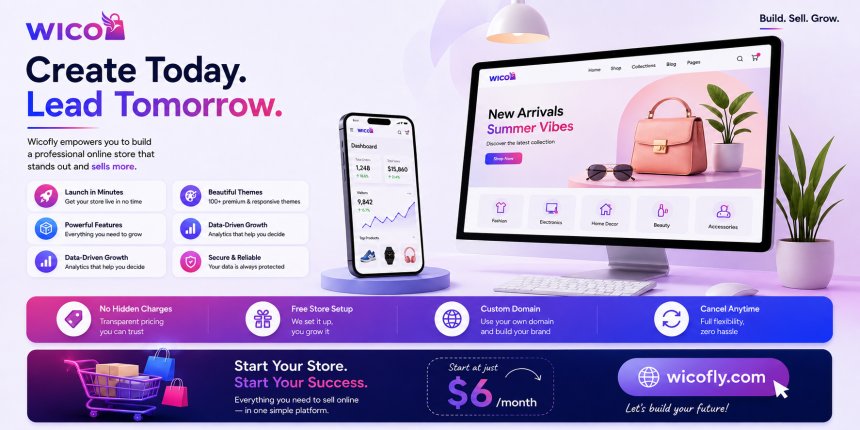
Ask anyone who launched an online store the hard way, and they'll tell you the same story: the business was the easy part. The website was the hard part. Before a single product sold, there was hosting to configure, a theme to wrestle with, plugins to update, payments to connect, and a hundred small technical decisions that had nothing to do with customers and everything to do with exhaustion. For people who already speak fluent technology, that maze is manageable. For everyone else, it's the reason the store never launches.
Wicofly was designed around a simple refusal: an entrepreneur should not have to become a developer before becoming a business owner. But the bigger idea behind the platform goes further than "easier website." Wicofly is built as an ecosystem — a connected environment where store owners, customers, suppliers, vendors, and partners each play a role, and where someone with an idea can travel the whole road from creating a store to running a growing online business.
This guide is the full picture: what Wicofly is, who it serves, how the ecosystem works, how stores get built and customized, how suppliers and partners plug in, how the pricing really compares, and where the whole thing is headed. Let's walk the entire map.
The Old Way Is Why Most People Never Start
Starting an online business used to demand a strange bundle of unrelated skills at once: web development, design, hosting, payment setup, product management, order handling, and marketing — all before the first sale. The cruel part is that most of those skills teach you nothing about business. They teach you about software.
A person with a product idea should be spending their energy on questions like What should I sell? Who is my customer? How do I price it? How do I grow? Instead, the traditional stack forces them to spend weeks on How do I even build a website? Wicofly's founding philosophy is that this trade is unnecessary. Business is complex — nobody should pretend otherwise — but the technical infrastructure of business doesn't have to be. The platform's job is to absorb that complexity so the merchant's attention goes where the money is: products, customers, and growth.
What Wicofly Actually Is (and What It Isn't)
At the most basic level, an e-commerce platform provides the infrastructure to sell online. But modern merchants need far more than a product page: a professional storefront, product and inventory management, categories, imagery, pricing, order and customer management, themes, customization, marketing room to breathe, reliability, scalability, and support. Wicofly gathers these into one ecosystem instead of making the merchant assemble them from disconnected services.
And here's the distinction that matters most: Wicofly is not just a website builder. A website builder creates pages. An e-commerce platform creates a business environment. When a customer visits a store, they see the front — homepage, hero, product grids, categories, cart, checkout, footer. But behind that glass, the merchant needs an entirely different world: products, orders, customers, settings, themes, inventory, content, and configuration. Wicofly is designed around both sides — the customer-facing storefront and the business-facing dashboard — rather than treating the pretty front as the whole product.
The Ecosystem: Five Participants, One Engine
The best way to understand Wicofly is as a connected economy of participants:
Customers, who discover stores and buy products. Store owners (vendors), who create and operate storefronts. Suppliers, who provide products merchants can sell. Partners, who contribute growth, distribution, services, professional store management, and referrals. And the Wicofly platform, the technology layer that connects them all.
The power isn't in any single participant; it's in the relationships. As more merchants join, the ecosystem becomes more valuable. As more suppliers join, merchants access more products. As more customers participate, merchants get more opportunities. As more partners contribute — whether by referring new merchants, managing stores professionally, or providing services — the whole system gains capabilities no single company could build alone. That's a network effect, and it's the difference between a tool and an economy.
Who Is Wicofly For?
Beginners are the heart of the design — people with a product idea and zero technical background, who know what they want to sell but not how a store gets built. A simplified platform removes that first wall. Existing store owners benefit too, centralizing operations so they can focus on running the business rather than maintaining its plumbing. Dropshippers get a coordinated home for the customer → store owner → supplier chain that their model depends on. And product-based brands get something social media can't give them: a dedicated digital home with their own identity, customer relationships, and presentation — instead of renting attention from a marketplace or a messaging app.
Professional store managers also find a home here — partners who offer their expertise to vendors who want someone else to handle the day-to-day operations of their store.
The Merchant Journey, Step by Step
The complete journey has a clean shape: Platform discovery, Store creation, Product setup, Customization, Launch, Marketing, Orders, and Growth.
For the store owner specifically, the working loop is simple: create an account, create a store, customize it, add products, configure the business, launch, market, receive orders, fulfill, grow. The point is that the merchant never has to think of the store as a pile of unrelated technologies — the platform is the operational foundation, and every stage has support attached to it, from partners who refer and manage to suppliers who stock the catalog.
Themes, Customization, and the Live Preview Magic
A major part of the store-building experience is the theme system. A theme determines how the store looks and how information presents itself — hero sections, navigation, product grids, categories, promotional blocks, detail layouts, calls to action, footers. The objective is a professional starting point, not a blank canvas that demands a designer. Theme concepts like Fly Default and Fly Shoes represent different visual directions and store use cases: pick the foundation that fits, then make it yours.
And making it yours is the part Wicofly refuses to make painful. A store owner should be able to change colors, typography, images, logos, sections, product presentation, navigation, buttons, and layout without calling a developer — because customization is control, and control is what separates "a page" from "my brand." The workflow that makes it intuitive is live preview: edit → preview → adjust → save → publish. Instead of changing a setting and guessing, the merchant sees the result visually, in real time. For beginners especially, that visual feedback closes the gap between technical configuration and creative decision-making.
Two more storefront truths round this out. Branding — logo, colors, imagery, voice, layout — is the difference between having an online page and having an online brand. And mobile commerce is not a luxury: modern customers browse, compare, and buy on phones, so responsive grids, touch-friendly navigation, readable type, and a smooth mobile checkout are fundamental requirements, not nice-to-haves.
The Dashboard: Where Browsing Becomes Business
The storefront is what customers see; the dashboard is what the merchant operates. A well-structured dashboard organizes the work into logical areas — store overview, products, orders, customers, themes, settings, analytics — and its purpose isn't merely to display information. It's to help the merchant make decisions.
Product management is the foundation: names, descriptions, images, prices, categories, availability, variations. A store with ten products can survive without organization; a store with hundreds cannot, which is why categories — Men's, Women's, Shoes, Accessories, New Arrivals, Sale — are both navigation and customer experience.
Then orders, where browsing becomes business. An order is an actual commercial transaction, and the merchant needs clean visibility into its information, customer, items, quantities, pricing, status, fulfillment, and delivery — a workflow that moves systematically from sale to fulfillment. And customers, where the mindset shift matters most: a business shouldn't think only in transactions, because a customer can buy many times. Customer information powers repeat purchases, support, marketing, and retention. The goal is to move from "I received an order" to "I am building a customer base."
Suppliers and Vendors: The Sourcing Layer
Suppliers are especially important in an ecosystem that supports dropshipping and supplier-driven selling. Imagine a supplier with a hundred products across categories, each with pricing, inventory, images, and descriptions. Instead of every merchant manufacturing independently, merchants work with the supplier to source — Supplier → Merchant → Customer — and each party specializes: the merchant handles presentation, marketing, acquisition, and sales; the supplier handles availability, sourcing, inventory, and fulfillment where applicable.
A scalable supplier ecosystem needs structured onboarding: registration with business information, verification per platform policy, a supplier profile, a product catalog, pricing structures, maintained availability, fulfillment details, and finally merchant access for approved products. That structure turns a handshake into a system.
Vendors are related but distinct: where a supplier primarily provides products, a vendor can represent a seller operating within the marketplace environment. Together they enable multi-party commerce — not one platform → one store → one source, but platform → many merchants → many suppliers and vendors → many customers. That structure is what makes the whole thing scalable.
And responsibilities stay clear: suppliers own availability, quality, accurate information, and inventory updates; merchants own marketing, store management, customer communication, pricing, and experience; the platform owns infrastructure, accounts, functionality, documentation, and ecosystem management. Clearly drawn lines prevent most ecosystem arguments before they start.
The Dropshipping Workflow, Without the Fairy Tales
Dropshipping is often sold as easy money. The reality is more honest: it still requires product research, supplier selection, pricing, marketing, acquisition, service, order management, and brand building. What Wicofly provides is the infrastructure layer — it doesn't replace entrepreneurship, it supports it.
The simplified supplier-based flow runs: the merchant discovers a supplier, selects products, adds them to the store catalog, and promotes them; a customer orders; the merchant processes the order; the supplier fulfills where the model requires; the customer receives the product; and the merchant owns communication and support throughout. Technology, merchant, supplier, and customer — connected in one chain.
Partners: The Growth, Service, and Professional Management Layer
Partners are where Wicofly gets genuinely interesting — and where the ecosystem becomes something no standalone store builder can offer. Partners don't just refer; they work in the ecosystem in multiple ways:
Partners as Professional Store Managers
Here's the scenario: a vendor creates a store but doesn't have the time, expertise, or desire to manage it day-to-day. They want someone professional to handle product uploads, marketing, order processing, customer service, and growth — without hiring a full-time employee.
That's where partners come in. A partner can create a gig — a service listing that says "I will manage your Wicofly store professionally, handling products, marketing, and operations." Vendors browse available gigs, find a partner whose expertise matches their needs, and hire them as a professional store manager. The partner gets access to the vendor's store dashboard, the vendor gets their business run by someone who knows what they're doing, and both benefit from the vendor's growth.
This turns Wicofly into something like a marketplace for e-commerce talent: vendors who want hands-off operations can find partners who want hands-on work, and the platform facilitates the connection.
Partners as Referrers with Recurring Commissions
Partners also earn through referrals — but not the usual one-time bounty that disappears after the first payment. Here's how it works:
When a partner refers someone who joins Wicofly and buys a plan, the partner earns a percentage of that first purchase. That's the immediate reward.
If admin approval is granted, the partner can also earn a recurring commission — a percentage of every monthly subscription the referred vendor pays, for as long as that vendor stays active. So if you refer ten stores and they each pay $6/month, you earn a slice of that $60/month indefinitely.
This creates alignment: partners are incentivized to refer quality merchants who will stay and grow, not just sign up and churn. It also means a partner who builds a referral portfolio over time can earn passive income — the kind of recurring revenue that turns a side hustle into a business.
Partners as Service Providers
Beyond store management and referrals, partners can offer other services: marketing campaigns, product photography, content creation, ad management, logistics coordination, or any other expertise a merchant might need. The platform becomes a place where vendors find not just tools, but people who help them succeed.
If that sounds like your organization, the Wicofly partner portal is where those conversations begin — because partnerships are how a platform expands beyond what one team can build internally.
The $6/Month Question: Simple, Predictable Pricing
Choosing a platform isn't only about features. For a new entrepreneur, pricing can be the deciding factor — and the real question isn't the signup price, it's: what will I actually pay after the introductory period ends?
With Wicofly, you can start your online store from just $6 per month — and the important part is that the price is designed to remain $6 per month, rather than being a teaser that jumps substantially after a few months. Predictable pricing makes planning possible: you know your technology cost, so your budget goes to the things that actually grow a business — sourcing, advertising, branding, content, acquisition, operations.
Compare that with the introductory model common elsewhere. Shopify, for example, has run promotions where a new merchant pays around $3/month for the first three months, after which the regular plan price applies — often around $25/month depending on plan and region. The intro is cheap; the renewal is the real cost.
|
Platform
|
Introductory Price
|
Regular Price
|
|---|---|---|
|
Shopify
|
~$3/mo (first 3 months)*
|
~$25/mo*
|
|
Wicofly
|
$6/mo
|
$6/mo
|
*Pricing and promotions vary by region, plan, billing cycle, and time — always check official pricing before subscribing.
Why does predictability matter so much? Because a beginner's budget is already stretched across products, packaging, ads, domain, content, photography, and delivery. A platform bill that quietly quadruples adds pressure at exactly the wrong moment. Instead of thinking "it's cheap now, but what will it cost later?", the merchant plans around "my store starts at $6 a month, and stays there." Lower platform cost means more room for the loop that actually matters: marketing → traffic → customers → orders → growth. That's Wicofly's pricing philosophy in one line: simple, transparent, predictable.
Wicofly vs Shopify vs WordPress/WooCommerce: An Honest Read
Shopify is one of the most mature e-commerce platforms on earth — deep ecosystem, vast apps, serious merchant infrastructure. But a powerful platform isn't automatically the right learning path for every beginner: subscription considerations, terminology, app-ecosystem decisions, configuration, and payment setup create a real curve. WordPress with WooCommerce is the flexibility champion — and flexibility introduces its own tax: hosting, plugins, updates, security, performance, compatibility, maintenance. For technical users, that trade is worth it. For beginners, the moving parts become friction.
The better comparison question isn't "which platform has more features?" It's "which platform helps this particular entrepreneur start and operate more effectively?" Wicofly's position is simplicity and accessibility — a focused commerce experience where the merchant spends time building the business, not assembling the technology. Imagine two entrepreneurs: one spends weeks learning hosting and plugins; the other spends those weeks learning products, customers, advertising, and service. The second one is investing in the actual business. That's the entire argument for simplicity.
Trust, Governance, and Keeping the Ecosystem Healthy
An ecosystem lives or dies on trust. Customers must trust the store, the product, the payment, and the delivery. Merchants must trust the platform, suppliers, and partners. Suppliers must trust merchants and platform processes. So long-term success depends not only on software but on ecosystem trust — which is why governance matters: account policies, product policies, supplier requirements, merchant responsibilities, customer protection, content standards, fraud prevention, and dispute handling. Good rules protect everyone participating.
Documentation, Community, and Never Being Alone
A platform becomes dramatically easier to use when the answers are waiting. Clear documentation — How do I create my store? Add a product? Customize a theme? Manage orders? How does supplier integration work? — reduces dependency on direct support and gives users the confidence to explore independently. That's the role of the Wicofly Help Center: the quiet teacher that's open at 2 a.m.
And because documentation can't answer everything, community carries the rest: peer learning, announcements, events, support, and success stories. A new entrepreneur always has questions only another entrepreneur can answer — which products should I test? how should I advertise? how do I evaluate a supplier? The goal is simple: nobody builds their business alone.
Design, Consistency, and Scalability
A platform can function and still feel outdated — and modern merchants notice. Clean interfaces, professional dashboards, responsive layouts, attractive themes, smooth interactions: a premium UI increases confidence, because if the platform looks professional, users believe the infrastructure behind it is professional too. And the design system shouldn't stop at the storefront; the same principles should run through the dashboard, theme editor, admin panel, documentation, and account pages. Consistency creates familiarity — once a user understands one part, they understand the next.
Scalability is the other quiet requirement. A merchant may start with five products and reach five hundred; a platform may start with ten merchants and reach ten thousand. Architecture, dashboards, data, supplier relationships, themes, support, and administration all have to grow without breaking — so scalability isn't a technical concern, it's a business requirement.
The Business Model: Growing When Merchants Grow
Depending on its final commercial structure, Wicofly can earn through store subscriptions, premium plans, transaction fees, premium themes, additional services, supplier-related services, partner programs, marketplace commissions, and value-added features. The guiding principle is alignment: a platform should grow when its merchants grow.
That changes what success means. A merchant who creates a store and never receives an order is a weak outcome, no matter how many stores were "created." A merchant who launches, acquires customers, fulfills orders, and grows is a strong outcome. So the metrics that matter are active merchants, store activity, orders, customer growth, retention, and repeat usage. Merchant success is platform success.
The Complete Commerce Flow in One Breath
The whole ecosystem compresses into one journey: Store creation (the entrepreneur signs up and builds) → Customization (theme chosen and branded) → Product sourcing (directly or through suppliers/vendors) → Product setup → Launch → Marketing → Customer (browses and buys) → Order (merchant manages it) → Fulfillment (supplier or merchant workflow) → Delivery → Retention (a relationship forms) → Growth (catalog, marketing, and operations expand).
If the vendor wants professional help, they can hire a partner as a store manager. If a partner referred them, that partner earns from their success. Suppliers stock the catalog. The platform connects it all.
From Store to Brand: The Long-Term Vision
The ultimate objective isn't temporary stores; it's brands. A store is a technical asset; a brand is a business identity. A merchant who begins with five products may end with a recognizable logo, a defined audience, repeat customers, a social presence, campaigns, and loyalty. Wicofly is the digital foundation where that journey starts.
And the long-term vision fits in four words: Build → Sell → Serve → Grow. The platform supports building and operating. Suppliers support sourcing. Partners support expansion, management, and referrals. Customers create demand. The platform connects all of it. For entrepreneurs in emerging e-commerce markets especially, that connection reduces the distance between "I have an idea" and "I have a functioning online store" — making the platform not just software, but an entry point into digital entrepreneurship.
Conclusion: The Distance Between an Idea and a Business
A standalone store builder helps someone create a website. An ecosystem helps someone build a business — and that distinction is the whole story. Wicofly connects merchants with technology, themes, suppliers, vendors, partners, community, and support, which means its value extends beyond software: it becomes infrastructure for entrepreneurship.
The most important idea isn't that Wicofly lets someone create a store. It's that Wicofly provides a path from creating a store to operating a real business — whether the vendor does it themselves, hires a partner to manage it professionally, or benefits from a partner's referral. The ecosystem makes all three paths possible, and the platform makes all three paths simple.
The future of e-commerce won't be defined only by how many features a platform has, but by how effectively it helps people use them to create real businesses — and by how well it rewards the partners who help those businesses succeed.
Ready to see it yourself? Start at wicofly.com, create your account at accounts.wicofly.com, learn the ropes at help.wicofly.com, explore partnership opportunities at partner.wicofly.com, and meet the people behind the platform at team.wicofly.com. The distance between an entrepreneur, an idea, and a functioning online business just got a lot shorter.
FAQs
What exactly is Wicofly? An e-commerce ecosystem that connects store building, product and order management, themes, suppliers, vendors, and partners in one environment — so someone with an idea can go from creating a store to running a growing business without assembling disconnected tools.
How much does it cost to start? You can start a Wicofly store from just $6 per month, and the proposition is that the price stays predictable rather than jumping after an introductory period. Always confirm current pricing on the official site before subscribing.
Do I need technical or coding skills? No. The platform is designed so merchants focus on products, customers, and marketing while the technical infrastructure is handled. Themes, customization with live preview, and the help center are built for non-developers.
How is it different from Shopify or WooCommerce? Shopify offers maturity and depth; WooCommerce offers flexibility — both with real learning curves and, in Shopify's case, introductory pricing that rises later. Wicofly positions itself around simplicity, accessibility, ecosystem support, and predictable pricing, especially for first-time entrepreneurs.
Can I dropship with Wicofly? Yes — the ecosystem supports supplier-driven models with structured supplier onboarding and a clear merchant–supplier workflow. But remember: the platform provides infrastructure, not entrepreneurship. Product research, marketing, and service still belong to you.
What if I want someone else to manage my store? You can hire a partner as a professional store manager. Partners create gigs offering their services, you browse and hire, and they get access to manage your store while you focus on other things.
How do partners earn money? Through multiple channels: referrals (earning a percentage when someone they refer buys a plan, plus potentially recurring monthly commissions if approved), professional store management (getting hired by vendors via gigs), and other services they offer.
Where do I get help if I'm stuck? The Help Center covers store creation, products, themes, orders, and supplier integration, and the community adds peer learning and support — so you're never building alone.
Quick Links
- Main platform: https://wicofly.com/
- Create your account / start a store: https://accounts.wicofly.com/
- Help Center & documentation: https://help.wicofly.com/
- Partner program: https://partner.wicofly.com/
- Team portal: https://team.wicofly.com/
Share
What's Your Reaction?
 Like
0
Like
0
 Dislike
0
Dislike
0
 Love
0
Love
0
 Funny
0
Funny
0
 Angry
0
Angry
0
 Sad
0
Sad
0
 Wow
0
Wow
0