
Why AI Color Is Wrong: 5 Essential Fixes
Discover why AI color matching looks wrong and how to fix it with expert color management pipelines. Read our ultimate guide now!

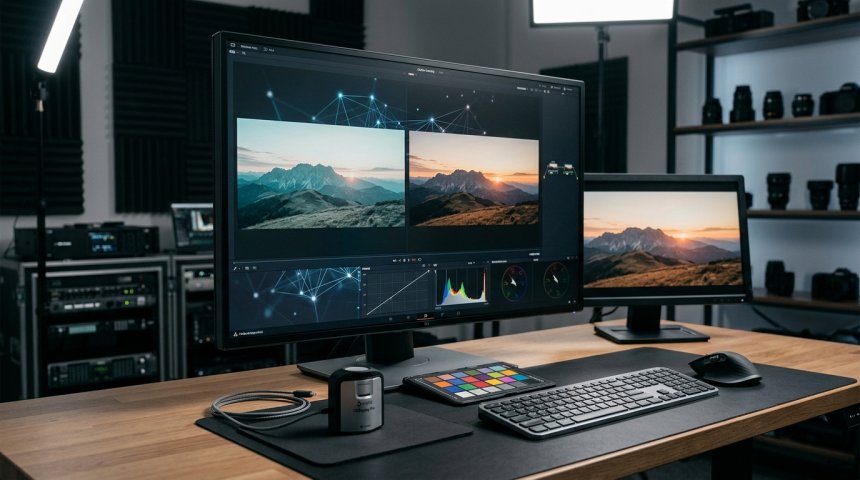
Quick Answer: Why AI Color Matching Looks Wrong, and How to Fix It?
It depends. AI color matching often looks wrong because machine learning models process numbers rather than physical light, frequently failing to account for device profiles, illumination changes, and gamut boundaries. You can fix these issues by implementing proper color-management pipelines, converting device-dependent inputs through standardized spaces, and applying ICC profiles. Alternatively, ignoring color workflows entirely leads to unpredictable color shifts across different screens and printers. Before acting, check your source profiles, display calibration targets, working color spaces, viewing conditions, and printer gamut constraints.
Digital imagery relies on a balance of physics, physiology, and software engineering. When automated tools or machine learning models attempt to match or correct colors, the results frequently clash with human expectations. A shade that appears saturated on a high-end monitor may look dull when printed or distorted by an unmanaged algorithm. Understanding why these discrepancies occur requires looking closely at how light, capture devices, and display systems interact.
Color is fundamentally light-dependent. As outlined by the International Color Consortium, the light reaching the human eye depends on both an object's reflectance properties and the spectral power distribution of the illuminant color.org. Changing the light source can easily break an apparent color match, a phenomenon known as metamerism. When automated tools analyze pixel values without accounting for lighting conditions, they treat numbers as absolute truths rather than context-dependent measurements.
Cameras do not directly record human color perception. Instead, a digital camera captures light through red, green, and blue color filter arrays. According to technical guidance from the ICC, camera RGB values must be profiled and converted to a device-independent color space; otherwise, automated systems may learn camera, lens, or lighting artifacts as if they were intrinsic properties of the scene color.org. Without proper profiling, an algorithm bases its adjustments on flawed foundational data.
Another major failure mode stems from gamut limits. Displays, scanners, and printers each operate within distinct color gamuts, meaning they can only reproduce a specific subset of the visible spectrum. When an image contains colors that exceed the target device's capability, those out-of-gamut colors must be compressed or remapped, which alters saturation, hue, or lightness color.org. Automated color tools often execute these transformations aggressively, producing harsh posterization or unnatural shifts.
The Physics of Color and Machine Perceptions
Human vision is a biological process influenced by surrounding context, adaptation, and individual observer differences. Digital systems, by contrast, rely on quantized numerical grids. When an algorithm evaluates an image, it interprets pixels as coordinate values within a specific mathematical framework. If that framework lacks calibration, the numbers lose their connection to physical reality.
Observer variation plays a remarkably large role in how color is judged. Spiky display spectra can produce different color matches for different viewers, even when measuring instruments report identical values color.org. An automated routine trained on a generalized dataset cannot account for individual perceptual variations or the specific viewing environment of the end user. Room lighting, windows, time of day, and mobile-use conditions constantly alter both the physical image and its perceived appearance color.org.
Also, AI outputs can be numerically plausible yet perceptually wrong. Exact color reproduction is not always physically possible when source and destination gamuts differ widely. Color-management systems aim for a visually pleasing approximation, but unconstrained algorithms often prioritize mathematical loss reduction over perceptual harmony. This mismatch explains why automated color grading often introduces unnatural skin tones or strange color casts.
Device-to-device consistency requires structured intervention. ICC profiles serve as the practical bridge between disparate hardware encodings and standardized color spaces color.org. By connecting device profiles into a managed chain, software can convert pixel values accurately from a capture device to a working space and finally to a proofing display or printer.
Common Pitfalls in Automated Color Pipelines
Many modern workflows incorporate automated enhancements without verifying the underlying color pipeline. When an application processes an image without checking embedded profiles, it assumes sRGB or an arbitrary working space. If the source file was captured in a wider gamut space like Adobe RGB or Display P3, the unmanaged conversion compresses or clips tonal ranges incorrectly.
Another frequent error involves ignoring display calibration. Displays drift over time as backlights age and hardware components wear down. If a monitor is not regularly calibrated and profiled, designers make corrective adjustments based on an inaccurate preview color.org. An automated tool trained on such distorted feedback loops will compound the error rather than correct it.
Software implementation details also matter. Using an embedded profile and color-managed software is necessary for maintaining integrity across different applications color.org. Operating systems handle color management differently; web browsers, image viewers, and editing suites often apply contrasting conversion rules unless explicitly forced to honor embedded ICC data.
Choosing the right working space is equally critical. ICC guidelines recommend selecting a working space close to the display's native capabilities color.org. While sRGB remains suitable for many standard web workflows, wider spaces preserve more chromatic data when the entire production pipeline supports them. For a deeper look into foundational color standards, review the ICC Getting Started Guide.
Advanced Techniques for Achieving Color Accuracy
Achieving predictable color fidelity requires moving beyond automated guesses and implementing strict calibration standards. The foundation of any reliable workflow is hardware calibration for every monitor involved in creation, review, and approval. Calibration sets the target white point, luminance, and gamma response, while profiling communicates how that display reproduces color so other devices can adapt accordingly color.org.
When evaluating differences between two color states, practitioners often rely on calculated distance metrics within uniform color spaces. However, a numerical color difference does not act as an absolute guarantee of visual correctness files.cie.co.at. Color difference formulas quantify distance under defined conditions, but they cannot fully model every complex appearance phenomenon or human psychological response.
Advanced workflows sometimes incorporate spectral data to resolve difficult matches. The iccMAX specification was designed to support needs beyond traditional version 4 ICC profiles, accommodating spectral measurements, custom illuminants, and alternative observers color.org. By utilizing spectral information, systems can simulate how materials react under changing light sources, overcoming the limitations of standard RGB or CMYK triples.
To explore how these specifications govern digital imaging, consult the ICC Specification Documentation. Ensuring that every step of a project utilizes valid profiles and color-aware software prevents the unpleasant surprises that typically plague unmanaged digital workflows.
Practical Steps to Correct Color Shifts
Fixing broken color matches in digital projects involves a systematic audit of hardware, software settings, and file metadata. The following actionable steps help eliminate erratic color behavior.
First, verify that your operating system and editing applications are fully color-managed. Ensure that software respects embedded ICC profiles rather than stripping them out or blindly assigning default color spaces.
Second, calibrate your hardware displays regularly using a spectrophotometer or colorimeter. Set target luminance levels appropriate for your working environment, typically between 80 and 120 candelas per square meter for print proofing, or slightly higher for bright web design environments.
Third, audit your input devices. If you use cameras or scanners, create or apply custom camera profiles rather than relying on generic manufacturer defaults color.org. This ensures that captured data maps correctly into a standard working space.
Fourth, manage your output transformations carefully. When preparing files for print or web publication, preview them using soft-proofing profiles that simulate the target medium's exact gamut limitations and paper white point.
Finally, document your color pipeline. Establish clear guidelines for team members regarding working spaces, export settings, and monitor calibration schedules to maintain consistency across different workstations.
Why Do Images Look Different on Mobile Devices Versus Desktop Monitors?
Mobile devices and desktop screens use varying display technologies, native color gamuts, and automatic brightness adjustments that alter visual perception. Many mobile screens operate in wide color gamuts and boost saturation to make images appear striking under direct sunlight. When an image created on an unmanaged desktop monitor is viewed on a mobile phone, the operating system may stretch the color space incorrectly, causing oversaturation or crushed shadows. Proper display profiling and viewing environment controls help mitigate these discrepancies.
Can Artificial Intelligence Ever Replace Manual Color Grading?
Artificial intelligence excels at rapid pattern recognition and bulk adjustments, but it lacks subjective creative intent and precise physical context. While AI can automate repetitive tasks like balancing exposure or neutralizing dominant color casts, it often struggles with artistic nuance, brand identity guidelines, and subtle skin tone grading. Human oversight remains necessary to guide automated tools, verify profile integrity, and ensure the final output aligns with the creator's vision.
How Do ICC Profiles Prevent Color Distortion?
ICC profiles act as translation dictionaries between device-dependent color values and device-independent reference spaces. A scanner profile describes how a specific device captures light, while a monitor profile describes how light is emitted. When an image moves between devices, the color management module uses these profiles to calculate the necessary numerical conversions, ensuring that a specific red or blue retains its intended appearance regardless of the hardware rendering it.
What Causes Banding and Posterization During Automated Processing?
Banding and posterization occur when color values are compressed into a smaller gamut or quantized across a limited bit depth. If an automated algorithm stretches tonal gradients or remaps out-of-gamut colors too aggressively, adjacent pixels can jump by noticeable numerical steps instead of blending smoothly. Working in 16-bit per channel modes and utilizing proper perceptual rendering intents helps preserve smooth tonal transitions during heavy edits.
Why Does Printed Output Rarely Match Screen Output Exactly?
Screens emit light directly using additive RGB mixing, whereas printers reflect ambient light using subtractive CMYK inks or specialized pigment sets. Because the physical gamut of reflective inks is smaller than the luminous gamut of modern displays, many bright screen colors simply cannot be printed. Soft-proofing allows designers to visualize these limitations before printing, ensuring that colors are compressed gracefully rather than clipping harshly at the edges of the ink gamut.
How Often Should Monitors Be Recalibrated for Accurate Work?
Displays should generally be recalibrated every two to four weeks in professional environments, or monthly for general creative work. Backlights degrade over time, and environmental factors like temperature fluctuations alter panel performance. Regular calibration ensures that the display's response curve remains aligned with your working space targets, preventing gradual drift from introducing errors into your color choices.
The Future of Color Management in an AI-Driven World
As machine learning models become integrated into creative software suites, the intersection of automated intelligence and traditional color science changes rapidly. Developers are beginning to realize that feeding raw, unmanaged pixel data into deep neural networks leads to unpredictable outcomes. To build color-matching tools, the next generation of software must bridge the gap between abstract mathematical loss functions and established colorimetric standards.
Future systems are likely to incorporate device characterization data directly into their training pipelines. Instead of treating an image as a generic matrix of numbers, modern architectures can ingest embedded ICC profiles alongside pixel arrays, allowing the algorithm to understand the exact physical constraints of the capture device. By respecting device-independent reference spaces from the moment an image is imported, AI tools can make intelligent adjustments that honor the true physics of light rather than chasing superficial pixel statistics.
Also, the adoption of advanced specification frameworks opens new paths for accurate reproduction. While traditional version 4 ICC profiles have served the industry well, the ongoing evolution of iccMAX Specification Documentation points toward a flexible future. Because iccMAX supports spectral data, custom illuminants, and alternative observers, future AI color models could theoretically reason about material properties and lighting interactions at a spectral level. This capability would allow an automated grading tool to predict how a product's color will shift when moving from fluorescent office lighting to natural sunlight, solving problems of metamerism that stump current algorithms.
Yet, technology alone cannot replace the critical eye of a trained colorist. Automated tools remain useful assistants for handling repetitive baseline adjustments, freeing human creators to focus on narrative mood, emotional resonance, and brand consistency. Maintaining a skepticism toward unverified AI outputs, enforcing strict hardware calibration routines, and ensuring that every file carries a valid profile remain the best defenses against color distortion. By combining the speed of machine learning with the rigor of disciplined color management, creators achieve predictable visual results across every screen and medium.
Understanding Metamerism and AI Color Matching Failures
Metamerism is one of the most stubborn challenges in both traditional color reproduction and modern artificial intelligence workflows. Two color samples may appear identical under one light source—such as standard office fluorescent lighting—yet look completely different when moved under natural daylight or incandescent bulbs. This phenomenon occurs because the spectral power distribution of the illumination interacts with the spectral reflectance curves of the objects, producing matching tristimulus values for a specific human observer under a specific light, but diverging elsewhere.
Standard machine learning models trained on millions of digital images rarely account for metamerism because they treat images as flat matrices of device-dependent RGB triplets. Without physical metadata, spectral information, or scene illuminant data, an AI color-matching algorithm has no way of knowing whether a particular shade of blue was captured under warm tungsten light or cool shadow. When the algorithm attempts to harmonize or match colors between two distinct scenes, it matches the numerical values displayed on screen rather than the actual physical properties of the subjects.
This oversight leads to failures when color-grading products, fashion items, or fine art reproductions. If an AI tool aligns the RGB values of a fabric sample photographed under mixed lighting, the resulting output may look plausible on a calibrated desktop monitor, but will clash violently in reality when viewed in a showroom or outdoors. Resolving these discrepancies requires incorporating advanced metadata and moving toward spectral color descriptions. To learn more about how frameworks handle these complex lighting variations, review the ICC Getting Started Guide.
The Mathematical Disconnect Between Loss Functions and Human Perception
At the core of automated color intelligence lies a fundamental mismatch: deep neural networks compute mathematical loss functions, whereas human beings perceive color through biological and psychological mechanisms. During training, an AI model is typically rewarded for minimizing pixel-level error metrics, such as Mean Squared Error or cross-entropy loss across color channels.
While minimizing numerical distance is efficient for computer vision tasks like object detection or segmentation, it is notoriously ill-suited for aesthetic color grading. A mathematically minimal adjustment in RGB space can cross a perceptual boundary, turning a warm, inviting skin tone into an anemic or sickly gray. Conversely, a substantial numerical shift may be required to maintain perceptual consistency when moving an image across devices with different native gamuts.
To bridge this gap, developers must integrate perceptually uniform color spaces—such as CIELAB or CIECAM02—directly into model architectures, rather than forcing neural networks to operate strictly in uncalibrated RGB domains. Also, because numerical color difference formulas do not capture every nuance of human visual adaptation, human-in-the-loop validation remains indispensable. For a deeper examination of how color differences are evaluated across various conditions, consult the findings in the CIE Open Access Papers.
Building a Standardized, Color-Managed AI Workflow
Integrating AI-driven enhancements into a professional production pipeline without sacrificing color integrity demands strict operational discipline. Creators cannot rely on default software settings or assume that modern applications will automatically handle conversions correctly. A disciplined workflow begins with establishing a controlled environment where every hardware component is actively managed.
- Enforce Profile Preservation: Ensure that all import and export presets across your editing suite explicitly embed ICC profiles. Never strip metadata or allow software to silently assign generic sRGB profiles to wide-gamut captures.
- Standardize Viewing Conditions: Control ambient light in your studio. Eliminate stray reflections, use neutral gray walls, and calibrate your monitors regularly to maintain a stable reference point.
- Audit Automated Tools: When testing new AI color-matching plugins or automated grading features, always evaluate the output using soft-proofing profiles tailored to your final delivery medium, whether that is web sRGB, Display P3, or commercial print CMYK.
By treating artificial intelligence as a high-speed assistant rather than an autonomous decision-maker, creators gain efficiency while maintaining absolute control over visual storytelling, brand accuracy, and emotional resonance.
Troubleshooting Common AI Color Shifts in Multi-Device Pipelines
When deploying artificial intelligence across multi-device production pipelines, color shifts often manifest unpredictably. A batch of product photographs processed by an automated grading script might look saturated and balanced on a developer's local workstation, only to appear washed out, overly saturated, or shifted toward an unwanted hue when accessed by marketing teams on mobile hardware or reviewed by clients via web browsers. These discrepancies usually stem from unmanaged handoffs where the AI model operates on raw pixel data without acknowledging the underlying device profiles.
To systematically troubleshoot and eliminate these color anomalies, technical directors and retouchers must audit every step where pixel values cross device boundaries. The first diagnostic step is checking whether the input files carry embedded ICC profiles. If an image lacks an explicit profile, color management systems are forced to make assumptions, often defaulting to standard sRGB even if the capture was executed in a wider color space like Adobe RGB or ProPhoto. Automated AI modules that ingest these unmanaged files will process the numerical values literally, treating a high-saturation wide-gamut pixel as if it belongs to a standard web space. As a result, the output files suffer from severe clipping or distorted saturation levels when rendered on properly managed displays.
Another major source of multi-device error involves the software environment executing the AI algorithm. Many command-line image processing scripts and lightweight plugins bypass the operating system's color management module entirely. By operating directly on raw RGB buffers without consulting display or working space transformations, these scripts introduce permanent color errors that cannot be undone downstream. Ensuring that your AI tooling relies on color-managed libraries capable of interpreting input profiles is important for maintaining fidelity. For detailed specifications on how color management modules handle these device-to-device transformations, consult the foundational documentation provided in the ICC Specification Overview.
Optimizing Soft-Proofing Strategies for AI-Assisted Output
Soft-proofing is an indispensable defense against the limitations of automated color matching, yet it is frequently misunderstood or misconfigured in AI-driven workflows. When an AI algorithm adjusts tones, balances shadows, or harmonizes color palettes across a series of images, it typically evaluates the changes against an infinite digital canvas or an unconstrained working space. However, real-world delivery media—such as coated offset paper, newsprint, or specialized mobile OLED displays—possess strict physical constraints that restrict the reproducible gamut.
Effective soft-proofing requires simulating these destination constraints in real time while evaluating the AI-generated adjustments. Designers should enable soft-proofing views within their editing software immediately after running an automated color match, rather than waiting until the final export stage. This allows the creator to spot out-of-gamut warnings where the AI has pushed colors beyond what the target medium can handle. When out-of-gamut clipping occurs, relying on perceptual rendering intents can compress the tonal range smoothly, whereas relative colorimetric intents clip saturated highlights and shadows abruptly, destroying texture and detail.
Also, creators must account for the paper white point or display white point when soft-proofing. Screens emit blueish-white light directly, whereas physical substrates reflect ambient room light through inks that often lean warm or neutral grey. An AI tool that automatically neutralizes white balances based purely on pixel statistics may strip away the deliberate warmth of a fine art paper stock or a specialized photographic emulsion. By locking down soft-proofing profiles that match your specific output medium before initiating automated batches, you provide a stable baseline that prevents AI algorithms from overriding critical artistic choices. For further guidance on aligning display gamuts with output profiles, refer to the ICC Display Gamut Guidelines.
Establishing Quality Control Protocols for Automated Grading
As artificial intelligence becomes standard in high-volume commercial photography, e-commerce cataloging, and post-production houses, scaling operations without sacrificing color accuracy requires rigorous quality control protocols. Relying on visual inspection alone is insufficient when processing thousands of assets daily, as human fatigue and varying monitor conditions introduce subjective inconsistencies.
A quality control framework for AI-assisted color grading should incorporate automated validation scripts alongside human checkpoints. These protocols should verify that output files retain correct metadata tags, confirm that embedded ICC profiles match the intended delivery specification, and check for unexpected clipping in tonal curves. In addition, establishing scheduled calibration routines for all production workstations ensures that the visual references used by human reviewers remain consistent over time. Backlights degrade and environmental lighting shifts, making monthly calibration a requirement for teams managing brand-critical assets.
By combining the speed and pattern-matching capacity of machine learning with strict color management discipline, studios can eliminate costly re-shoots and revisions. Understanding the physical limitations of light, respecting device-independent color spaces, and maintaining skepticism toward unverified AI outputs allow creators to use automation safely while preserving the integrity of their visual work. To explore broader foundational concepts and keep pace with evolving color standards, review the resources available at the ICC Official Portal.
Share
What's Your Reaction?
 Like
0
Like
0
 Dislike
0
Dislike
0
 Love
0
Love
0
 Funny
0
Funny
0
 Angry
0
Angry
0
 Sad
0
Sad
0
 Wow
0
Wow
0