
California Driving Rules: The Essential 2026 Guide for Drivers
Master California driving rules in 2026. Complete guide to traffic laws, DMV requirements, insurance mandates, commercial compliance, and autonomous vehicle regulations.

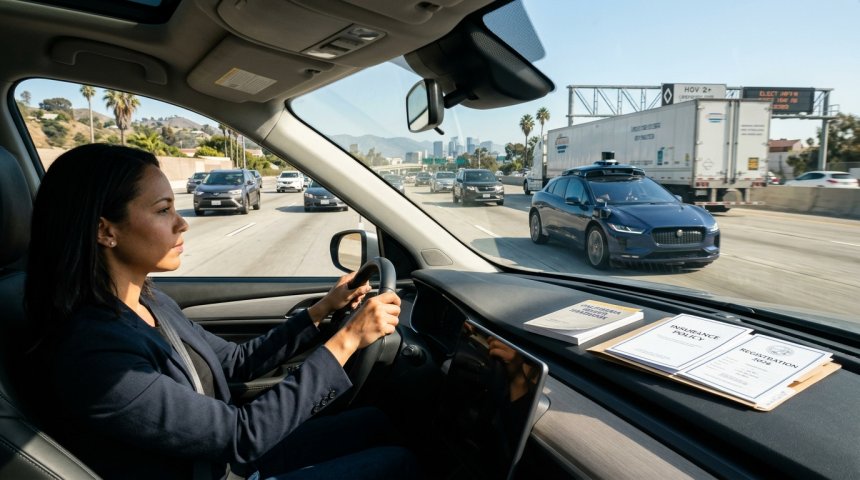
California is not just a state—it's a driving ecosystem unto itself. With 40 million residents, 270,000 miles of public roads, 15 million registered vehicles, and an economy that would rank as the fourth-largest in the world if it were a standalone country, California's driving rules are more complex, more strictly enforced, and more frequently updated than almost any other jurisdiction in the United States. Whether you're a lifelong resident who's been navigating the 405 for decades, a new transplant trying to decode the carpool lane rules, a commercial fleet operator managing hundreds of vehicles across the state, or a business owner ensuring your delivery drivers stay compliant, understanding California's driving rules in 2026 isn't optional—it's a financial, legal, and operational imperative.
The stakes are real. A single traffic violation in California can cost you $300–$1,000 in fines, add 1–2 points to your driving record, increase your insurance premiums by 20–40% for three years, and—if you're operating a commercial vehicle or managing a fleet—trigger DOT audits, insurance cancellations, or even license suspensions that shut down your business overnight. For businesses, the exposure multiplies: a fleet of 50 vehicles with even a 10% violation rate means 5 citations, $5,000+ in fines, a 15–25% insurance premium increase across the entire fleet, and potential liability exposure if a violation leads to an accident.
But here's the good news: California's driving rules, while extensive, are logical, well-documented, and navigable once you understand the framework. This guide is that framework. We'll walk through everything—from the basic rules of the road that every driver must know, to the commercial vehicle regulations that businesses must comply with, to the emerging autonomous vehicle rules that are reshaping California's transportation landscape in 2026. Whether you're an individual driver trying to avoid tickets, a rideshare driver maximizing your uptime, a delivery fleet manager optimizing compliance, or a corporate transportation director reducing liability, this guide will give you the knowledge to drive legally, safely, and confidently in the Golden State.
Let's start with the foundation.
Chapter 1: The California Driver's License System — Your Legal Permission to Operate
Everything starts with the license. In California, the Department of Motor Vehicles (DMV) issues driver's licenses that authorize you to operate specific classes of vehicles on public roads. Driving without a valid license, or operating a vehicle class your license doesn't cover, is a misdemeanor punishable by fines up to $1,000, vehicle impoundment, and potential jail time for repeat offenses.
License Classes in California
Class C — Standard Passenger License The most common license, authorizing operation of:
- Passenger vehicles (cars, trucks, vans) under 26,001 lbs GVWR (Gross Vehicle Weight Rating)
- Vehicles towing trailers under 10,000 lbs
- Housecars (RVs) under 40 feet
- Two-axle vehicles under 26,001 lbs
This is what 95% of California drivers hold. If you're driving a personal vehicle, a rideshare vehicle, or a small delivery van under 26,001 lbs, Class C is sufficient.
Class B — Commercial Medium-Duty License Authorizes operation of:
- Single vehicles over 26,001 lbs GVWR
- Vehicles towing trailers under 10,000 lbs
- Buses (with appropriate endorsements)
- Heavy straight trucks (dump trucks, box trucks, cement mixers)
Required for delivery drivers operating medium-duty box trucks, bus drivers, and construction vehicle operators. Requires a knowledge test, skills test, and medical certification (DOT physical).
Class A — Commercial Heavy-Duty License Authorizes operation of:
- Combination vehicles (tractor-trailers, truck-trailer combinations) over 26,001 lbs GVWR
- Any vehicle Class B or Class C covers
Required for semi-truck drivers, long-haul freight operators, and heavy equipment transporters. Requires additional knowledge tests, skills tests with combination vehicles, and medical certification.
Class M1/M2 — Motorcycle Licenses
- M1: All motorcycles, motor-driven cycles, and motorized scooters
- M2: Motorized bicycles, mopeds, and scooters under 150cc
Required for motorcycle delivery drivers (food delivery, courier services) and personal motorcycle operators. Requires knowledge test, skills test, and completion of a CMSP (California Motorcyclist Safety Program) course for riders under 21.
Special Endorsements
- Hazardous Materials (HazMat): Required for transporting hazardous materials. Requires TSA background check, fingerprinting, and additional knowledge test.
- Passenger (P): Required for vehicles designed to carry 16+ passengers (including driver). Required for bus drivers, shuttle operators, and rideshare drivers operating large vehicles.
- School Bus (S): Required for school bus drivers. Requires additional background checks, training, and testing.
- Tanker (N): Required for liquid/gas tank vehicles. Additional knowledge test required.
- Doubles/Triples (T): Required for pulling multiple trailers. Additional skills test required.
Business Implication: If you operate a fleet or hire drivers, verifying that each driver holds the correct license class and endorsements for their assigned vehicle is a legal requirement and a liability shield. A driver with a Class C license operating a 30,000-lb box truck is driving illegally—and if they cause an accident, your business faces vicarious liability, insurance denial, and potential criminal charges for negligent entrustment. Implement a monthly license verification process using the DMV's Employer Pull Notice (EPN) program (more on this below).
Getting a California Driver's License
For New Residents: California law requires new residents to obtain a California driver's license within 10 days of establishing residency. Residency is established by voting, paying in-state tuition, filing for homeowner's property tax exemption, or any other act indicating permanent presence. You must:
- Schedule a DMV appointment (online or by phone)
- Bring your out-of-state license, proof of identity (passport, birth certificate), proof of Social Security number, and two proofs of California residency (utility bill, lease agreement, bank statement)
- Pass a vision exam
- Pass a knowledge test (unless your out-of-state license is valid and from a U.S. state/territory)
- Surrender your out-of-state license
- Pay the $45 application fee
For First-Time Applicants (Under 18): California has a Graduated Driver's License (GDL) program for drivers under 18:
- Learner's Permit (age 15½+): Pass knowledge test and vision exam. Must hold permit for 6 months, complete 50 hours of supervised driving (10 hours at night), and complete a driver education course.
- Provisional License (age 16+): Pass behind-the-wheel driving test. Restrictions: no passengers under 20 for the first 12 months (except family members), no driving between 11 PM–5 AM for the first 12 months (exceptions for work, school, medical emergencies).
- Full License (age 18): All restrictions lifted.
For First-Time Applicants (18+):
- Schedule a DMV appointment
- Bring proof of identity, Social Security number, and two proofs of California residency
- Pass vision exam and knowledge test
- Obtain a learner's permit
- Practice driving (no mandatory supervised hours for adults, but recommended)
- Pass behind-the-wheel driving test
- Pay the $45 application fee
Knowledge Test Details:
- 46 multiple-choice questions for Class C (under 18); 36 questions for 18+
- Must answer 38 correct (under 18) or 30 correct (18+) to pass
- Covers traffic laws, road signs, safe driving practices, and California-specific rules
- Available in 30+ languages
- Three attempts allowed before requiring a new application fee
Behind-the-Wheel Test Details:
- 20-minute road test with a DMV examiner
- Evaluates vehicle control, observation skills, adherence to traffic laws, parking, lane changes, turns, and freeway driving (if applicable)
- Must provide a registered, insured, mechanically sound vehicle for the test
- Three attempts allowed before requiring a new application fee
Business Implication: If you hire drivers, especially young drivers or new residents, verify their license status and restrictions. A 17-year-old driver with a provisional license cannot legally drive between 11 PM–5 AM or carry non-family passengers under 20—critical restrictions for delivery routes, rideshare shifts, or overnight operations. Build license restriction checks into your hiring and scheduling systems.
License Renewal and Real ID
Renewal Cycles:
- Under 70: Renew every 5 years. Can renew online, by mail, or in person if eligible (no violations, no address change, no name change).
- 70+: Must renew in person every 5 years. Knowledge test and vision exam required at each renewal.
- Commercial licenses (Class A/B): Renew every 2 years. Medical certification (DOT physical) required at each renewal.
Real ID Compliance: As of May 7, 2025, a Real ID-compliant driver's license or identification card is required for domestic air travel and entry into federal facilities (military bases, federal courthouses, etc.). Real ID licenses are marked with a gold bear and star in the upper right corner. To obtain a Real ID:
- Visit a DMV office in person (not available online or by mail)
- Provide proof of identity (passport, birth certificate), Social Security number, and two proofs of California residency
- Pay the standard renewal fee ($45 for Class C)
Non-Real ID licenses remain valid for driving but cannot be used for federal purposes. If your drivers fly for work or access federal facilities, ensure they have Real ID-compliant licenses.
Business Implication: For fleets with drivers who travel interstate or access federal facilities, Real ID compliance is an operational requirement. Track Real ID status in your driver management system and schedule renewal appointments proactively to avoid operational disruptions.
The Employer Pull Notice (EPN) Program
For businesses employing drivers, California's Employer Pull Notice (EPN) program is a mandatory compliance tool. When you enroll in EPN, the DMV automatically notifies you of any driving record changes for your enrolled drivers—including new violations, accidents, license suspensions, revocations, or expirations.
How it works:
- Enroll your business in the EPN program through the DMV (free for most employers)
- Submit driver information (name, license number, date of birth) for each employee who drives as part of their job
- Receive automatic notifications when a driver's record changes
- Take appropriate action (retraining, suspension, termination) based on the notification
Why it matters:
- Legal requirement: California Labor Code and Vehicle Code require employers to monitor the driving records of employees who drive as part of their job. Failure to monitor can result in negligent entrustment liability if an employee with a suspended license causes an accident.
- Insurance requirement: Most commercial auto insurance policies require employers to monitor driver records. Failure to comply can result in claim denials or policy cancellation.
- Risk management: Early detection of violations allows you to intervene before a minor violation becomes a major accident. A driver with two speeding tickets in six months is a risk signal—retrain or reassign them before they cause a crash.
Enrollment process:
- Complete the EPN application (Form INF 1125) on the DMV website
- Designate an EPN coordinator for your business
- Submit driver information for each enrolled driver
- Receive notifications via email or mail when records change
- Maintain records of all notifications and actions taken for at least 3 years
Business Implication: EPN enrollment is non-negotiable for any business with drivers. The cost is minimal (free enrollment, $2–$5 per driver record pull), but the liability protection is enormous. A single accident caused by a driver with a suspended license that you failed to detect can result in a seven-figure negligent entrustment judgment. Enroll today, monitor continuously, and document every action.
Chapter 2: The Rules of the Road — California Traffic Laws Every Driver Must Know
California's traffic laws are codified in the California Vehicle Code (CVC). With 40,000+ sections, the full code is encyclopedic, but the rules that affect daily driving—and generate the most citations—fall into a manageable set of categories. Let's break them down.
Speed Limits and Speed Enforcement
Statutory Speed Limits (CVC 22349–22413):
- Residential districts: 25 mph unless otherwise posted
- Business districts: 25 mph unless otherwise posted
- School zones: 25 mph when children are present (or as posted, often 15–25 mph)
- Alleys: 15 mph
- Highways/freeways: 65 mph unless otherwise posted (some rural freeways posted at 70 mph)
- Trucks/vehicles towing trailers on freeways: 55 mph maximum
- School buses: 55 mph maximum
Basic Speed Law (CVC 22350): "No person shall drive a vehicle upon a highway at a speed greater than is reasonable or prudent having due regard for weather, visibility, the traffic on, and the surface and width of, the highway, and in no event at a speed which endangers the safety of persons or property."
This is the most important speed rule in California. Even if the posted limit is 65 mph, driving 65 mph in heavy rain, fog, or traffic can be a violation of the Basic Speed Law. Conversely, driving 50 mph in a 65 mph zone can be a violation if you're impeding the normal flow of traffic (CVC 22400). Speed limits are maximums for ideal conditions, not targets for all conditions.
Speed Enforcement Technologies:
- Radar/LIDAR: Traditional speed guns used by CHP and local police. LIDAR (laser) is more precise and increasingly common.
- Photo Radar/Automated Speed Enforcement (ASE): California legalized ASE programs in 2023 for designated high-injury corridors. As of 2026, Los Angeles, San Francisco, San Jose, Oakland, and several other cities operate ASE cameras that photograph speeding vehicles and mail citations to registered owners. Fines range from $50–$500 depending on speed over the limit.
- Red Light Cameras: Automated cameras at intersections that photograph vehicles running red lights. Legal in California since 1995. Operated in 20+ cities. Fines: $490–$1,000 including penalties.
- CHP Aircraft Speed Enforcement: CHP uses aircraft to clock speeds on freeways, especially in construction zones and high-collision corridors. Ground units intercept violators.
Speeding Penalties:
- 1–15 mph over limit: $35–$150 base fine + penalties/assessments = $230–$500 total. 1 point on driving record.
- 16–25 mph over limit: $70–$200 base fine + penalties = $350–$700 total. 1 point.
- 26+ mph over limit: $100–$300 base fine + penalties = $500–$1,000+ total. 1–2 points. Possible reckless driving charge (misdemeanor) for extreme speeds.
- Exceeding 100 mph: Reckless driving (CVC 23103), misdemeanor. Up to 90 days jail, $1,000 fine, 2 points, possible license suspension.
Insurance Impact: Each speeding conviction adds 1–2 points to your driving record. Insurance companies use point counts to determine premiums. One point typically increases premiums 15–25% for 3 years. Two points can increase premiums 30–50%. Multiple points can trigger policy non-renewal.
Business Implication: For fleets, speeding violations multiply across drivers and vehicles. A fleet of 50 vehicles with an average of 2 speeding tickets per year per vehicle = 100 tickets, $50,000+ in fines, 100–200 points across the fleet, and a 20–30% insurance premium increase fleet-wide. Invest in telematics (GPS tracking with speed monitoring), driver coaching programs, and speed governance technology (engine governors limiting top speed) to reduce violations. The ROI on telematics ($20–$40 per vehicle per month) pays for itself in reduced fines, lower insurance, and fewer accidents.
Right-of-Way Rules
Right-of-way violations are among the most common causes of accidents in California. The rules are straightforward but frequently ignored.
Intersections (CVC 21800–21806):
- Stop signs: First vehicle to stop goes first. If two vehicles stop simultaneously, the vehicle on the right goes first. If facing each other, the vehicle going straight goes before the vehicle turning left.
- Yield signs: Yield to all traffic on the through road. Proceed only when safe.
- Uncontrolled intersections (no signs/signals): Yield to vehicles already in the intersection. If arriving simultaneously, yield to the vehicle on the right.
- Roundabouts: Yield to traffic already in the roundabout. Enter when there's a safe gap. Travel counterclockwise. Exit using your right turn signal.
Pedestrians (CVC 21950–21971):
- Crosswalks (marked or unmarked): Drivers must yield to pedestrians in crosswalks. "Unmarked crosswalks" exist at every intersection—even without painted lines, the extension of the sidewalk across the road is a legal crosswalk.
- Mid-block crosswalks: Marked crosswalks between intersections require drivers to yield to pedestrians.
- School crossings: Stop for crossing guards and pedestrians in school zones. Fines double in school zones ($500–$1,000 for failing to yield to a pedestrian).
- Sidewalks: Never block sidewalks with vehicles. Yield to pedestrians entering or exiting driveways that cross sidewalks.
Emergency Vehicles (CVC 21806–21809):
- Approaching emergency vehicles (lights/sirens): Pull to the right edge of the roadway and stop until the emergency vehicle passes. On divided highways, move to the nearest edge and stop.
- Stationary emergency vehicles (Move Over Law, CVC 21809): When approaching a stationary emergency vehicle, tow truck, or Caltrans vehicle with flashing lights, move over one lane if safe. If unable to move over, slow down and proceed with caution. Violation: $250–$1,000 fine, 1 point.
Freeway Merging (CVC 21802–21804):
- On-ramps: Vehicles on the freeway have the right-of-way. Merging vehicles must yield and adjust speed to merge safely. Freeway drivers should move left or adjust speed to facilitate merging when safe.
- Zipper merge: In heavy traffic, alternate merging (one car from ramp, one car from freeway) is the most efficient and safest method. California encourages zipper merging in congested conditions.
Business Implication: Right-of-way violations are leading causes of commercial vehicle accidents, which trigger DOT investigations, insurance claims, and liability exposure. Train drivers on right-of-way rules quarterly, especially for intersections, pedestrian crossings, and freeway merging. Use dashcams to review near-misses and reinforce training. A single pedestrian accident in a crosswalk can result in a $1M+ liability claim—prevention through training is infinitely cheaper.
Lane Usage and Carpool (HOV) Lane Rules
California's freeways are famous for their carpool lanes—and the confusion surrounding them.
Carpool/HOV Lane Requirements (CVC 21655.5–21655.12):
- Minimum occupancy: 2+ persons per vehicle (3+ on some freeways in LA, SF, and SD during peak hours—check signage)
- Motorcycles: Allowed in HOV lanes with single rider (CVC 21655.8)
- Clean Air Vehicles (CAV): Vehicles with a valid CAV decal (electric, hybrid, hydrogen) may use HOV lanes with single rider until the decal expires. As of 2026, white and green CAV decals expired January 1, 2025. Red and purple decals expire January 1, 2026. Check your decal expiration date.
- Hours of operation: Most HOV lanes operate 24/7, but some are part-time (check signage). Part-time HOV lanes revert to general-purpose lanes outside posted hours.
- Entry/exit: Enter and exit HOV lanes only at designated breaks in the solid line. Crossing a solid line into or out of an HOV lane is a violation ($250–$500 fine, 1 point).
Express Lanes (FasTrak Required): Many California freeways now have Express Lanes (tolled HOV lanes) that require a FasTrak transponder:
- HOV 2+ or 3+: Free or discounted toll with valid FasTrak and required occupancy
- Solo drivers: Pay full toll with FasTrak
- No FasTrak: Toll billed to license plate via camera (higher rate + penalty)
- FasTrak Flex: Switchable transponder for HOV 2+/3+ toll discounts. Set to correct occupancy before entering.
Lane Splitting (Motorcycles Only, CVC 21658.1): California is the only state that explicitly permits motorcycle lane splitting (riding between lanes of stopped or slow-moving traffic). Guidelines (not law, but CHP enforcement standards):
- Don't split at speeds over 10 mph faster than surrounding traffic
- Don't split when traffic is moving over 30 mph
- Split near the center of the lane, not near the edges
- Be extra cautious near freeway on-ramps and off-ramps
- Don't split between trucks/buses and passenger vehicles
Lane Changing Rules (CVC 21658):
- Signal continuously for at least 100 feet before changing lanes (5 seconds at freeway speeds)
- Check mirrors and blind spots before changing lanes
- Don't change lanes in intersections
- Don't cross solid lane lines (double yellow, solid white, HOV boundary)
- Yield to vehicles already in the target lane
Business Implication: For fleets, HOV lane violations are common and costly. Drivers using HOV lanes solo to save time generate $250–$500 tickets plus insurance points. Implement clear policies: HOV lanes only with required occupancy, FasTrak transponders properly configured, and no solid-line crossings. Telematics can detect HOV lane usage and flag violations for coaching. For motorcycle delivery fleets, train riders on lane splitting guidelines to reduce accident risk and liability.
DUI/DWI Laws — Zero Tolerance for Impairment
California has some of the strictest DUI/DWI laws in the nation. The consequences are severe, escalating, and long-lasting.
Legal Limits (CVC 23152–23153):
- Adults (21+): 0.08% Blood Alcohol Concentration (BAC) or higher is per se DUI
- Commercial drivers: 0.04% BAC or higher is per se DUI
- Under 21: 0.01% BAC or higher is per se DUI (Zero Tolerance Law)
- Drugs: Any detectable amount of impairing drugs (THC, cocaine, methamphetamine, prescription medications) can result in DUI charges. No per se limit for drugs—impairment is determined by officer observation and Drug Recognition Expert (DRE) evaluation.
Implied Consent Law (CVC 23612): By driving in California, you implicitly consent to chemical testing (breath, blood, or urine) if lawfully arrested for DUI. Refusing a chemical test after arrest results in:
- Automatic 1-year license suspension (separate from any DUI conviction)
- Possible jail time enhancement if convicted of DUI
- No restricted license eligibility during suspension
DUI Penalties (First Offense, Adult):
- Criminal: Misdemeanor. 3–5 years probation. $390–$1,000 base fine + penalties = $1,500–$3,000 total. 48 hours–6 months jail (often waived or converted to work release). 3–9 months DUI school ($500–$1,200). Possible ignition interlock device (IID) for 6 months.
- Administrative: 4-month license suspension (DMV administrative per se). Restricted license available after 30 days with IID installation and SR-22 insurance filing.
- Insurance: SR-22 filing required for 3 years. Premiums increase 50–100% or more. Many insurers non-renew after DUI.
- Points: 2 points on driving record (negligent operator points).
DUI Penalties (Second Offense, Within 10 Years):
- Criminal: Misdemeanor (can be felony if injury involved). 3–5 years probation. $390–$1,000 base fine + penalties = $2,000–$5,000 total. 96 hours–1 year jail. 18–30 months DUI school. 1–2 years IID required.
- Administrative: 2-year license suspension. Restricted license after 90 days with IID.
- Insurance: SR-22 for 3 years. Premiums double or triple. High-risk insurer required.
DUI Penalties (Third+ Offense, Within 10 Years):
- Criminal: Felony (wobbler—can be charged as misdemeanor or felony). 3–5 years probation. $1,000+ base fine + penalties = $5,000–$10,000+ total. 120 days–3 years jail or prison. 30 months DUI school. 2–3 years IID. Possible vehicle forfeiture.
- Administrative: 3-year license revocation.
- Insurance: SR-22 for 3 years. Extreme premium increases or inability to obtain coverage.
Open Container Law (CVC 23221–23229): It's illegal for drivers or passengers to possess open containers of alcohol in the passenger area of a vehicle on a public road. Exceptions: passengers in buses, taxis, limousines, RVs (living quarters), and vehicles for hire. Violation: $250 fine.
Business Implication: A commercial driver with a DUI is a catastrophic event. CDL holders face 0.04% BAC limits and 1-year CDL disqualification for first DUI (lifetime disqualification for second). A fleet driver with a DUI triggers DOT reporting, insurance notification, potential policy cancellation, and vicarious liability if the DUI occurred during work hours. Implement pre-employment drug/alcohol screening, random drug testing (DOT-required for CDL drivers), post-accident testing, and reasonable suspicion testing. Maintain a zero-tolerance DUI policy with immediate termination for violations. The cost of prevention is trivial compared to the cost of a single DUI-related fleet accident ($1M+ liability, insurance cancellation, reputational damage).
Cell Phone and Distracted Driving Laws
California has progressively tightened distracted driving laws over the past decade. As of 2026, the rules are among the strictest in the nation.
Handheld Cell Phone Ban (CVC 23123–23124): It's illegal to hold a cell phone or electronic wireless communications device while driving. This includes:
- Talking without hands-free
- Texting, emailing, or messaging
- Browsing social media
- Taking photos or videos
- Using GPS navigation (unless mounted and operated with a single swipe/tap)
Hands-Free Requirements:
- Phones must be mounted on the windshield, dashboard, or center console
- Operation limited to a single swipe or tap (no typing, scrolling, or multi-step interactions)
- Voice-activated commands are permitted
- Drivers under 18 are prohibited from using any cell phone while driving, even hands-free (except emergency calls to 911, fire, or medical services)
Penalties:
- First offense: $162 base fine + penalties = $500–$700 total. 1 point.
- Second+ offense (within 36 months): $285 base fine + penalties = $700–$1,000 total. 1 point.
- School zone/construction zone: Fines double.
Distracted Driving (CVC 23103): Beyond cell phones, any activity that diverts attention from driving can be cited as reckless driving or unsafe operation: eating, drinking, grooming, reading, adjusting the radio, interacting with passengers, or using in-vehicle touchscreens excessively. Officers have broad discretion to cite distracted driving under the Basic Speed Law or reckless driving statutes.
Business Implication: Distracted driving is the #1 cause of commercial vehicle accidents nationwide. A delivery driver checking a dispatch app, a sales rep responding to a client email, or a rideshare driver adjusting a GPS—all are violations if the phone is handheld or operated with more than a single tap. Implement strict policies: phones mounted, voice commands only, pull over for complex interactions. Use telematics with phone-use detection to flag violations. Train drivers quarterly on distracted driving risks and policies. A single distracted driving accident can result in a $500K–$2M liability claim—mounting brackets and voice commands are cheap insurance.
Seat Belt and Child Safety Seat Laws
Seat Belt Law (CVC 27315): California has a primary seat belt law—officers can stop and cite you solely for not wearing a seat belt. Requirements:
- Drivers and all passengers: Must wear seat belts regardless of seating position
- Front seat passengers under 18: Must wear seat belts; driver is responsible for passengers under 16
- Back seat passengers 18+: Must wear seat belts
- Exceptions: Vehicles manufactured before 1964 (no factory seat belts), postal workers on delivery routes, certain medical conditions with physician certification
Penalties:
- Driver or passenger 16+: $162 base fine + penalties = $400–$600 total. 1 point.
- Passenger under 16: Driver cited. $270 base fine + penalties = $600–$800 total. 1 point.
Child Safety Seat Law (CVC 27360–27368):
- Under 2 years: Rear-facing car seat unless child weighs 40+ lbs or is 40+ inches tall
- Under 8 years: Car seat or booster seat in the back seat
- 8 years or older OR 4'9"+ tall: Seat belt (must fit properly—lap belt across hips, shoulder belt across chest)
- Under 8 in front seat: Prohibited unless rear seats are side-facing, rear-facing, or occupied by other children under 12; or no rear seat exists; or medical necessity
Penalties:
- First offense: $100 base fine + penalties = $300–$500 total. 1 point.
- Second+ offense: $250 base fine + penalties = $600–$1,000 total. 1 point.
- Court may waive fines if defendant proves economic hardship and completes a car seat safety program.
Business Implication: For fleets transporting passengers (shuttle services, rideshare, school transport, non-emergency medical transport), seat belt and child seat compliance is a liability minefield. A passenger injury due to missing seat belts or improper child restraints can result in a $250K–$1M+ claim. Implement pre-trip vehicle inspections that include seat belt functionality checks. For passenger transport services, maintain age-appropriate child seats and train drivers on proper installation. Document all safety checks and training for liability protection.
Parking Rules and Enforcement
Parking violations are the most common citations in California—low severity but high volume, and they add up quickly for individuals and fleets.
Common Parking Violations:
- Expired meter: $40–$100 depending on city and duration
- No parking zones (red curb): $100–$250. Red curb = no stopping, standing, or parking at any time.
- Loading zones (yellow curb): $100–$200. Commercial vehicles may load/unload for up to 30 minutes (or as posted). Non-commercial vehicles may load/unload passengers for up to 5 minutes.
- Short-term parking (green curb): $40–$100. Time-limited parking as posted (usually 15–30 minutes).
- Disabled parking (blue curb): $250–$1,000. Must display valid disabled person placard or license plate. Fraudulent use of disabled placards is a misdemeanor.
- Fire hydrant: $100–$250. No parking within 15 feet of a fire hydrant.
- Crosswalk/sidewalk: $100–$250. No parking in crosswalks or blocking sidewalks.
- Driveway: $100–$250. No blocking driveways.
- Street sweeping: $40–$100. Posted street sweeping schedules—parking prohibited during posted hours.
- Double parking: $100–$250. No parking alongside a parked vehicle.
- Blocking bike lane: $250–$500. Increasingly enforced in CA cities with protected bike infrastructure.
Towing and Impoundment: Vehicles parked in violation can be towed at the owner's expense. Towing fees in California range from $150–$400+ plus $25–$75/day storage. Retrieving a towed vehicle requires paying all fees, providing proof of ownership, and showing valid registration and insurance. Vehicles parked on public streets for 72+ consecutive hours can be towed even without a specific violation (CVC 22651).
Business Implication: For delivery fleets, parking violations are a constant operational cost. Delivery drivers parking in loading zones, red curbs, or bike lanes to make deliveries generate hundreds of tickets per year across a fleet. Strategies to reduce violations: route optimization to minimize parking time, designated delivery parking partnerships with property managers, commercial loading zone permits where available, and driver training on parking rules. Some cities offer commercial vehicle parking permits or designated delivery windows—investigate local programs. Budget $50–$150 per vehicle per month for parking violations in dense urban areas, and invest in reduction strategies to bring that cost down.
Chapter 3: Special California Driving Rules — What Makes the Golden State Different
Beyond the standard traffic laws, California has several unique rules that catch out-of-state drivers and even longtime residents off guard.
The Move Over Law (CVC 21809)
When approaching a stationary emergency vehicle, tow truck, or Caltrans vehicle displaying flashing amber or red lights, you must:
- Move over one lane if safe to do so
- If unable to move over, slow down and proceed with caution
This applies to all roadways, including freeways, highways, and surface streets. Violation: $250–$1,000 fine, 1 point. If the violation causes injury or death, it's a misdemeanor with enhanced penalties.
Business Implication: Fleet drivers, especially those operating on freeways (delivery, logistics, service vehicles), encounter stationary emergency vehicles daily. Train drivers on the Move Over Law and include it in defensive driving courses. A violation that injures a roadside worker can result in criminal charges and seven-figure liability.
Chain Requirements in Winter Conditions (CVC 27450–27465)
During winter storms, Caltrans and CHP enforce chain requirements on mountain passes and snowy corridors (I-80 over Donner Pass, I-5 over the Grapevine, US-395, SR-120, etc.). Chain control levels:
- R1 (Requirement 1): Chains required on all vehicles except 4WD/AWD with snow tires. Trucks over 6,500 lbs must carry chains.
- R2 (Requirement 2): Chains required on all vehicles except 4WD/AWD with snow tires on all four wheels. Trucks over 6,500 lbs must chain up.
- R3 (Requirement 3): Chains required on all vehicles, no exceptions. Rare—only in extreme conditions.
Chain installation: Must be installed on drive wheels (front wheels for FWD, rear wheels for RWD, all four for 4WD/AWD if R2/R3). Cable chains ("snow cables") are acceptable alternatives to traditional link chains.
Penalties: $100–$500 fine for failing to install chains when required. Vehicles turned around at checkpoints if not properly equipped.
Business Implication: For fleets operating in winter conditions (delivery, logistics, construction), chain compliance is critical. Equip all vehicles with approved chains or cables during winter months (November–April). Train drivers on chain installation. Monitor Caltrans chain control announcements and adjust routes accordingly. A fleet vehicle stuck on a mountain pass without chains creates safety hazards, delivery delays, and liability exposure.
Bicycle and E-Scooter Rules (CVC 21200–21235)
California treats bicycles as vehicles with the same rights and responsibilities as cars, plus additional protections.
Bicycle Rules:
- Same rules as vehicles: Bicyclists must obey all traffic laws—stop signs, signals, lane markings, right-of-way rules.
- Lane positioning: Ride as close to the right side of the road as practicable, except when passing, turning left, avoiding hazards, or when the lane is too narrow to share safely (CVC 21202).
- Bike lanes: Bicyclists may use bike lanes but aren't required to. Motor vehicles may not park, stop, or drive in bike lanes (except to enter/exit driveways or make right turns within 200 feet of the turn, yielding to bicyclists).
- Sidewalks: Local ordinances govern sidewalk riding. Some cities prohibit it; others allow it. Check local rules.
- Helmets: Required for riders under 18 (CVC 21212). Adults 18+ not required to wear helmets, but strongly recommended.
- Lights and reflectors: At night, bicycles must have a front white light visible from 300 feet, rear red reflector or light visible from 500 feet, and pedal/wheel reflectors (CVC 21201).
- Three-foot passing rule: Motor vehicles must give bicyclists at least 3 feet of clearance when passing (CVC 21760). Violation: $250–$500 fine, 1 point. If the violation causes injury, enhanced penalties.
E-Scooter Rules (CVC 21230):
- Speed limit: 15 mph maximum on roadways, bike lanes, and paths. Local ordinances may impose lower limits.
- Where to ride: Bike lanes, paths, and roadways with speed limits ≤25 mph. Sidewalks prohibited unless local ordinance allows.
- Helmets: Required for riders under 18. Adults 18+ not required.
- License: Valid driver's license or learner's permit required.
- Passengers: Prohibited. One rider per scooter.
- Parking: Must not block sidewalks, driveways, crosswalks, or ADA ramps. Local ordinances govern parking rules.
Business Implication: For delivery fleets operating in urban areas, bicycle and e-scooter interactions are high-risk scenarios. Door-zone collisions, right-hook turns, and lane-change conflicts are leading causes of bicycle/scooter accidents involving commercial vehicles. Train drivers on the three-foot passing rule, bike lane awareness, and right-turn protocols (check mirrors and blind spots for bicyclists before turning right). Install side-view cameras and proximity sensors on fleet vehicles. A single bicycle fatality involving a commercial vehicle can result in a $2M–$10M+ liability claim and criminal charges for the driver.
Autonomous Vehicle (AV) Regulations — California's 2026 Framework
California is the global leader in autonomous vehicle testing and deployment. As of 2026, the regulatory framework is mature, evolving, and increasingly relevant for businesses operating or interacting with AVs.
DMV Autonomous Vehicle Program: The California DMV regulates AV testing and deployment through two permit types:
- Testing Permits: Allow manufacturers to test AVs on public roads with a safety driver (Level 2–4) or without a safety driver (Level 4–5, driverless testing). As of 2026, 60+ companies hold testing permits, with 30+ authorized for driverless testing.
- Deployment Permits: Allow manufacturers to deploy AVs for commercial use (robotaxis, delivery vehicles) without a safety driver. As of 2026, Waymo and Cruise hold deployment permits for robotaxi services in San Francisco, Los Angeles, and select other cities. Several delivery AV companies hold permits for sidewalk/roadway delivery robots.
Rules for AVs on Public Roads:
- Compliance with traffic laws: AVs must obey all California traffic laws—speed limits, signals, right-of-way, parking rules, etc.
- Interaction with law enforcement: AVs must be capable of interacting with law enforcement (pulling over, displaying registration/insurance information, communicating with officers). Manufacturers must provide a 24/7 remote assistance contact for law enforcement.
- Incident reporting: Manufacturers must report AV collisions to the DMV within 10 days if the AV was engaged in autonomous mode and the collision resulted in injury, death, or property damage exceeding $750. Annual disengagement reports (when the safety driver or system disengages autonomous mode) are also required.
- Insurance: AV manufacturers must maintain $5M+ in liability insurance or self-insurance for testing and deployment.
Rules for Human Drivers Interacting with AVs:
- Same rules as other vehicles: Treat AVs like any other vehicle. Follow right-of-way rules, maintain safe following distances, and don't interfere with AV operation.
- Don't block or harass AVs: Intentionally blocking, interfering with, or harassing an AV is illegal (CVC 23114). Penalties: $250–$1,000 fine, possible misdemeanor charges for repeated or dangerous interference.
- Emergency vehicle interaction: AVs are programmed to yield to emergency vehicles. Don't exploit this by pretending to be an emergency vehicle or blocking AVs during emergency responses.
Delivery Robots (Sidewalk/Pathway Devices): Several California cities (San Francisco, Los Angeles, Santa Monica, Mountain View) permit sidewalk delivery robots under local ordinances:
- Speed limits: 3–6 mph on sidewalks, 10–15 mph on crosswalks/paths
- Weight limits: 50–100 lbs maximum
- Right-of-way: Yield to pedestrians. Pedestrians always have priority on sidewalks.
- Permits: Operators must obtain local permits and maintain liability insurance ($1M+ typical requirement).
- Identification: Robots must display company name, contact information, and permit number.
Business Implication: For businesses operating AVs or delivery robots, compliance with DMV permits, local ordinances, insurance requirements, and incident reporting is mandatory. For businesses whose drivers interact with AVs (delivery fleets, rideshare, logistics), train drivers on AV interaction rules—don't block, don't harass, treat AVs like other vehicles, and report aggressive or malfunctioning AVs to the manufacturer's remote assistance line and local authorities. As AV deployment expands in 2026–2030, AV interaction will become a standard component of driver training programs.
Chapter 4: Commercial Vehicle Regulations — Business Compliance Essentials
If you operate a business that uses vehicles—delivery fleets, service vehicles, construction equipment, passenger transport, or freight hauling—California imposes additional regulations beyond the standard traffic laws. These rules are enforced by the California Highway Patrol (CHP), Department of Transportation (Caltrans), Department of Motor Vehicles (DMV), and the federal Department of Transportation (DOT) through the Federal Motor Carrier Safety Administration (FMCSA).
Vehicle Registration and Licensing
Commercial Vehicle Registration (CVR): Vehicles used for business purposes must be registered as commercial vehicles with the DMV. Commercial registration fees are based on vehicle weight, type, and usage:
- Light commercial (under 10,001 lbs GVWR): $100–$300/year
- Medium commercial (10,001–26,000 lbs GVWR): $300–$800/year
- Heavy commercial (26,001+ lbs GVWR): $800–$3,000+/year
- Tractor-trailers: $1,000–$5,000+/year depending on weight and configuration
Permanent Fleet Registration (PFR): Fleets of 5+ vehicles can enroll in PFR for streamlined registration renewal. Instead of renewing each vehicle individually, the fleet renews as a unit with a single payment and consolidated paperwork. Significant administrative savings for large fleets.
International Registration Plan (IRP): Vehicles operating interstate must register under IRP, which apportions registration fees across states based on mileage in each state. California is an IRP member. IRP registration is required for vehicles over 26,000 lbs GVWR or with 3+ axles operating across state lines.
California Air Resources Board (CARB) Compliance: California has the strictest vehicle emissions standards in the nation, enforced by CARB. Key regulations affecting commercial vehicles:
- Truck and Bus Regulation: Requires diesel trucks and buses operating in California to meet progressively stricter emissions standards. As of 2026, most diesel trucks must have 2010+ model year engines or equivalent emissions controls. Older trucks must be retrofitted with diesel particulate filters (DPF) or retired.
- Advanced Clean Fleets (ACF) Regulation: Requires fleet operators to transition to zero-emission vehicles (ZEVs) on a phased timeline. By 2035, 100% of new medium/heavy-duty vehicle sales in California must be ZEV. Large fleets (50+ vehicles or $50M+ revenue) must begin purchasing ZEVs in 2024–2026 depending on fleet type. Drayage trucks (port/rail freight) must be 100% ZEV by 2035.
- Transport Refrigeration Unit (TRU) Regulation: Refrigerated trailers and containers operating in California must meet CARB TRU emissions standards. Older TRUs must be upgraded or replaced with compliant units.
- Low Carbon Fuel Standard (LCFS): Credits and deficits system for fuel carbon intensity. Fleet operators using low-carbon fuels (electricity, hydrogen, renewable diesel, biodiesel) generate LCFS credits that can be sold. High-carbon fuel users generate deficits that must be offset.
Business Implication: CARB compliance is a major operational and financial consideration for California fleets. Non-compliance results in fines ($1,000–$10,000+ per vehicle per day), vehicle registration holds, and inability to operate legally in California. Develop a CARB compliance roadmap: inventory your fleet's emissions profile, identify non-compliant vehicles, budget for retrofits or ZEV replacements, and track compliance deadlines. Many fleets are accelerating ZEV adoption ahead of mandates to capture LCFS credits, reduce fuel costs, and future-proof against tightening regulations.
Driver Qualification and Monitoring
Commercial Driver's License (CDL) Requirements: Drivers operating vehicles over 26,001 lbs GVWR, vehicles carrying 16+ passengers, or vehicles transporting hazardous materials must hold a CDL with appropriate endorsements. CDL requirements:
- Knowledge tests: General knowledge, air brakes (if applicable), combination vehicles (Class A), passenger (P endorsement), HazMat (H endorsement), tanker (N endorsement), doubles/triples (T endorsement)
- Skills test: Pre-trip inspection, basic vehicle control, on-road driving in a vehicle matching the license class
- Medical certification: DOT physical exam every 2 years (or more frequently if medically required). Conducted by a certified medical examiner listed on the National Registry.
- Entry-Level Driver Training (ELDT): First-time CDL applicants and those upgrading license class or adding endorsements must complete FMCSA-approved ELDT before taking the skills test.
Driver Qualification Files (DQF): FMCSA regulations (49 CFR 391) require motor carriers to maintain a DQF for each driver, containing:
- Driver application
- Motor vehicle record (MVR) from each state where the driver held a license in the past 3 years
- Road test certificate or equivalent (CDL skills test satisfies this)
- Medical examiner's certificate
- Annual MVR review and notes
- Employment verification for the past 3 years
- Drug and alcohol testing records (for CDL drivers)
DQFs must be maintained for the duration of employment plus 3 years. CHP and DOT auditors can request DQFs during inspections—missing or incomplete files result in violations and fines.
Drug and Alcohol Testing (49 CFR 382): CDL drivers are subject to FMCSA drug and alcohol testing requirements:
- Pre-employment: Drug test before starting safety-sensitive functions
- Random: Random drug and alcohol testing throughout employment (minimum 50% drug, 10% alcohol annual rates)
- Post-accident: Drug and alcohol testing after qualifying accidents (fatalities, injuries requiring medical treatment away from scene, disabling damage requiring tow)
- Reasonable suspicion: Drug and alcohol testing when a trained supervisor observes behavior suggesting impairment
- Return-to-duty: Drug and alcohol testing before returning to safety-sensitive functions after a violation
- Follow-up: Unannounced drug and alcohol testing for up to 5 years after return-to-duty
Hours of Service (HOS) Rules (49 CFR 395): CDL drivers operating commercial motor vehicles are subject to HOS rules limiting driving time:
- 11-hour driving limit: Maximum 11 hours of driving after 10 consecutive hours off duty
- 14-hour on-duty limit: Cannot drive beyond the 14th consecutive hour after coming on duty, following 10 consecutive hours off duty
- 30-minute break: Must take a 30-minute break after 8 cumulative hours of driving
- 60/70-hour limit: Cannot drive after being on duty 60 hours in 7 consecutive days or 70 hours in 8 consecutive days. Can restart the cycle with 34+ consecutive hours off duty.
- Electronic Logging Device (ELD): Most CDL drivers must use an ELD to record HOS automatically. Paper logs permitted only for drivers using paper logs for ≤8 days out of 30, or operating under specific exemptions.
Business Implication: HOS violations are among the most common DOT citations and carry significant penalties ($1,000–$11,000 per violation). More importantly, HOS violations are strong predictors of fatigue-related accidents, which carry the highest liability exposure in commercial transportation. Implement ELDs across your fleet, train drivers on HOS rules, monitor HOS compliance in real-time through your telematics/ELD platform, and intervene when drivers approach HOS limits. A single fatigue-related accident can result in a $5M–$20M+ liability judgment—ELD compliance and HOS monitoring are non-negotiable risk management tools.
Vehicle Inspection and Maintenance
Pre-Trip and Post-Trip Inspections (49 CFR 396.11–396.13): CDL drivers must conduct pre-trip and post-trip inspections of their vehicles, documenting any defects or deficiencies on a Driver Vehicle Inspection Report (DVIR). Defects affecting safety (brakes, lights, tires, steering, coupling devices) must be repaired before the vehicle is operated again. DVIRs must be retained for 3 months.
Annual Inspections (49 CFR 396.17): All commercial motor vehicles must undergo a comprehensive annual inspection by a qualified inspector. The inspection covers all systems and components listed in FMCSA Appendix G. Inspection reports must be retained for 14 months.
California Biennial Smoke Opacity Test: Diesel vehicles over 14,000 lbs GVWR operating in California must undergo biennial smoke opacity testing through CARB's Heavy-Duty Vehicle Inspection Program (HDVIP). Vehicles exceeding smoke opacity limits must be repaired and retested. Non-compliant vehicles receive citations ($500–$1,000) and registration holds.
Business Implication: Inspection and maintenance compliance is both a safety imperative and a liability shield. Well-maintained vehicles have fewer breakdowns, fewer accidents, and stronger legal defenses if accidents occur. Implement a computerized maintenance management system (CMMS) that tracks inspection schedules, maintenance history, repair records, and compliance deadlines. Train drivers on thorough pre-trip/post-trip inspections and enforce DVIR completion. A single accident caused by a preventable maintenance defect (worn brakes, bald tires, failed lights) can result in a punitive damages award that multiples compensatory damages by 2–5x—maintenance compliance is cheap insurance.
Insurance Requirements
California Minimum Liability Insurance:
- Personal vehicles (Class C): $15,000/$30,000/$5,000 (bodily injury per person/bodily injury per accident/property damage)
- Commercial vehicles (light, under 10,001 lbs): $15,000/$30,000/$5,000 minimum, but most commercial policies carry $100,000/$300,000/$100,000 or higher
- Commercial vehicles (medium/heavy, over 10,001 lbs): $750,000–$5,000,000 depending on cargo type and weight. Hazardous materials carriers: $1M–$5M. Passenger carriers: $1.5M–$5M.
FMCSA Insurance Requirements: Interstate commercial carriers must file proof of insurance (MCS-90 endorsement) with FMCSA:
- General freight: $750,000 minimum
- Hazardous materials (non-bulk): $1,000,000 minimum
- Hazardous materials (bulk, oil):: $1,000,000–$5,000,000 depending on material
- Passenger carriers (16+ passengers): $1,500,000–$5,000,000 depending on capacity
SR-22 Filing: Drivers with DUI convictions, at-fault accidents without insurance, or multiple violations must file an SR-22 (Certificate of Financial Responsibility) with the DMV for 3 years. The SR-22 is filed by the insurance company, confirming the driver carries the state-required minimum liability coverage. SR-22 filings trigger premium increases of 50–100%+ and often require high-risk insurers.
Business Implication: California's minimum liability limits are dangerously low for commercial operations. A single serious accident can exhaust $15,000/$30,000/$5,000 limits instantly, exposing your business to personal liability for the excess. Carry commercial umbrella liability insurance ($5M–$25M) above your primary auto policy. Review coverage limits annually with your insurance broker. Ensure all drivers are covered under your policy (named driver or omnibus clause). Verify that hired and non-owned auto coverage extends to employees using personal vehicles for business. A single uninsured/underinsured accident can bankrupt a small business—adequate insurance is existential, not optional.
Chapter 5: Insurance and Financial Responsibility — Protecting Yourself and Your Business
Insurance isn't just a legal requirement—it's the financial backbone that protects you from catastrophic loss when something goes wrong. California's insurance landscape is complex, evolving, and increasingly expensive. Understanding the rules helps you stay compliant and optimize coverage.
Personal Auto Insurance Requirements
Minimum Liability Coverage (CVC 16056):
- Bodily Injury Liability: $15,000 per person / $30,000 per accident
- Property Damage Liability: $5,000 per accident
These minimums are widely considered inadequate for California's high medical costs and property values. A single hospital visit for a moderate injury can exceed $50,000. A totaled vehicle can cost $30,000–$100,000+. The state minimums expose you to personal liability for any excess.
Recommended Coverage:
- Bodily Injury Liability: $100,000/$300,000 or higher
- Property Damage Liability: $100,000 or higher
- Uninsured/Underinsured Motorist (UM/UIM): $100,000/$300,000 or higher (covers you when the at-fault driver has insufficient or no insurance)
- Medical Payments (MedPay) or Personal Injury Protection (PIP): $5,000–$25,000 (covers medical expenses regardless of fault)
- Collision: Covers damage to your vehicle from accidents (subject to deductible)
- Comprehensive: Covers non-collision damage (theft, vandalism, fire, natural disasters, animal strikes)
Proof of Insurance (CVC 16028): Drivers must carry proof of insurance (insurance card, digital copy on phone) at all times and present it upon request by law enforcement or after an accident. Failure to provide proof: $100–$200 fine for first offense, $200–$500 for subsequent offenses. Vehicle may be impounded if no proof is provided.
Financial Responsibility Alternatives: Instead of insurance, drivers can demonstrate financial responsibility through:
- Cash deposit: $35,000 cash or securities deposited with the DMV
- Surety bond: $35,000 bond from a licensed surety company
- Self-insurance certificate: DMV-issued certificate for owners of 25+ vehicles (typically fleets)
These alternatives are impractical for most individual drivers but relevant for large fleets.
Commercial Auto Insurance
Coverage Types:
- Primary Liability: Covers bodily injury and property damage your vehicles cause to others. Required by law.
- Physical Damage: Collision and comprehensive coverage for your vehicles. Not legally required but essential for financed/leased vehicles and asset protection.
- Cargo Insurance: Covers damage to or loss of cargo you're transporting. Required by many shippers and brokers.
- Hired and Non-Owned Auto (HNOA): Covers liability when employees use rented vehicles or personal vehicles for business. Critical for businesses without owned fleets.
- Umbrella/Excess Liability: Additional liability coverage above primary policy limits. Essential for commercial operations—$5M–$25M umbrella is standard for fleets.
- Workers' Compensation: Covers employee injuries sustained while driving for work. Required by California law for all employees.
Rating Factors: Commercial auto insurance premiums are determined by:
- Fleet size and vehicle types: More vehicles and heavier vehicles = higher premiums
- Driving radius: Local, regional, or long-haul operations affect risk exposure
- Cargo type: General freight, hazardous materials, passengers, refrigerated goods—each carries different risk profiles
- Driver records: MVR points, violations, and accidents across the fleet
- Loss history: Prior claims frequency and severity
- Safety programs: Formal safety programs, telematics, driver training, and DOT compliance reduce premiums
- Credit score: In California, credit-based insurance scoring is restricted but still influences commercial rates indirectly
Premium Reduction Strategies:
- Telematics/GPS tracking: Demonstrates safe driving behavior, reduces theft, and provides accident reconstruction data. 5–15% premium discount typical.
- Driver training programs: Formal defensive driving, HOS compliance, and safety training programs. 3–10% discount.
- DOT compliance: Clean DOT safety rating (Satisfactory or better), low CSA scores, and clean audit results. 5–15% discount.
- Higher deductibles: Increasing physical damage deductibles from $500 to $2,500–$5,000 reduces premiums 10–20%.
- Safety equipment: Dashcams, ADAS (advanced driver assistance systems), ELDs, and anti-theft devices. 2–8% discount per device.
- Loss control programs: Formal accident investigation, root cause analysis, and corrective action programs. 3–8% discount.
Business Implication: Commercial auto insurance is often the second-largest operating expense for fleet businesses (after fuel). Optimizing premiums through safety programs, telematics, driver training, and DOT compliance can save tens of thousands annually. Work with a broker specializing in commercial transportation—not a generalist agent—to access specialized markets, negotiate better terms, and identify all available discounts. Review coverage annually to ensure limits match your exposure and policies reflect your current operations.
California's Insurance Market Dynamics in 2026
California's insurance market has undergone significant stress in recent years. Major insurers (State Farm, Allstate, Farmers) have restricted new policy issuance or exited certain markets due to wildfire losses, inflation, and regulatory constraints on rate increases. This has created:
- Reduced competition: Fewer insurers writing new policies = less pricing pressure = higher premiums
- FAIR Plan expansion: California's insurer of last resort (FAIR Plan) has grown significantly as private insurers restrict availability. FAIR Plan policies are more expensive and offer limited coverage.
- Rate increases: Approved rate increases of 10–30%+ for personal and commercial auto policies in 2024–2026
- Non-renewals: Insurers non-renewing policies with claims, violations, or high-risk characteristics more aggressively
Strategies for Navigating the Tight Market:
- Shop early: Begin renewal shopping 60–90 days before expiration. Don't wait until the last minute.
- Work with independent brokers: Independent brokers access multiple carriers, including surplus lines markets for hard-to-place risks.
- Improve risk profile: Reduce violations, implement safety programs, install telematics, and improve DOT compliance to qualify for better markets.
- Consider captive insurance or risk retention groups: For large fleets ($1M+ annual premiums), captive insurance or RRG membership can provide more stable, customized coverage.
- Maintain continuous coverage: Any lapse in coverage triggers higher premiums and limited market access. Never let a policy lapse, even for a day.
Chapter 6: Points, Negligent Operator System, and License Suspension
California uses a point system to track driving violations and identify high-risk drivers. Accumulating too many points triggers license suspension under the Negligent Operator Treatment System (NOTS).
Point Values
- 1 point: Minor violations (speeding 1–25 mph over, illegal lane change, failure to signal, seat belt violation, cell phone violation, parking violations don't add points)
- 2 points: Serious violations (DUI, reckless driving, hit-and-run, speeding 26+ mph over, evading police, driving with suspended license)
Points remain on your driving record for:
- 1-point violations: 3 years
- 2-point violations: 10 years (DUI, hit-and-run) or 3 years (other 2-point violations)
Negligent Operator Treatment System (NOTS)
The DMV automatically suspends your license if you accumulate:
- 4 points in 12 months
- 6 points in 24 months
- 8 points in 36 months
Suspension periods:
- First suspension: 6 months
- Second suspension: 1 year
- Third+ suspension: 2+ years
Before suspension, the DMV sends a Notice of Intent to Suspend. You can request a hearing to contest the suspension, present mitigating evidence, or request a restricted license for work/medical purposes.
Traffic School and Point Masking
For eligible 1-point violations, you can attend DMV-approved traffic school to mask the point from your insurance record:
- Eligibility: One traffic school attendance per 18 months. Violation must be 1-point, non-commercial, non-DUI, non-speeding over 25 mph over limit.
- Effect: Point remains on your DMV driving record (visible to law enforcement and courts) but is masked from your insurance record (insurance company can't see it for rating purposes).
- Cost: $30–$60 for traffic school course + court administrative fee ($30–$50). Total: $60–$110 plus the original ticket fine.
- Time commitment: 6–8 hours of coursework (online or in-person). Must complete within 60–90 days of court approval.
Business Implication: For fleet drivers, traffic school eligibility is limited (commercial vehicle violations are generally not eligible for point masking). This makes violation prevention even more critical for commercial drivers—points accumulate faster and can't be masked. Implement proactive driver coaching, telematics-based feedback, and regular safety training to prevent violations before they occur. A driver who accumulates 4 points in 12 months loses their license for 6 months—creating staffing disruptions, overtime costs for replacement drivers, and operational chaos. Prevention is infinitely cheaper than replacement.
Chapter 7: Emerging Trends and Future Rules — What's Coming in 2026–2030
California's driving rules are not static. The state is actively legislating and regulating in response to technological, environmental, and social changes. Here's what's on the horizon.
Zero-Emission Vehicle Mandates
Advanced Clean Cars II (ACC II): Requires 100% of new passenger vehicle sales in California to be zero-emission (battery electric, hydrogen fuel cell, or plug-in hybrid with 50+ mile electric range) by 2035. Phased targets: 35% ZEV by 2026, 68% by 2030, 100% by 2035. This affects fleet procurement decisions—businesses replacing vehicles must increasingly choose ZEVs to comply with state mandates and CARB fleet rules.
Advanced Clean Fleets (ACF): Requires fleet operators to transition to ZEVs on accelerated timelines:
- Drayage trucks (port/rail): 100% ZEV by 2035. New drayage trucks must be ZEV starting 2024.
- High-priority fleets (50+ vehicles or $50M+ revenue): ZEV purchase schedules beginning 2024–2026 depending on fleet type. 100% ZEV by 2035–2042 depending on vehicle class.
- Federal fleets, state/local government fleets: ZEV purchase requirements beginning 2024–2027.
Business Implication: ZEV mandates are reshaping fleet economics. ZEVs have higher upfront costs ($50K–$200K+ premium vs. diesel equivalents) but lower operating costs (fuel, maintenance) and access to CARB incentives, LCFS credits, and HOV lane access. Develop a ZEV transition plan: assess your fleet's replacement schedule, identify ZEV-compatible routes and duty cycles, budget for charging infrastructure, and apply for CARB/Federal incentives (HVIP, EPA Clean School Bus, LCFS credits). Early adopters capture incentive funding and competitive advantages; late adopters face compressed timelines and depleted incentive pools.
Expanded Automated Speed Enforcement
California's 2023 ASE legalization is expanding rapidly. By 2027, most major California cities are expected to operate ASE programs on high-injury corridors. Key developments:
- Camera density increasing: More cameras on more corridors, covering more speed thresholds
- AI-powered enforcement: Cameras using AI to detect speed, red-light running, bus lane violations, and bike lane blocking simultaneously
- Equity-focused deployment: ASE programs prioritizing high-injury neighborhoods rather than revenue-generating corridors
- Fine structures evolving: Income-based fines, payment plans, and community service alternatives for low-income violators
Business Implication: ASE expansion means more automated citations for fleet vehicles. Speed governance technology (engine governors, telematics-based speed alerts) becomes even more critical. Budget for increased ASE citations in urban operations and invest in prevention technology. A fleet of 50 vehicles in Los Angeles could generate 200–500 ASE citations annually at $100–$300 each—$20,000–$150,000 in annual fines without speed governance.
V2X (Vehicle-to-Everything) Communication Mandates
The National Highway Traffic Safety Administration (NHTSA) is finalizing rules requiring V2X communication capability in new vehicles. California is likely to adopt and potentially accelerate these requirements. V2X enables vehicles to communicate with each other (V2V), infrastructure (V2I), pedestrians (V2P), and networks (V2N) to prevent accidents, optimize traffic flow, and enable autonomous operations.
Business Implication: V2X mandates will affect fleet procurement decisions. New vehicles purchased after mandate effective dates must include V2X hardware. Fleets should factor V2X capability into vehicle specifications and budget for the incremental cost ($200–$500 per vehicle). V2X-enabled fleets will benefit from improved safety, reduced accidents, and potential insurance discounts.
Privacy and Data Collection Regulations
California's Consumer Privacy Act (CCPA) and California Privacy Rights Act (CPRA) impose strict rules on data collection, including telematics data, dashcam footage, and driver monitoring data. Key requirements:
- Transparency: Disclose what data you collect, how you use it, and who you share it with
- Consent: Obtain explicit consent for sensitive data collection (geolocation, biometric, behavioral monitoring)
- Access and deletion: Drivers can request access to their data and request deletion
- Data minimization: Collect only data necessary for stated purposes
- Security: Implement reasonable security measures to protect collected data
Business Implication: If you use telematics, dashcams, or driver monitoring systems, you must comply with CCPA/CPRA. Update your privacy policies, obtain driver consent, implement data access/deletion procedures, and secure collected data. Non-compliance can result in fines of $2,500–$7,500 per violation and private lawsuits for data breaches. Work with legal counsel to ensure your driver monitoring programs comply with California privacy law.
Chapter 8: Practical Tools and Resources for California Drivers
Navigating California's driving rules is easier with the right tools. Here's your resource toolkit.
Official Government Resources
California DMV:
- Driver's license applications, renewals, and replacements
- Vehicle registration and titling
- Driving records (MVR requests)
- EPN program enrollment
- Real ID information
- Driver handbook (free PDF download—essential reference)
- Appointment scheduling
California Highway Patrol (CHP):
- Traffic collision reports
- Chain control information
- Commercial vehicle enforcement
- DUI enforcement statistics
- Safety tips and alerts
Caltrans:
- Road conditions and closures
- Chain control requirements
- Construction zone information
- Traffic alerts and advisories
- QuickMap (real-time traffic and incident map)
California Courts:
- Traffic ticket payment and court appearance scheduling
- Traffic school eligibility and provider lists
- Fine schedules and penalty information
- Online dispute resolution for traffic citations
California Air Resources Board (CARB):
- Truck and Bus Regulation compliance
- Advanced Clean Fleets requirements
- TRU regulation information
- LCFS credit marketplace
- HDVIP smoke testing information
- ZEV incentive programs (HVIP)
Federal Motor Carrier Safety Administration (FMCSA):
- CDL requirements and ELDT information
- Hours of Service rules and ELD mandate
- Drug and alcohol testing requirements
- CSA safety ratings and inspection data
- Driver qualification file requirements
Third-Party Tools and Apps
Navigation and Traffic:
- Google Maps / Apple Maps: Real-time traffic, route optimization, speed limit display, speed camera alerts
- Waze: Crowd-sourced traffic, police presence, hazard alerts, speed camera warnings
- Sigalert (CHP): Official CHP traffic incident feed for Southern California
- Caltrans QuickMap: Official Caltrans traffic and incident map
Parking:
- ParkMobile / SpotHero / BestParking: Find and pay for parking, reserve spots in advance
- LA Express Park / SFpark: Dynamic pricing parking programs in LA and SF
Fuel and EV Charging:
- GasBuddy: Real-time gas price comparison
- PlugShare / ChargePoint / Electrify America: EV charging station locations, availability, and pricing
- CARB ZEV App: California ZEV incentive and charging station information
Insurance and Records:
- MyDMV: Online DMV account for registration, license, and record management
- Insurance company apps: Policy management, claims filing, digital insurance cards
- MVR services: Third-party MVR providers for employer driver screening
Learning and Test Prep:
- DMV practice tests: Free official practice knowledge tests
- Driving-Tests.org: Free California-specific practice tests and study guides
- YouTube channels: DMV test prep channels with video explanations of rules and signs
Professional Resources for Businesses
Industry Associations:
- California Trucking Association (CTA): Advocacy, compliance resources, training, and networking for trucking fleets
- California Association of Fleet Managers (CAFM): Fleet management best practices, benchmarking, and professional development
- American Trucking Associations (ATA): National trucking advocacy, compliance resources, and industry data
- National Private Truck Council (NPTC): Resources for private fleets (non-for-hire)
Insurance Brokers and Consultants:
- Work with brokers specializing in commercial transportation insurance (not generalist agents)
- Engage DOT compliance consultants for audit preparation and regulatory guidance
- Hire safety consultants for fleet safety program development and driver training
Legal Counsel:
- Retain transportation attorneys for regulatory compliance, accident liability defense, and employment law
- Consult privacy attorneys for CCPA/CPRA compliance in driver monitoring programs
- Engage environmental attorneys for CARB compliance and ZEV transition planning
Conclusion: Driving in California Is a Privilege, Not a Right
California's driving rules exist for a reason: to protect 40 million people sharing 270,000 miles of road with 15 million vehicles in one of the world's largest economies. The rules are complex because the environment is complex. They're strictly enforced because the stakes—safety, liability, environmental impact—are high. And they're constantly evolving because technology, climate, and society are constantly evolving.
For individual drivers, the takeaway is simple: know the rules, follow the rules, and stay informed as the rules change. A little knowledge prevents costly tickets, insurance increases, and license suspensions. Read the DMV driver handbook. Take a defensive driving course. Use the tools and resources available to you. Drive defensively, courteously, and legally. The roads are shared spaces—your choices affect everyone around you.
For businesses, the stakes are higher and the obligations broader. You're not just responsible for your own driving—you're responsible for every driver in your fleet, every vehicle in your operation, and every interaction your business has with California's transportation ecosystem. Compliance isn't optional—it's the foundation of your license to operate. Invest in systems (EPN, telematics, ELDs, CMMS), training (defensive driving, HOS, CARB compliance), insurance (adequate limits, umbrella coverage), and culture (safety-first mindset, accountability, continuous improvement). The cost of compliance is trivial compared to the cost of non-compliance—fines, liability claims, insurance cancellations, operational disruptions, and reputational damage.
California's driving rules in 2026 are a reflection of the state's values: safety, environmental stewardship, technological innovation, and individual responsibility. Whether you agree with every rule or not, they're the rules of the road. Learn them, follow them, and help make California's roads safer for everyone.
Drive safe. Stay compliant. And remember—the person in the car next to you is someone's parent, child, friend, or colleague. Your choices behind the wheel matter far beyond the ticket you might avoid or the fine you might pay. They matter to the people sharing the road with you.
That's the real reason to know California's driving rules. Not to avoid tickets. To protect lives.
Frequently Asked Questions (FAQs)
What's the speed limit on California freeways?
The default speed limit on California freeways is 65 mph unless otherwise posted. Some rural freeways are posted at 70 mph. Trucks and vehicles towing trailers are limited to 55 mph on freeways regardless of posted limits. However, the Basic Speed Law (CVC 22350) requires you to drive at a speed that's reasonable and prudent for current conditions—weather, visibility, traffic, and road surface. Even if the posted limit is 65 mph, driving 65 mph in heavy rain, fog, or congestion can be a violation. Conversely, driving significantly below the speed limit can be a violation if you're impeding the normal flow of traffic (CVC 22400). Speed limits are maximums for ideal conditions, not targets for all conditions.
Can I use my cell phone while driving in California?
California prohibits holding a cell phone or electronic device while driving (CVC 23123–23124). Phones must be mounted on the windshield, dashboard, or center console, and operation is limited to a single swipe or tap—no typing, scrolling, or multi-step interactions. Voice-activated commands are permitted. Drivers under 18 are prohibited from using any cell phone while driving, even hands-free, except for emergency calls to 911, fire, or medical services. First offense: $500–$700 total fine with penalties, 1 point. Second+ offense within 36 months: $700–$1,000 total fine, 1 point. Fines double in school zones and construction zones. For businesses, implement strict policies: phones mounted, voice commands only, pull over for complex interactions. Use telematics with phone-use detection to flag violations.
What are the carpool (HOV) lane rules in California?
Carpool/HOV lanes require 2+ persons per vehicle (3+ on some freeways in LA, SF, and SD during peak hours—check signage). Motorcycles with single riders are allowed. Clean Air Vehicles (CAV) with valid decals may use HOV lanes with single rider until the decal expires (white/green expired Jan 1, 2025; red/purple expire Jan 1, 2026). Enter and exit HOV lanes only at designated breaks in the solid line—crossing a solid line is a violation ($250–$500 fine, 1 point). Many freeways have Express Lanes (tolled HOV lanes) requiring a FasTrak transponder: HOV 2+/3+ get free or discounted tolls with valid FasTrak and correct occupancy; solo drivers pay full toll; no FasTrak results in higher tolls billed to your license plate. For fleets, implement clear HOV policies, ensure FasTrak transponders are properly configured, and use telematics to detect HOV lane violations.
What happens if I get a DUI in California?
California DUI penalties escalate severely. First offense (adult, 0.08%+ BAC): misdemeanor, 3–5 years probation, $1,500–$3,000 total fines with penalties, 48 hours–6 months jail (often waived), 3–9 months DUI school ($500–$1,200), 4-month license suspension (restricted license after 30 days with ignition interlock device), SR-22 insurance filing for 3 years, 2 points, insurance premiums increase 50–100%+. Second offense within 10 years: 96 hours–1 year jail, 18–30 months DUI school, 2-year license suspension, 1–2 years IID required. Third+ offense: felony potential, 120 days–3 years jail/prison, 3-year license revocation, possible vehicle forfeiture. Commercial drivers face 0.04% BAC limits and 1-year CDL disqualification for first DUI (lifetime for second). For businesses, implement pre-employment screening, random drug testing, post-accident testing, and zero-tolerance policies. A single fleet DUI can trigger insurance cancellation and seven-figure liability.
Do I need a Real ID to drive in California?
No—a Real ID is not required for driving. A standard California driver's license remains valid for driving regardless of Real ID status. However, as of May 7, 2025, a Real ID-compliant license (marked with a gold bear and star) is required for domestic air travel and entry into federal facilities (military bases, federal courthouses, etc.). If you fly for work or access federal facilities, you need a Real ID. To obtain one, visit a DMV office in person with proof of identity (passport, birth certificate), Social Security number, and two proofs of California residency. The fee is the same as a standard renewal ($45 for Class C). Non-Real ID licenses remain valid for driving but cannot be used for federal purposes. For fleets with drivers who travel interstate or access federal facilities, track Real ID status and schedule renewals proactively.
What's the minimum car insurance required in California?
California's minimum liability insurance requirements are $15,000 bodily injury per person, $30,000 bodily injury per accident, and $5,000 property damage per accident (often written as 15/30/5). These minimums are widely considered inadequate—a single hospital visit for a moderate injury can exceed $50,000, and a totaled vehicle can cost $30,000–$100,000+. Recommended coverage: $100,000/$300,000 bodily injury, $100,000 property damage, plus uninsured/underinsured motorist coverage, medical payments, collision, and comprehensive. Commercial vehicles have higher requirements: $750,000–$5,000,000 depending on vehicle weight, cargo type, and passenger capacity. Always carry proof of insurance (physical card or digital copy) and present it upon request by law enforcement or after an accident. Failure to provide proof: $100–$500 fine, possible vehicle impoundment.
How do California's chain requirements work in winter?
During winter storms, Caltrans and CHP enforce chain requirements on mountain passes and snowy corridors. Chain control levels: R1 = chains required on all vehicles except 4WD/AWD with snow tires; trucks over 6,500 lbs must carry chains. R2 = chains required on all vehicles except 4WD/AWD with snow tires on all four wheels; trucks over 6,500 lbs must chain up. R3 = chains required on all vehicles, no exceptions (rare, extreme conditions only). Chains must be installed on drive wheels. Cable chains ("snow cables") are acceptable alternatives. Violation: $100–$500 fine. Vehicles turned around at checkpoints if not properly equipped. For fleets operating in winter conditions, equip all vehicles with approved chains/cables during winter months (November–April), train drivers on installation, and monitor Caltrans chain control announcements. A fleet vehicle stuck on a mountain pass without chains creates safety hazards, delivery delays, and liability exposure.
What are the rules for bicycles and e-scooters in California?
Bicycles are treated as vehicles with the same rights and responsibilities as cars, plus additional protections. Bicyclists must obey all traffic laws. Ride as close to the right side as practicable except when passing, turning left, avoiding hazards, or when the lane is too narrow to share. Motor vehicles must give bicyclists at least 3 feet of clearance when passing (CVC 21760)—violation: $250–$500 fine, 1 point. Helmets required for riders under 18. At night, bicycles need a front white light (300 ft visibility), rear red reflector/light (500 ft visibility), and pedal/wheel reflectors. E-scooters: 15 mph max speed, ride in bike lanes/paths/roads ≤25 mph, sidewalks prohibited unless local ordinance allows, helmets required under 18, valid driver's license required, one rider per scooter, must not block sidewalks/driveways/crosswalks. For delivery fleets, train drivers on the three-foot passing rule, bike lane awareness, and right-turn protocols. Install side-view cameras and proximity sensors. A single bicycle fatality involving a commercial vehicle can result in a $2M–$10M+ liability claim.
What is California's Employer Pull Notice (EPN) program, and do I need it?
The EPN program is a DMV service that automatically notifies employers of driving record changes for enrolled drivers—including new violations, accidents, license suspensions, revocations, or expirations. If you employ anyone who drives as part of their job, you should enroll in EPN. It's effectively mandatory because California law requires employers to monitor the driving records of employees who drive for work, and most commercial insurance policies require it. Enrollment is free for most employers. Submit driver information (name, license number, DOB) for each employee who drives. Receive automatic notifications when records change. Take appropriate action (retraining, suspension, termination) based on notifications. Maintain records for at least 3 years. The cost is minimal ($2–$5 per driver record pull), but the liability protection is enormous—a single accident caused by a driver with a suspended license that you failed to detect can result in a seven-figure negligent entrustment judgment.
What are California's autonomous vehicle rules in 2026?
California regulates AVs through the DMV's Autonomous Vehicle Program. Testing permits allow manufacturers to test AVs on public roads with or without safety drivers (60+ companies hold permits, 30+ authorized for driverless testing). Deployment permits allow commercial AV operations (robotaxis, delivery vehicles) without safety drivers—Waymo and Cruise hold deployment permits for robotaxi services in SF, LA, and select cities. AVs must obey all traffic laws, interact with law enforcement (pull over, display registration/insurance, provide 24/7 remote assistance contact), and report collisions to the DMV within 10 days if the AV was in autonomous mode and the collision caused injury, death, or $750+ property damage. Manufacturers must maintain $5M+ liability insurance. Human drivers must treat AVs like any other vehicle—don't block, harass, or interfere with AV operation (CVC 23114, $250–$1,000 fine). Delivery robots on sidewalks must yield to pedestrians, operate at 3–6 mph, weigh under 50–100 lbs, and display company name/contact/permit number. For businesses operating AVs or delivery robots, compliance with DMV permits, local ordinances, insurance requirements, and incident reporting is mandatory. For fleets interacting with AVs, train drivers on AV interaction rules as AV deployment expands in 2026–2030.
How many points does it take to lose my license in California?
California's Negligent Operator Treatment System (NOTS) automatically suspends your license if you accumulate: 4 points in 12 months, 6 points in 24 months, or 8 points in 36 months. Minor violations (speeding 1–25 mph over, cell phone, seat belt, lane change) are 1 point. Serious violations (DUI, reckless driving, hit-and-run, speeding 26+ mph over, evading police) are 2 points. Suspension periods: 6 months for first suspension, 1 year for second, 2+ years for third+. Before suspension, the DMV sends a Notice of Intent to Suspend—you can request a hearing to contest, present mitigating evidence, or request a restricted license for work/medical purposes. For eligible 1-point violations, you can attend DMV-approved traffic school (once per 18 months) to mask the point from your insurance record—the point stays on your DMV record but insurance can't see it for rating. Commercial vehicle violations are generally not eligible for traffic school point masking, making violation prevention even more critical for commercial drivers.
What are California's commercial vehicle emissions (CARB) requirements?
CARB enforces the strictest vehicle emissions standards in the nation. Key regulations: Truck and Bus Regulation requires diesel trucks operating in California to meet progressively stricter emissions standards—as of 2026, most diesel trucks must have 2010+ model year engines or equivalent emissions controls; older trucks must be retrofitted with diesel particulate filters or retired. Advanced Clean Fleets (ACF) Regulation requires fleet operators to transition to zero-emission vehicles on phased timelines—by 2035, 100% of new medium/heavy-duty vehicle sales in California must be ZEV; large fleets (50+ vehicles or $50M+ revenue) must begin purchasing ZEVs in 2024–2026; drayage trucks must be 100% ZEV by 2035. Transport Refrigeration Unit (TRU) Regulation requires refrigerated trailers/containers to meet CARB TRU emissions standards. Low Carbon Fuel Standard (LCFS) creates a credit/deficit system for fuel carbon intensity—fleets using low-carbon fuels generate sellable credits. Non-compliance results in fines ($1,000–$10,000+ per vehicle per day), registration holds, and inability to operate legally. Develop a CARB compliance roadmap: inventory your fleet's emissions profile, identify non-compliant vehicles, budget for retrofits or ZEV replacements, and track compliance deadlines.
Can I get a ticket from a speed camera in California?
Yes. California legalized Automated Speed Enforcement (ASE) programs in 2023 for designated high-injury corridors. As of 2026, Los Angeles, San Francisco, San Jose, Oakland, and several other cities operate ASE cameras that photograph speeding vehicles and mail citations to registered owners. Fines range from $50–$500 depending on speed over the limit. Red light cameras have been legal since 1995 and operate in 20+ cities—fines range from $490–$1,000 including penalties. ASE programs are expanding rapidly; by 2027, most major California cities are expected to operate ASE on high-injury corridors. For fleets, ASE expansion means more automated citations. Speed governance technology (engine governors, telematics-based speed alerts) becomes critical. A fleet of 50 vehicles in Los Angeles could generate 200–500 ASE citations annually at $100–$300 each—$20,000–$150,000 in annual fines without speed governance. Invest in prevention technology—the ROI pays for itself quickly.
Share
What's Your Reaction?
 Like
0
Like
0
 Dislike
0
Dislike
0
 Love
0
Love
0
 Funny
0
Funny
0
 Angry
0
Angry
0
 Sad
0
Sad
0
 Wow
0
Wow
0