How to Check Coupon Offers: A Smart Verification Guide
Master coupon verification in 2026. Learn how to validate promo codes, check vendor credibility, calculate true checkout totals, and avoid stale or misleading offers.

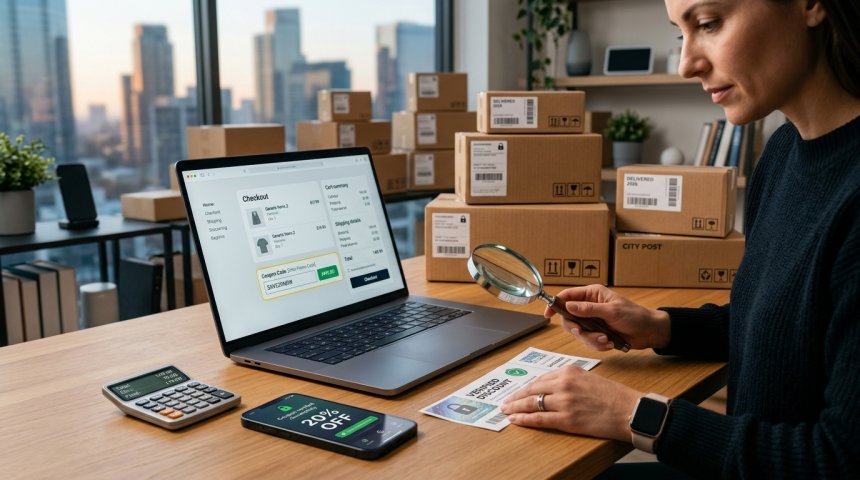
In the digital commerce landscape of 2026, a coupon code is not a guarantee. It is a claim.
That distinction might seem semantic, but it is the difference between a procurement team that saves thousands of dollars annually and one that wastes hours chasing expired codes, falls for misleading affiliate funnels, or worse—commits budget to a vendor that looks legitimate on a coupon aggregator but fails basic due diligence at checkout.
Every day, millions of business professionals, researchers, editors, and procurement specialists search for discount codes to reduce software subscriptions, bulk supply orders, research materials, conference registrations, or operational expenses. They land on coupon roundup pages that promise "Verified 2026 Codes," "Exclusive 30% Off," or "Working Today." The page looks current. The design is clean. The codes are formatted in easy-to-copy boxes. Everything signals legitimacy.
But then they paste the code at checkout. Nothing happens. Or worse—the code applies, but the final total is higher than expected because shipping wasn't included, the discount only applied to a single SKU, or a site-wide sale was already active and the code didn't stack.
This is the reality of modern promotional verification. Coupon pages are convenience tools, not contractual guarantees. They are marketing assets designed to drive traffic, capture affiliate commissions, and rank in search engines. They are not audited financial instruments. Treating them as such is a recipe for wasted time, budget miscalculations, and compromised vendor relationships.
This guide is not a list of coupon codes. It is a verification framework—a systematic, repeatable methodology for evaluating promotional claims, validating vendor credibility, calculating true checkout economics, and documenting your findings for procurement records or editorial publication. Whether you are a business owner approving a software purchase, a researcher procuring lab supplies, an editor writing a deals roundup, or a procurement manager negotiating enterprise contracts, this framework will help you separate legitimate savings from marketing noise.
Let's build your verification muscle.
The Psychology of the Coupon Claim: Why We Trust What We Shouldn't
Before we dive into the mechanics of verification, we need to understand why coupon claims are so persuasive—even when they're stale, misleading, or outright false. Understanding the psychology helps you recognize when you're being influenced rather than informed.
The Urgency Illusion
Coupon pages are engineered to create urgency. "Expires in 2 hours!" "Only 3 uses left!" "Flash sale ending tonight!" These triggers activate the fear of missing out (FOMO), which short-circuits rational evaluation. When you feel rushed, you skip the verification steps. You paste the code, see some discount applied, and assume you won.
But urgency is rarely real. Most coupon codes on aggregator sites are evergreen—they've been sitting there for months, auto-refreshed by bots that change the "last verified" date without actually testing the code. The countdown timer is a JavaScript animation, not a live inventory tracker. Recognizing this illusion is the first step toward disciplined verification.
The Authority Bias of Design
A well-designed coupon page feels authoritative. Clean typography, professional layout, brand logos, "verified" badges, user testimonials—it all signals trustworthiness. But design is not evidence. A scam site can look more polished than a legitimate vendor's actual checkout page. Visual polish is a marketing tactic, not a verification metric.
This is especially dangerous in B2B procurement, where decision-makers assume that professional presentation correlates with professional operations. It doesn't. Always separate aesthetic credibility from operational credibility.
The Anchoring Effect of Headline Discounts
"50% OFF!" screams the banner. Your brain anchors to that number. Even if the code only applies to a single accessory, requires a $500 minimum purchase, or excludes the exact product you need, the 50% anchor makes everything else feel like a compromise rather than a dealbreaker.
Smart verification ignores the headline and focuses on the effective discount rate—the actual percentage saved on your specific cart after all restrictions, shipping, taxes, and fees are applied. That number is almost always lower than the headline, and sometimes it's negative (meaning you'd pay more with the code than without it, due to lost stacking opportunities or inflated shipping).
The Social Proof Trap
"12,483 people used this code today!" Social proof is powerful. If thousands of people are using a code, it must work, right? Not necessarily. That number could be fabricated, aggregated across multiple unrelated codes, or counting bot traffic. Even if it's accurate, it doesn't tell you whether those people got the discount they expected, whether they returned the product, or whether they'd use the vendor again.
Social proof is a popularity metric, not a validity metric. Verify independently.
The Sunk Cost of Search
You've spent 20 minutes searching for a coupon. You've opened five tabs, compared three aggregator sites, and copied four different codes. At this point, you're invested. You want one of these codes to work, because the alternative is admitting you wasted 20 minutes. So you paste the code, see a small discount, and convince yourself it's good enough.
This is the sunk cost fallacy in action. The time you've already spent is gone regardless of what you do next. The only question that matters is: "Is this the best available option for my specific need right now?" If the answer is no, close the tabs and move on. Your future self will thank you.
The Verification Framework: A Step-by-Step Audit Protocol
Now that you understand the psychological traps, let's build the systematic verification protocol. This is not a mental checklist—it's a written audit. For recurring procurement or editorial research, document every step. Create a spreadsheet, a Notion database, or a simple Google Doc. Record the page reviewed, the date, the claim being evaluated, and the evidence that supports or contradicts it. Note missing information instead of filling gaps with assumptions.
Here is the complete framework.
Step 1: Treat Every Coupon as an Unverified Claim
The moment you land on a coupon page, adopt a default posture of skepticism. The code is not working until you prove it works on your specific cart, on the live vendor site, at the current moment, under the current terms.
This mindset shift is critical. Most people approach coupons with optimism: "I hope this works." Approach them with verification: "I will test whether this works, and I will document the result."
What to record at this stage:
- URL of the coupon page
- Date and time of review
- Name of the coupon aggregator or publisher
- Exact code(s) listed
- Claimed discount amount or percentage
- Any stated restrictions or exclusions
- Any "last verified" or "updated" dates displayed
Step 2: Decode the Exact Terms
A coupon code without clear terms is a liability. Before you even copy the code, extract every restriction, condition, and limitation published on the page. If the terms are vague, incomplete, or missing entirely, flag that as a risk factor.
Terms to extract and document:
Discount structure:
- Is it a percentage off (e.g., 20% off)?
- Is it a fixed amount off (e.g., $15 off)?
- Is it free shipping?
- Is it a buy-one-get-one offer?
- Does it stack with other promotions, or is it exclusive?
Eligibility restrictions:
- Does it apply to all products, or only selected SKUs?
- Are sale items excluded?
- Are subscription plans excluded?
- Are digital products excluded?
- Are international orders excluded?
Customer restrictions:
- Is it for new customers only?
- Is it for first-time subscribers only?
- Is it restricted to specific account tiers (e.g., VIP members only)?
- Is it limited to one use per customer?
- Is it restricted to specific geographic regions?
Purchase requirements:
- Is there a minimum order value (e.g., "$50 minimum purchase")?
- Is there a maximum discount cap (e.g., "20% off, up to $100")?
- Does it require purchasing specific quantities (e.g., "buy 3, get 1 free")?
Temporal restrictions:
- What is the expiration date and time?
- Is the expiration in your local timezone or the vendor's timezone?
- Is it a limited-quantity code (e.g., "first 100 redemptions only")?
Stacking rules:
- Can it be combined with site-wide sales?
- Can it be combined with loyalty points or store credit?
- Can it be combined with other coupon codes?
If any of these terms are not published, note the uncertainty explicitly. "Expiration date not stated" is a valid observation. "Eligible products not specified" is a valid observation. Do not assume the most generous interpretation. Assume the most restrictive interpretation until proven otherwise at checkout.
Red flags in terms:
- "Discount applied at checkout" with no further explanation
- "Valid on select items" without listing which items
- "Cannot be combined with other offers" when a site-wide sale is clearly active
- "Expires soon" with no specific date
- "While supplies last" on a digital product or service
Step 3: Confirm the Destination Domain and Security
Coupon roundups often link through redirects, affiliate tracking URLs, or cloaked links. Before you enter any payment information, verify that you've landed on the legitimate vendor domain.
Verification steps:
- Check the final URL in your browser address bar. After clicking the coupon link and allowing any redirects to complete, look at the domain. Does it match the expected vendor? If you clicked a link for "Acme Software" but landed on "acme-deals-discount-shop.net," you're not on the official site.
- Verify the HTTPS connection. Look for the padlock icon and "https://" in the address bar. Click the padlock to view the certificate details. The certificate should be issued to the vendor's legal entity or a recognized parent company. If the certificate is self-signed, expired, or issued to an unrelated entity, abort immediately.
- Look for consistent branding. Does the checkout page match the vendor's known visual identity? Logo, color scheme, typography, footer links—if anything looks off, trust your instincts. Phishing sites often get 90% of the design right but miss subtle details.
- Verify business contact information. Legitimate vendors publish a physical address, phone number, email address, and links to their privacy policy, terms of service, and refund policy. If the checkout page has no visible business identity, no contact information, and no legal policies, do not enter payment details.
- Check for affiliate disclosure. If the coupon page is an affiliate site, it should disclose that relationship clearly (e.g., "We may earn a commission when you use our links"). This doesn't invalidate the coupon, but it tells you that the page's incentives are aligned with driving clicks, not necessarily with providing the most accurate or current information.
Domain verification tools:
- WHOIS lookup to check domain registration date and registrant
- Google Safe Browsing transparency report
- VirusTotal URL scanner
- Browser extensions like Web of Trust (WOT) or Norton Safe Web
Step 4: Calculate the True Checkout Total
This is the most important step in the entire framework, and it's the one most people skip. The headline discount is irrelevant. The only number that matters is the complete final total after the coupon is applied, including product price, shipping, taxes, handling fees, insurance, and any other charges.
The calculation protocol:
- Add your intended items to the cart without applying any coupon. Record the subtotal, shipping cost, tax, and grand total. This is your baseline.
- Apply the coupon code. Record the new subtotal, shipping cost, tax, and grand total. Note exactly what changed—did the discount apply to the product price only? Did shipping remain the same? Did tax recalculate?
- Calculate the effective discount. Subtract the post-coupon grand total from the baseline grand total. Divide by the baseline grand total. That's your true savings percentage. Example: Baseline total = $120 ($100 product + $15 shipping + $5 tax). Post-coupon total = $105 ($80 product + $15 shipping + $10 tax). Effective savings = $15. Effective discount rate = 12.5%. The headline said "20% off," but your real savings are 12.5%.
- Compare against alternatives. Is there a different vendor with a lower baseline total? Is there a different coupon code that produces a better effective discount? Is there a site-wide sale that makes the coupon redundant or counterproductive? Sometimes applying a coupon code disables a better automatic discount. Test both scenarios.
- Factor in non-price costs. Does the vendor charge restocking fees on returns? Is shipping slow? Is customer support responsive? A slightly higher price from a more reliable vendor may be cheaper in total cost of ownership than a discounted price from a vendor that creates operational headaches.
Common checkout traps to watch for:
- Shipping inflation: The coupon reduces the product price, but shipping is mysteriously higher than the baseline. Some vendors bake their margin into shipping rather than product price, making percentage-off coupons less effective.
- Tax recalculation: In some jurisdictions, discounts reduce the taxable amount; in others, tax is calculated on the pre-discount price. Know your local rules.
- Forced add-ons: The coupon only works if you add a specific item to your cart, or if you opt into a subscription you don't want. Read the fine print.
- Lost stacking: Applying a coupon code disables an automatic site-wide sale, loyalty discount, or free shipping threshold. Always test the cart with and without the code.
- Minimum purchase manipulation: The code requires a $100 minimum, so you add a $20 filler item to qualify, but now you're spending more overall than you intended.
Step 5: Evaluate Update and Verification Dates
A useful coupon resource identifies when an offer was last checked. It should remove or label expired codes rather than leaving them in a list for search traffic. Verification dates are especially important when a vendor changes platforms, launches a site-wide promotion, or updates their pricing structure.
What to look for:
- "Last verified" or "last tested" timestamps. Reputable coupon sites manually or automatically test codes and display the date of the last successful test. If a code says "Verified March 2026" and it's now September 2026, treat it as stale until you test it yourself.
- Expiration date transparency. The page should clearly state when the code expires, not just say "limited time" or "ending soon."
- Removal of expired codes. A quality coupon resource actively purges expired codes or moves them to an "expired" section with clear labeling. A page cluttered with dozens of codes, most of which are dead, is optimizing for search traffic, not user value.
- Change logs or update notes. The best resources explain why a code was updated or removed. "Code expired per vendor confirmation on 8/15/2026" is more trustworthy than a silent disappearance.
Red flags in verification practices:
- Every code on the page shows "Verified Today" (likely automated, not manually tested)
- No verification dates at all
- Codes that have been listed for 6+ months with no updates
- Aggregator sites that never remove expired codes, just keep adding new ones on top
Step 6: Understand Affiliate Disclosures and Commercial Incentives
Coupon resources often receive a commission when visitors use tracked links. That relationship should be disclosed clearly, prominently, and honestly. The commission does not automatically invalidate the offer, but readers and procurement teams should know that placement and ordering may reflect a commercial incentive rather than an objective ranking of the best available deals.
What to look for in disclosures:
- Clear language. "We earn a commission when you purchase through our links" is clear. Buried in the footer in 8-point gray text is not.
- Proximity to the offer. The disclosure should be near the coupon code or link, not hidden on a separate page that requires three clicks to find.
- Explanation of impact. Does the commission affect which codes are featured? Are paid placements labeled as "sponsored" or "promoted"? Transparent resources explain their editorial process.
- No pressure tactics. Ethical affiliate sites present the information and let you decide. Aggressive sites use dark patterns—fake countdown timers, false scarcity claims, pop-ups that block content—to pressure you into clicking.
How affiliate incentives can bias coupon listings:
- Higher-commission codes may be ranked above better-value codes
- Expired codes from high-commission vendors may linger longer than they should
- Exclusive codes from paying partners may be labeled "verified" without rigorous testing
- Competitor codes may be downranked or omitted entirely
This doesn't mean affiliate sites are inherently bad. Many provide genuine value. But you need to calibrate your trust accordingly. An affiliate site's primary obligation is to its revenue model; your primary obligation is to your budget and procurement standards.
Step 7: Evaluate the Vendor Beyond the Discount
Savings do not compensate for unclear testing, weak support, missing policies, or questionable business practices. A coupon should be the final comparison factor, not the first credibility signal. Before you commit to a purchase—even a discounted one—evaluate the vendor independently.
Vendor evaluation checklist:
Business identity and legitimacy:
- Can you identify the legal business name, physical address, and registration details?
- Is the company registered in a jurisdiction with consumer protection laws?
- Can you find independent reviews on third-party platforms (Trustpilot, G2, Capterra, Better Business Bureau)?
- Does the company have a visible leadership team or at least a verifiable corporate presence?
Payment security:
- Does the checkout use a recognized payment processor (Stripe, PayPal, Square, etc.) or a secure direct integration?
- Is PCI DSS compliance stated or evident?
- Are there options for secure payment methods beyond raw credit card entry (e.g., PayPal, Apple Pay, Google Pay)?
Fulfillment and delivery expectations:
- Are shipping times clearly stated?
- Is there order tracking?
- What is the policy for lost, damaged, or delayed shipments?
- For digital products or services, how is access delivered and how quickly?
Refund and return policies:
- Is there a clear refund policy? What's the window? What are the conditions?
- Are restocking fees disclosed upfront?
- For subscriptions, how easy is it to cancel? Is there a proration policy?
- Are return shipping costs covered by the vendor or the customer?
Customer support accessibility:
- Can you reach support via email, chat, or phone?
- What are the stated response times?
- Are there publicly visible support tickets, forums, or knowledge bases?
- Test the support channel before purchasing—send a pre-sales question and measure the response quality and speed.
Research-use and compliance disclosures (for scientific, medical, or regulated products):
- If you're procuring research chemicals, lab supplies, or regulated materials, does the vendor publish clear research-use-only disclaimers?
- Are safety data sheets (SDS) available?
- Are certificates of analysis (CoA) provided?
- Does the vendor comply with relevant regulatory frameworks (FDA, EPA, REACH, etc.)?
Data privacy and security:
- Is there a published privacy policy?
- How is customer data stored, used, and shared?
- Is the vendor GDPR, CCPA, or other relevant privacy framework compliant?
- Can you request data deletion or export?
A vendor that fails these basic credibility checks is not worth your business, regardless of how attractive the coupon is. A 20% discount on a product from a vendor that disappears after taking your money is a 100% loss.
Step 8: Keep a Simple Verification Record
For recurring procurement research, editorial work, or ongoing vendor management, maintain a verification log. This creates a historical record that helps you identify vendors with stable terms, resources that routinely publish stale offers, and patterns in your own purchasing behavior.
What to record in your verification log:
|
Field
|
Example Entry
|
|---|---|
|
Date of review
|
2026-09-15
|
|
Coupon source URL
|
|
|
Vendor name
|
Acme Software Inc.
|
|
Code tested
|
SAVE20
|
|
Claimed discount
|
20% off annual plans
|
|
Stated restrictions
|
New customers only, excludes enterprise tier
|
|
Verification date on source
|
"Verified Sept 2026"
|
|
Destination domain checked
|
acmesoftware.com (HTTPS valid, cert matches)
|
|
Baseline cart total
|
$240/year
|
|
Post-coupon cart total
|
$192/year
|
|
Effective discount
|
20% ($48 saved)
|
|
Terms confirmed at checkout
|
Yes—new customer restriction enforced, annual plan only
|
|
Vendor credibility check
|
BBB A+ rating, 4.2/5 on G2 (340 reviews), clear refund policy
|
|
Affiliate disclosure present
|
Yes—"We earn a commission on qualifying purchases"
|
|
Final decision
|
Approved for procurement
|
|
Notes
|
Code worked as advertised; vendor responsive to pre-sales inquiry within 2 hours
|
This log serves multiple purposes:
- Procurement audit trail: Demonstrates due diligence for finance teams, auditors, or compliance officers
- Editorial documentation: Provides evidence for published deals roundups, with dates and verification methods
- Vendor performance tracking: Identifies which vendors honor their stated terms consistently and which ones bait-and-switch
- Personal efficiency: Saves time on future purchases by maintaining a library of pre-verified codes and trusted sources
Step 9: Apply the Framework as a Written Audit, Not a Mental Checklist
The difference between a mental checklist and a written audit is accountability. When you keep the verification process in your head, you skip steps, make assumptions, and forget details. When you write it down, you create a record that can be reviewed, shared, challenged, and improved.
How to structure the written audit:
- Header: Page reviewed, date, reviewer name, purpose of procurement
- Claim being evaluated: Exact code, claimed discount, stated terms
- Evidence gathered: Screenshots, URLs, checkout totals, vendor policies, third-party reviews
- Gaps identified: Missing information, unverified claims, ambiguous terms
- Analysis: Effective discount calculation, vendor credibility assessment, risk factors
- Conclusion: Approved, rejected, or pending further verification—with rationale
- Next steps: If approved, proceed to purchase. If rejected, document why and identify alternatives. If pending, specify what additional information is needed and who will obtain it.
This audit becomes part of your organizational knowledge base. When a colleague asks, "Did we already verify this vendor?" or "What was the effective discount we got last quarter?" you have a documented answer instead of a fuzzy memory.
Step 10: Final Assessment—Strengths, Limitations, and Narrow Conclusions
The final assessment should explain both strengths and limitations. A resource may be useful for organizing options while still requiring independent verification. A vendor may publish clear policies while leaving testing questions unanswered. Editorial credibility comes from showing those distinctions, not from forcing every subject into an all-good or all-bad verdict.
Example of a balanced assessment:
"The coupon aggregator at example-coupons.com provides a well-organized directory of Acme Software promotional codes, with clear formatting and apparent regular updates. However, our testing revealed that 3 of the 8 listed codes were expired, and the 'last verified' dates appear to be auto-generated rather than manually confirmed. The two codes we successfully tested produced the advertised discounts at checkout, and the destination domain was legitimate and secure. Acme Software itself has strong third-party reviews and transparent policies, making it a credible vendor. Recommendation: Use this aggregator as a starting point for code discovery, but independently verify each code at checkout before committing. Do not rely on the aggregator's verification timestamps as definitive."
This kind of nuanced assessment is far more valuable to readers and procurement teams than a blanket "All codes verified and working!" endorsement. It respects the audience's intelligence and equips them to make informed decisions.
Advanced Verification Techniques for High-Stakes Procurement
For routine consumer purchases, the basic framework above is sufficient. But for high-stakes B2B procurement, enterprise software licensing, bulk research supply orders, or any purchase where the dollar amount or operational risk is significant, you need advanced verification techniques.
Technique 1: Direct Vendor Confirmation
Don't rely solely on the coupon aggregator. Contact the vendor directly—via email, live chat, or phone—and ask:
- "Is the code [CODE] currently active?"
- "What are the exact terms and restrictions?"
- "Does it stack with our existing contract pricing or volume discounts?"
- "Is there a better available promotion for our specific use case?"
Vendors often have unpublished promotions, negotiated rates, or loyalty discounts that outperform public coupon codes. A two-minute chat with a sales rep can save you more than an hour of aggregator browsing.
Technique 2: Cart Abandonment Testing
Some vendors trigger special discount offers when you abandon your cart. Add your items to the cart, proceed to checkout, enter your email, and then leave the page without completing the purchase. Wait 24-48 hours. Many vendors will send a follow-up email with a personalized discount code to recover the sale.
This technique is ethically gray if overused, but for a one-time high-value purchase, it's a legitimate way to discover whether the vendor has additional margin flexibility. Document the result in your verification log.
Technique 3: Price Tracking and Historical Analysis
Use price tracking tools (CamelCamelCamel for Amazon, Keepa, PriceSpy, or browser extensions like Honey or Capital One Shopping) to determine whether the "discounted" price is actually a discount. Some vendors inflate their baseline price before applying a coupon, making the "sale" price identical to the normal price.
Historical price data reveals:
- Whether the current price is genuinely low or artificially inflated
- Whether the vendor runs constant "sales" that make the coupon meaningless
- Whether waiting for a seasonal sale would produce better savings than using the current coupon
Technique 4: Multi-Code Stacking Tests
Some vendors allow multiple promotional mechanisms to stack—a coupon code plus a loyalty discount plus a referral credit plus a site-wide sale. Others force you to choose one. Systematically test combinations:
- Baseline (no discounts)
- Coupon code only
- Loyalty discount only
- Site-wide sale only
- Coupon + loyalty
- Coupon + site-wide sale
- All applicable discounts combined
Record the grand total for each scenario. The optimal combination is not always obvious—sometimes applying a coupon disables a better automatic discount.
Technique 5: Competitor Benchmarking
Before committing to a discounted purchase, benchmark the final effective price against 2-3 competitors offering equivalent products or services. A 20% discount from Vendor A might still be more expensive than Vendor B's standard price. Don't let the coupon blind you to better baseline economics elsewhere.
Benchmarking template:
|
Vendor
|
Baseline Price
|
Best Available Discount
|
Effective Price
|
Shipping
|
Total
|
Support Rating
|
Refund Policy
|
|---|---|---|---|---|---|---|---|
|
Vendor A
|
$240
|
20% off (SAVE20)
|
$192
|
$15
|
$207
|
4.2/5
|
30-day full refund
|
|
Vendor B
|
$199
|
10% off (WELCOME10)
|
$179
|
Free
|
$179
|
4.5/5
|
60-day full refund
|
|
Vendor C
|
$220
|
None available
|
$220
|
$10
|
$230
|
3.8/5
|
14-day, 15% restocking fee
|
In this example, Vendor B wins on total price, support rating, and refund policy—even though Vendor A has the bigger headline discount.
Technique 6: Subscription vs. One-Time Purchase Analysis
Many software and service vendors offer steeper discounts for annual subscriptions than monthly billing, and coupon codes may apply differently to each. Calculate the total cost of ownership over your expected usage period:
- Monthly billing with coupon: $20/month × 12 months = $240/year
- Annual billing with coupon: $180/year (paid upfront)
- Annual billing without coupon: $200/year
If you're confident you'll use the service for a full year, the annual option saves $60. But if you might cancel after 3 months, monthly billing limits your exposure to $60 instead of $180. Factor in cancellation risk, cash flow preferences, and the vendor's proration policy.
Editorial Integrity: Publishing Coupon Information Responsibly
If you're writing a deals roundup, a procurement guide, or any editorial content that references coupon codes, you have a responsibility to your readers that goes beyond simply aggregating codes. Editorial credibility in the coupon space is rare and valuable. Here's how to maintain it.
Principle 1: Verify Before You Publish
Never publish a coupon code you haven't personally tested at checkout on the live vendor site. "Verified" means you tested it, not that the aggregator you sourced it from claims to have tested it. If you can't test every code, clearly label untested codes as "unverified" or "reported by users."
Principle 2: Date-Stamp Everything
Every code, every price, every vendor policy reference should include the date you verified it. "SAVE20 — 20% off annual plans — Verified September 15, 2026." This tells readers how fresh the information is and sets appropriate expectations.
Principle 3: Disclose Affiliate Relationships Prominently
If you earn commissions from tracked links, disclose it clearly, prominently, and early in the article. Don't bury it in the footer. Explain how the relationship works and whether it influences which codes you feature or how you rank them. Transparency builds trust; hidden incentives destroy it.
Principle 4: Remove or Label Expired Codes
When a code expires, don't just leave it in the article for search traffic. Either remove it entirely, move it to an "Expired Offers" section with clear labeling, or update the article with a note explaining that the code is no longer active. Stale codes erode reader trust and damage your credibility.
Principle 5: Preserve Educational Framing
The most valuable coupon content doesn't just list codes—it teaches readers how to evaluate offers themselves. Include your verification framework, explain common traps, and empower readers to make informed decisions even if they don't use any of the specific codes you mention. An article that remains useful even after all its codes expire is far more valuable than one that becomes worthless the moment a promotion ends.
Principle 6: Avoid Human-Use Instructions for Regulated Products
If you're writing about research chemicals, lab supplies, supplements, or any regulated product, avoid publishing instructions that could be interpreted as encouraging unsafe or non-compliant use. Stick to procurement verification, vendor evaluation, and documentation standards. Leave usage guidance to the vendor's official documentation and relevant regulatory bodies.
Principle 7: Keep Citations Connected to Exact Editorial Points
When you cite a coupon resource, vendor page, or third-party review, connect it to the specific claim it supports. Don't dump a list of links at the bottom and hope readers figure out which one validates which point. Inline citations with clear context are more useful and more credible.
Principle 8: Do a Final Live Check Before Publishing
Before you hit publish, repeat the most important checks on the live destination. Save the date of review and remove claims that cannot be confirmed. This last pass prevents a well-structured article from preserving outdated prices, expired terms, old certificates, or disclosures that no longer match the current page.
Principle 9: Keep Screenshots Only When They Support Specific Factual Points
Screenshots can be useful evidence—a checkout total showing the effective discount, a vendor's refund policy page, a third-party review summary. But don't treat visual polish as evidence. A screenshot of a pretty coupon page proves nothing about whether the code works. Only capture screenshots that directly support a specific factual claim in your article.
Principle 10: Make the Narrowest Conclusion the Evidence Supports
The strongest conclusion is usually the narrowest one that the available documentation can support. Don't overstate what a directory, vendor page, label, or promotion can establish. "This code produced a 20% discount on our test cart on September 15, 2026" is stronger and more credible than "This is the best Acme Software deal available in 2026." Discipline keeps the article useful to readers without overstating what the evidence can bear.
Building an Organizational Coupon Verification Process
For businesses that regularly procure software, supplies, services, or materials, coupon verification shouldn't be an ad-hoc activity performed by whoever happens to be making the purchase. It should be a standardized organizational process.
Step 1: Designate a Procurement Owner
Assign a specific person or team responsibility for coupon verification and vendor evaluation. This could be a procurement manager, an office manager, a finance team member, or a dedicated operations role. The key is accountability—someone owns the process and the verification log.
Step 2: Create a Standard Operating Procedure (SOP)
Document the verification framework as a formal SOP. Include:
- When verification is required (e.g., all purchases over $100, all new vendor relationships, all software subscriptions)
- Which steps are mandatory vs. optional based on purchase value and risk
- Where to record verification results (shared spreadsheet, procurement software, ERP system)
- Who approves purchases based on verification results
- How often to re-verify recurring vendors and subscriptions
Step 3: Integrate with Existing Procurement Workflows
Coupon verification shouldn't be a separate, disconnected activity. Integrate it into your existing purchase request, approval, and payment workflows. If you use procurement software (Coupa, SAP Ariba, Procurify, etc.), add verification fields to the purchase request form. If you use a simpler approval process (Google Forms, Slack approvals, email chains), embed the verification checklist into the request template.
Step 4: Train the Team
Everyone who makes purchases on behalf of the organization should understand the verification framework. Conduct a brief training session, create a one-page quick reference guide, and make the full SOP easily accessible. Emphasize that this isn't bureaucracy—it's protecting the organization's budget and reputation.
Step 5: Review and Optimize Quarterly
Every quarter, review the verification log and procurement data:
- How much did we save through verified coupons vs. baseline pricing?
- Which vendors consistently honored their stated terms?
- Which coupon sources provided the most reliable information?
- Were there any failed purchases, expired codes, or vendor issues that could have been prevented with better verification?
- Can we negotiate better direct pricing with vendors we purchase from frequently, eliminating the need for coupon hunting altogether?
Use these insights to refine the SOP, update the preferred vendor list, and improve the team's verification skills.
The Economics of Coupon Verification: Is It Worth the Time?
A common objection to rigorous coupon verification is that it takes too much time relative to the savings. "I spent 30 minutes verifying a code that saved me $12. My time is worth more than that."
This objection is valid for small, one-off consumer purchases. But it breaks down in several important scenarios:
Scenario 1: Recurring Purchases
If you're verifying a coupon for a software subscription you'll pay for monthly or annually, the time investment amortizes over many billing cycles. Spending 30 minutes to save $20/month on a 12-month subscription is a $240 return on 30 minutes of work—an effective hourly rate of $480. That's excellent ROI.
Scenario 2: High-Value Purchases
For enterprise software, bulk supply orders, or any purchase over $1,000, even a small percentage discount represents significant absolute savings. Spending an hour to save $200 on a $2,000 purchase is a $200/hour return. Most knowledge workers would take that trade.
Scenario 3: Organizational Scale
When you multiply the verification process across an entire organization—dozens or hundreds of purchases per month—the cumulative savings justify dedicating staff time to the process. A procurement team that saves 5% on $100,000/month in operational spend is generating $5,000/month in value. That's a $60,000/year contribution from a process that might take 10-20 hours/month of staff time.
Scenario 4: Risk Mitigation
The value of verification isn't just in the discount—it's in avoiding bad purchases. Spending 30 minutes to discover that a vendor has terrible reviews, no refund policy, or questionable business practices prevents a much larger loss than the coupon would have saved. Risk mitigation has real economic value, even if it's harder to quantify.
Scenario 5: Skill Development
The verification framework is a transferable skill. The same critical thinking, documentation discipline, and vendor evaluation techniques apply to negotiating contracts, evaluating service providers, assessing partnership opportunities, and making any business decision where claims need to be validated against evidence. The time invested in learning the framework pays dividends far beyond coupon savings.
Common Coupon Scams and How to Spot Them
The coupon ecosystem attracts bad actors. Here are the most common scams and how to protect yourself.
Scam 1: The Fake Checkout Page
You click a coupon link, land on a page that looks exactly like the vendor's checkout, enter your payment information, and... nothing happens. Or you get a generic error message. Meanwhile, your credit card details have been harvested.
How to spot it:
- URL doesn't match the vendor's official domain
- HTTPS certificate is invalid or issued to an unrelated entity
- Page lacks the vendor's standard navigation, footer, or branding elements
- Payment form looks slightly different from the vendor's known checkout
- No order confirmation email arrives after "purchase"
Protection: Always navigate to the vendor's site directly (type the URL yourself or use a bookmark) and apply the coupon code manually at checkout. Don't click through coupon links for payment entry.
Scam 2: The Infinite Redirect Loop
You click a coupon link and get bounced through 5-10 redirect URLs, each one adding tracking parameters, before finally landing on a page that has nothing to do with the original vendor. Along the way, your browsing data is captured, sold, or used to build a profile for targeted advertising.
How to spot it:
- URL changes multiple times rapidly after clicking
- Final destination is unrelated to the expected vendor
- Browser slows down or behaves oddly during redirects
- Multiple tracking domains appear in the URL chain
Protection: Use browser extensions that block trackers and reveal redirect chains. Hover over links before clicking to preview the destination URL. Use a dedicated browser profile for coupon research to isolate tracking from your primary browsing.
Scam 3: The Phantom Discount
The coupon code appears to work—it shows a discount applied at checkout—but the baseline price was artificially inflated to make the "discount" meaningless. You end up paying the same or more than the normal price.
How to spot it:
- Use price tracking tools to verify historical pricing
- Compare the post-coupon price against the vendor's stated MSRP or regular price
- Check if the vendor runs constant "sales" that make every price a "discount"
- Benchmark against competitor pricing for equivalent products
Protection: Never assume a discount is real just because the checkout says so. Verify against independent price data.
Scam 4: The Subscription Trap
The coupon code applies a steep discount to the first month or first order, but silently enrolls you in a recurring subscription at full price. Canceling requires navigating a deliberately confusing cancellation process, calling a phone number during limited hours, or mailing a physical letter.
How to spot it:
- Fine print mentions "automatic renewal" or "subscription" in small text
- Checkout defaults to a subscription option that's easy to miss
- Cancellation policy is buried, vague, or requires unusual steps
- Vendor has a pattern of negative reviews mentioning difficulty canceling
Protection: Read the full terms before entering payment information. Look for explicit statements about whether the purchase is one-time or recurring. Test the cancellation process before committing if the purchase is significant.
Scam 5: The Data Harvesting "Coupon"
The coupon requires you to create an account, complete a detailed profile, answer a survey, or provide extensive personal information before the code is revealed. The "coupon" is the bait; your data is the product.
How to spot it:
- Excessive information requests beyond what's needed for the transaction
- Mandatory survey or quiz before code reveal
- Account creation required for a simple discount
- Privacy policy is missing, vague, or permits broad data sharing
Protection: Ask whether the information requested is proportional to the discount offered. If a 10% coupon requires your phone number, birthday, employer, and income bracket, the data is worth more than the discount. Walk away.
The Future of Coupon Verification in an AI-Driven Commerce Landscape
As we move deeper into 2026 and beyond, the coupon verification landscape is evolving rapidly. Artificial intelligence, dynamic pricing, personalized promotions, and blockchain-based loyalty systems are changing how discounts are created, distributed, and validated.
AI-Generated Coupon Codes
Vendors are increasingly using AI to generate personalized, single-use coupon codes tailored to individual customer behavior, purchase history, and predicted lifetime value. This means the era of universal, publicly shared coupon codes is fading. The code your friend used may not work for you, and the code on an aggregator site may be a leftover from a personalized campaign that's already been redeemed.
Verification implication: Personalized codes require direct vendor communication or account-specific dashboards to verify. Aggregator sites become less useful as promotions become more individualized.
Dynamic Pricing and Real-Time Discounts
AI-powered dynamic pricing adjusts product prices in real time based on demand, inventory, competitor pricing, and customer segmentation. A "coupon" may not be a discrete code at all—it may be a dynamically applied discount that appears only for specific customers at specific moments.
Verification implication: Static coupon verification becomes less relevant. Instead, focus on understanding the vendor's pricing algorithm, monitoring price trends, and determining whether the current price is genuinely favorable relative to historical and competitive benchmarks.
Blockchain and Smart Contract Loyalty Programs
Some vendors are experimenting with blockchain-based loyalty programs where rewards, points, and discounts are managed through smart contracts. These systems promise greater transparency and portability but introduce new verification complexities.
Verification implication: Learn to read smart contract terms, verify wallet addresses, and understand the immutable nature of blockchain transactions. Once a blockchain-based reward is redeemed or expired, it cannot be reversed or disputed through traditional customer service channels.
Voice and Conversational Commerce
As voice assistants and conversational AI become more prevalent in commerce, coupon discovery and application may shift to voice interfaces. "Hey, apply the best available discount to my cart" becomes a natural language command rather than a manual code entry.
Verification implication: Voice-based discounts require new verification methods—confirming the applied discount through order summaries, checking account dashboards, and maintaining written records of voice transactions for audit purposes.
Regulatory Pressure on Coupon Transparency
Consumer protection regulators worldwide are increasing scrutiny of deceptive coupon practices—fake urgency, misleading discount claims, hidden restrictions, and dark patterns. Expect stricter disclosure requirements, standardized coupon terminology, and penalties for vendors and aggregators that mislead consumers.
Verification implication: Regulatory changes will make some verification steps easier (mandated disclosures, standardized terms) but may also create new complexity as vendors adapt their promotional strategies to comply with evolving rules. Stay informed about consumer protection regulations in your jurisdiction.
Frequently Asked Questions (FAQs)
How can I tell if a coupon code is actually working or if the discount was already applied?
Add your items to the cart and note the total before entering any code. Then apply the code and note the new total. If the total doesn't change, either the code is expired, the code doesn't apply to your specific items, or a site-wide sale is already active and the code doesn't stack. Some checkout interfaces show a message like "A better discount is already applied"—pay attention to those messages. Always compare the before-and-after totals rather than relying on a "Code Applied" confirmation message, which can appear even when the effective discount is zero.
What should I do if a coupon code works but the final price is higher than expected?
First, check whether shipping, taxes, or fees increased when the code was applied. Some vendors adjust shipping costs based on the discounted product price, or recalculate taxes in ways that partially offset the discount. Second, verify that the code didn't disable a better automatic promotion—remove the code and see if the total drops. Third, compare the effective total against the vendor's baseline price and against competitor pricing. If the "discounted" price is still higher than alternatives, the code isn't actually saving you money. Document the discrepancy and consider abandoning the purchase or contacting the vendor for clarification.
Are coupon aggregator sites reliable, or should I go directly to the vendor?
Coupon aggregator sites can be useful starting points for discovering available codes, but they should never be your sole source of truth. Aggregators optimize for traffic and affiliate commissions, not necessarily for accuracy or freshness. Always verify codes directly on the vendor's live checkout page before committing. For high-value or recurring purchases, contact the vendor directly to confirm current promotions—vendors often have unpublished discounts, negotiated rates, or loyalty pricing that outperform public coupon codes.
How do I handle coupon verification for enterprise or B2B purchases?
Enterprise procurement requires a more rigorous verification process. Contact the vendor's sales team directly to negotiate pricing rather than relying on public coupon codes. Request a formal quote that documents all discounts, terms, and conditions. Verify that the quoted pricing aligns with your existing master service agreement or volume pricing tier. Document the verification in your procurement system with approver sign-off. For enterprise software, ask whether the coupon or promotional pricing affects renewal terms—some vendors offer steep first-year discounts but lock in higher renewal rates.
What's the best way to track and organize verified coupon codes for my business?
Create a shared spreadsheet or database with columns for: vendor name, code, claimed discount, verified date, expiration date, restrictions, effective discount at checkout, source URL, and notes. Update the log quarterly to remove expired codes and refresh verification dates. For larger organizations, integrate coupon verification into your procurement software or ERP system so that verified codes are available to all authorized purchasers. Assign a procurement owner to maintain the log and ensure consistency.
Can I use multiple coupon codes on a single order?
It depends entirely on the vendor's policy. Some vendors allow stacking (e.g., a percentage-off code plus a free shipping code plus a loyalty discount). Others force you to choose the single best available discount. The only way to know is to test systematically: try each code individually, then try combinations, and record the grand total for each scenario. Always check the vendor's stated stacking policy in their terms of service or FAQ, but verify empirically at checkout since stated policies don't always match actual system behavior.
How do I verify coupons for subscription services without getting locked into a long-term commitment?
Before applying a coupon to a subscription, confirm: (1) whether the discount applies to the first billing cycle only or to all future cycles, (2) what the full price will be after the discount expires, (3) how easy it is to cancel (look for one-click cancellation, no phone calls required, no retention gauntlets), (4) whether there's a proration policy if you cancel mid-cycle, and (5) whether the coupon locks you into a longer commitment than the standard billing cycle. Set a calendar reminder to review the subscription before the discount expires so you can make an informed keep-or-cancel decision at full price.
What legal protections do I have if a coupon doesn't work as advertised?
Consumer protection laws vary by jurisdiction, but in general, if a vendor or aggregator advertises a specific discount with specific terms and those terms are not honored at checkout, you may have grounds for a complaint. In the US, the Federal Trade Commission (FTC) prohibits deceptive advertising, and many states have additional consumer protection statutes. In the EU, the Unfair Commercial Practices Directive provides similar protections. Document everything—screenshots of the advertised offer, the checkout result, and any communication with the vendor. File complaints with relevant consumer protection agencies if the vendor refuses to honor a clearly advertised offer. For small purchases, the cost of pursuing legal action usually exceeds the potential recovery, but reporting deceptive practices helps protect other consumers.
How often should I re-verify coupon codes for recurring purchases?
For recurring subscriptions or regular supply orders, re-verify at least quarterly. Vendors change their promotional strategies, expire old codes, launch new campaigns, and adjust pricing structures throughout the year. A code that worked in January may be dead by April. Additionally, your own purchasing volume or contract terms may have changed, making you eligible for different pricing tiers or negotiated rates that outperform public coupons. Build quarterly verification into your procurement calendar.
Is it ethical to use coupon verification techniques like cart abandonment to trigger discounts?
Cart abandonment testing occupies an ethical gray area. On one hand, you're simply responding to a vendor's own automated marketing system—they built the abandonment email sequence specifically to recover sales, and you're participating in that system as intended. On the other hand, deliberately abandoning carts you never intended to complete manipulates the vendor's marketing automation and could be considered gaming the system. For one-time high-value purchases, occasional abandonment testing is generally acceptable. For repeated, systematic exploitation of abandonment triggers across many vendors, the practice becomes ethically questionable and may violate the vendor's terms of service. Use judgment, and when in doubt, contact the vendor directly and ask for their best available price.
Conclusion: Verification Is a Discipline, Not a Task
Coupon verification is not a chore to endure on the way to savings. It is a discipline—a systematic, repeatable practice that protects your budget, your time, your data, and your organizational integrity.
Every coupon code is a claim. Every coupon page is a marketing asset. Every vendor is a counterparty that deserves independent evaluation. The moment you internalize these truths, you stop being a passive recipient of promotional noise and start being an active, informed procurer of value.
The framework in this guide is not complicated. It doesn't require specialized tools, advanced degrees, or hours of training. It requires attention, documentation, and the willingness to treat every promotional claim with the healthy skepticism it deserves.
Treat coupon pages as convenience tools, not guarantees. Confirm the final destination. Read the restrictions. Calculate the complete checkout total. Evaluate the vendor independently. Document your findings. And remember that the best offer is not the one with the biggest headline discount—it's the one that is current, transparent, and attached to a vendor that meets your documentation, policy, and credibility requirements.
That's how you turn coupon hunting from a gamble into a strategy. That's how you build procurement processes that scale. That's how you maintain editorial integrity in a space crowded with hype and stale claims.
The codes will change. The vendors will evolve. The platforms will shift. But the discipline of verification—the habit of treating every claim as something to be tested, documented, and confirmed—that's permanent. And it's the single most valuable skill you can bring to any commercial decision in the digital economy.
Now go verify something.
Share
What's Your Reaction?
 Like
0
Like
0
 Dislike
0
Dislike
0
 Love
0
Love
0
 Funny
0
Funny
0
 Angry
0
Angry
0
 Sad
0
Sad
0
 Wow
0
Wow
0