Tiny Home Appliance Repairs: A Business Troubleshooting Guide
Explore tiny home appliance troubleshooting for businesses, covering fridge cooling, dishwasher drainage, parts sourcing, service models, and market opportunities.

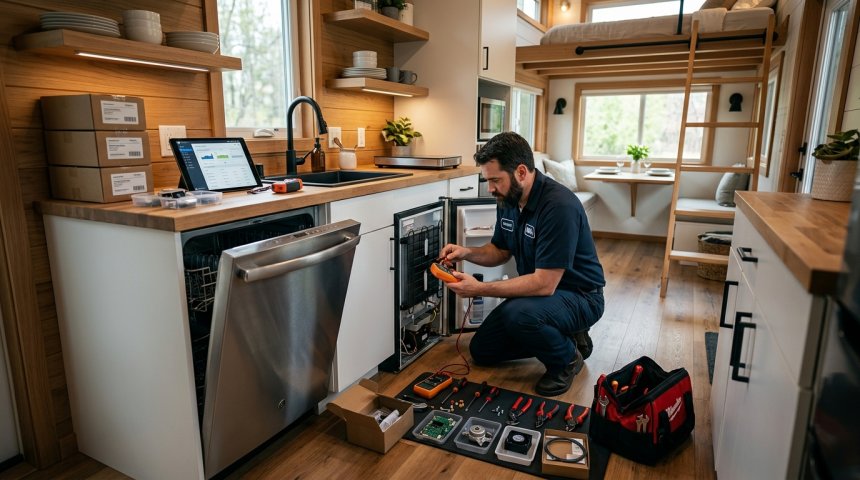
The tiny home movement has matured from novelty to legitimate housing alternative, but the infrastructure supporting it hasn't kept pace. Traditional appliance service networks assume standard residential addresses, conventional home layouts, and readily available replacement parts. Tiny homes—whether on wheels, on remote rural land, or in off-grid communities—defy these assumptions at every turn. The refrigerator that fails in a 200-square-foot dwelling three hours from the nearest service center isn't just an inconvenience; it's a potential food safety crisis, a warranty claim complication, a customer satisfaction emergency, or a rental property revenue loss depending on who owns it and how it's used.
For businesses operating in the tiny home ecosystem—builders, manufacturers, retailers, property managers, service providers, and parts suppliers—appliance troubleshooting represents both significant challenge and substantial opportunity. Challenge because conventional service models fail in this context; opportunity because solving these failures creates defensible competitive advantages, recurring revenue streams, and customer loyalty that generic appliance retailers cannot replicate. Understanding tiny home appliance troubleshooting from a business perspective means recognizing that technical problems are inseparable from operational, logistical, and relational dimensions unique to this market segment.
This guide examines tiny home appliance troubleshooting through a business lens, addressing the two most common failure modes (refrigerator cooling failures and dishwasher drainage issues), dissecting the parts procurement challenges specific to remote and non-standard installations, exploring service delivery models adapted to geographic and spatial constraints, analyzing warranty and liability considerations for manufacturers and builders, identifying revenue opportunities in aftermarket support, and providing frameworks for building sustainable competitive advantage in this underserved niche. Whether you're a tiny home builder designing for serviceability, a retailer stocking appropriate inventory, a service provider developing mobile capabilities, or a property manager maintaining rental units, this deep dive delivers the strategic understanding needed to turn appliance troubleshooting from cost center into value proposition.
Let's begin by understanding why tiny home appliances fail differently—and why that difference matters commercially.
Chapter 1: The Tiny Home Appliance Ecosystem — Why Standard Models Fail
Tiny home appliances operate under conditions fundamentally different from standard residential units. Understanding these differences informs product selection, installation practices, service protocols, and inventory strategies.
Environmental Stress Factors
Vibration and Movement: Tiny homes on wheels experience constant vibration during transit and settling shifts when parked. Vibration loosens electrical connections, damages compressor mounts, cracks solder joints, misaligns door seals, and fatigues drain hoses. Appliances designed for stationary installation lack vibration dampening adequate for mobile applications. Builders selecting appliances without considering transport stresses create premature failure patterns generating warranty claims and customer dissatisfaction.
Temperature Extremes: Tiny homes have less thermal mass than conventional structures, making interior temperatures more susceptible to external extremes. Refrigerators in uninsulated walls or exposed cabinetry face ambient temperatures exceeding design specifications during summer heat waves. Freezing temperatures in winter can crack water lines, damage valves, and compromise electronic controls. Appliances rated for climate-controlled environments fail prematurely in tiny homes lacking adequate HVAC capacity or insulation. Product selection must account for actual operating environment, not laboratory test conditions.
Power Quality Variations: Off-grid tiny homes relying on solar, battery, or generator power experience voltage fluctuations, frequency variations, and harmonic distortion absent from grid-connected homes. Sensitive electronic controls in modern appliances malfunction under poor power quality. Compressor motors draw excessive current during low-voltage conditions accelerating wear. Inverter-generated power may contain harmonics damaging control boards. Power conditioning equipment adds cost but prevents costly appliance failures. Builders and electricians must specify power quality requirements matching appliance tolerances.
Humidity and Condensation: Compact spaces with limited ventilation accumulate humidity from cooking, bathing, and breathing. Condensation forms on cold surfaces including refrigerator cabinets, dishwasher interiors, and electrical components. Moisture accelerates corrosion, promotes mold growth, and causes electrical shorts. Appliances installed without adequate clearance or vapor barriers suffer moisture-related failures. Installation standards must address tiny home humidity dynamics rather than assuming conventional ventilation adequacy.
Spatial and Access Constraints
Installation Clearances: Manufacturer-specified service clearances often exceed available space in tiny homes. Refrigerators installed flush against walls without rear airflow clearance overheat and fail prematurely. Dishwashers tucked under counters without accessible drain connections become unserviceable without major disassembly. Builders prioritizing space efficiency over serviceability create long-term maintenance nightmares. Design phase decisions determine lifetime service costs; cheaping out on clearance creates expensive callbacks.
Component Accessibility: Standard appliances assume technician access from multiple angles. Tiny home installations frequently block access panels, compress hose routing, or orient controls toward inaccessible walls. Simple repairs requiring five minutes in conventional installations demand hours of disassembly in tiny homes. Labor costs escalate; customer frustration mounts. Pre-installation planning should map service access points verifying adequate clearance before finalizing appliance placement.
Weight and Balance Considerations: Tiny homes on wheels have strict weight distribution requirements affecting towing safety and structural integrity. Heavy appliances positioned improperly create balance issues requiring repositioning after initial installation. Repositioning damages flooring, cabinetry, and utility connections creating secondary repair needs. Weight-conscious appliance selection and strategic placement during design phase prevent costly corrections.
Usage Pattern Differences
Intermittent Operation: Vacation rentals and seasonal tiny homes experience appliances sitting idle for extended periods followed by intensive use. Seals dry out, lubricants congeal, and electronic components degrade during dormancy then fail under load. Intermittent usage patterns differ from continuous residential operation assumed by manufacturer testing. Maintenance schedules should reflect actual usage patterns rather than calendar-based intervals.
Higher Cycle Frequency: Compact appliances in tiny homes run more frequently per unit volume than full-size equivalents serving similar loads. Small refrigerators cycle more often maintaining temperature with less thermal mass. Compact dishwashers run daily for households that would run full-size units every other day. Higher cycle counts accelerate component wear reducing effective lifespan. Warranty terms and replacement part inventory should reflect accelerated wear expectations.
Multi-Purpose Spaces: Kitchen areas in tiny homes serve cooking, dining, workspace, and storage functions simultaneously. Appliances experience higher ambient temperatures from adjacent cooking, greater physical contact from multi-use traffic, and increased contamination risk from non-kitchen activities. Durability requirements exceed standard residential specifications. Product selection should prioritize commercial-grade or heavy-duty residential models despite higher upfront cost.
Business Implications of Ecosystem Differences
Understanding these differences enables proactive business strategies:
Product Selection Criteria: Specify appliances tested or rated for mobile/RV/off-grid applications rather than assuming standard residential suitability. Document selection rationale supporting warranty defense and customer education.
Installation Standards Development: Create proprietary installation protocols addressing tiny home-specific requirements exceeding manufacturer minimums. Train installers on protocols; audit compliance. Superior installation reduces callback rates and builds reputation.
Preventive Maintenance Programs: Design maintenance schedules reflecting actual operating conditions and usage patterns. Offer maintenance contracts as recurring revenue stream while reducing emergency service calls. Educate customers on maintenance importance improving satisfaction and reducing blame attribution.
Inventory Strategy Alignment: Stock parts matching actual failure patterns in tiny home applications rather than generic residential averages. Analyze warranty claim data identifying high-failure components; maintain deeper inventory for those items. Reduce stockouts improving service speed and customer satisfaction.
Customer Education Investment: Proactively educate customers on proper operation, maintenance, and early warning signs. Educated customers prevent failures, report issues earlier enabling simpler repairs, and attribute problems appropriately rather than blaming products or builders. Education reduces support costs while increasing trust.
Key Insight: For authoritative guidance on appliance installation, maintenance, and safety standards specific to mobile and compact dwellings, the RV Industry Association Service & Maintenance Standards (dofollow) provides industry-recognized benchmarks applicable to tiny homes on wheels and park models, informing compliant installation practices and warranty-supportable service procedures.
Chapter 2: Refrigerator Cooling Failures — Diagnosis, Resolution, and Business Impact
Refrigerator failures represent the highest-stakes appliance issue in tiny homes due to food safety implications, replacement difficulty, and customer urgency. Systematic diagnosis minimizes downtime and cost.
Common Failure Modes in Tiny Home Context
Compressor Failures: Vibration damage during transport, inadequate ventilation causing overheating, power quality issues stressing motor windings, and manufacturing defects all contribute to compressor failures. Compressors are expensive, labor-intensive replacements often totaling $400-$800 including parts and labor. In remote locations, compressor replacement may require specialized technicians unavailable locally extending downtime days or weeks. Business impact includes warranty expense, customer accommodation costs (food replacement, temporary housing), and reputational damage.
Condenser Coil Issues: Dust accumulation in tight spaces, pet hair ingestion in multi-use environments, and inadequate airflow from improper installation reduce heat rejection efficiency. Coils clogged or blocked cause compressors to overwork, overheat, and fail prematurely. Condenser cleaning is simple preventive maintenance frequently neglected in tiny homes due to access difficulty. Businesses offering scheduled condenser cleaning services prevent costly compressor replacements while generating recurring revenue.
Evaporator Fan Motor Failures: Fan motors circulate cold air throughout refrigerator compartments. Motors fail from bearing wear, ice buildup obstruction, electrical connection vibration damage, or control board failures. Symptoms include warm fresh food section with cold freezer, unusual noises, or complete cooling loss. Fan motor replacement is moderate-cost repair ($100-$250) but requires diagnostic accuracy distinguishing fan failure from thermostat, defrost system, or sealed system problems. Misdiagnosis wastes time, parts, and customer patience.
Defrost System Malfunctions: Frost buildup on evaporator coils blocks airflow eliminating cooling. Defrost heaters, thermostats, timers, or control boards fail preventing automatic defrost cycles. Ice accumulation symptoms develop gradually allowing intervention before complete failure if customers recognize warning signs. Customer education on frost monitoring enables early detection reducing repair complexity and cost. Businesses providing defrost system inspection during routine maintenance catch failures before customer-impacting breakdowns.
Door Seal Degradation: Vibration, UV exposure, temperature cycling, and physical wear compromise door gaskets allowing warm air infiltration. Compromised seals force compressors to run continuously increasing energy consumption and accelerating wear. Seal replacement is inexpensive ($30-$80 parts) but labor varies dramatically based on accessibility. Poorly installed seals leak immediately creating repeat service calls. Quality seal installation training reduces callbacks and improves customer satisfaction.
Thermostat and Control Board Failures: Electronic controls vulnerable to power surges, moisture intrusion, vibration damage, and manufacturing defects. Symptoms range from intermittent cooling to complete failure to erratic temperature swings. Control diagnostics require multimeter proficiency and wiring diagram literacy. Technician training investment pays dividends through accurate first-time diagnosis reducing return visits and parts waste.
Diagnostic Framework for Service Efficiency
Systematic diagnosis reduces troubleshooting time and improves first-fix rates:
Step 1: Symptom Clarification Document exact symptoms, onset timing, recent events (transport, power outage, storm), and customer observations. Distinguish "not cooling at all" from "cooling poorly" from "intermittent cooling." Precise symptom definition narrows diagnostic path avoiding unnecessary testing.
Step 2: Basic Checks First Verify power supply, thermostat settings, door seal integrity, condenser cleanliness, and interior airflow obstructions before invasive diagnostics. Many perceived cooling failures stem from simple correctable issues. Basic checks take minutes; skipping them wastes hours on complex diagnostics for simple problems.
Step 3: Component Testing Sequence Test components in logical sequence from simplest/cheapest to most complex/expensive: thermostat → fans → defrost system → start relay → compressor. Sequential testing isolates faults efficiently. Random component replacement wastes money and erodes customer confidence.
Step 4: Documentation and Communication Document findings, tests performed, and conclusions clearly. Communicate diagnosis to customer in understandable terms explaining cause, repair scope, cost, and timeline. Transparent communication builds trust even when news is unfavorable. Documentation supports warranty claims and future service reference.
Step 5: Root Cause Analysis Identify underlying cause beyond immediate component failure. Was compressor failure caused by inadequate ventilation? Was fan motor failure caused by vibration damage? Addressing root causes prevents recurrence. Root cause analysis informs design improvements, installation protocol updates, and customer education content.
Business Strategies Around Refrigerator Reliability
Warranty Policy Design: Structure warranty terms reflecting realistic tiny home operating conditions. Exclude failures caused by improper installation, inadequate ventilation, power quality issues outside specified tolerances, or transport damage not reported within defined window. Clear exclusions protect against abuse while fair coverage builds trust. Document warranty rationale supporting defensibility.
Spare Parts Inventory Optimization: Analyze historical failure data identifying high-probability compressor, fan, thermostat, and seal replacements for models sold. Maintain strategic inventory balancing carrying costs against stockout risks. For remote service areas, consider consignment inventory at local partners reducing response time without full inventory investment.
Technician Training Investment: Specialized training on compact/RV refrigerator systems improves diagnostic accuracy and repair quality. Manufacturer-specific training for brands sold ensures familiarity with unique designs. Cross-training on multiple brands increases scheduling flexibility. Training ROI measured through reduced callback rates, faster repair times, and improved customer satisfaction scores.
Customer Support Content Creation: Develop troubleshooting guides, maintenance videos, and FAQ resources enabling customer self-service for simple issues. Self-service reduces support call volume freeing staff for complex cases. Quality content demonstrates expertise building brand authority. Content optimized for search captures organic traffic from frustrated owners seeking solutions.
Replacement Unit Logistics Planning: For catastrophic failures requiring unit replacement, pre-plan logistics for remote deliveries including freight options, installation coordination, and old unit disposal. Replacement logistics failures compound customer frustration beyond original breakdown. Partnerships with regional distributors or mobile installers reduce response time. Document replacement procedures ensuring consistent execution under stress.
Chapter 3: Dishwasher Drainage Failures — Technical Solutions and Operational Responses
Dishwasher drainage problems rank second only to refrigerator failures in tiny home appliance service volume. Drainage issues combine mechanical simplicity with diagnostic complexity due to multiple potential failure points and access challenges.
Failure Mode Analysis
Drain Hose Obstructions: Kinked hoses from tight installation spaces, food debris accumulation, grease buildup, and foreign object intrusion block drainage. Tiny home installations frequently route hoses through constrained paths increasing kink risk. Hose inspection and replacement requires accessing cramped spaces adding labor time. Preventive maintenance including periodic hose flushing and strainer cleaning reduces obstruction frequency. Customer education on pre-rinsing and strainer maintenance empowers self-prevention.
Drain Pump Failures: Pumps fail from debris jamming impellers, motor burnout from repeated obstruction attempts, seal leakage causing motor damage, or electrical connection corrosion. Pump replacement costs $150-$350 including parts and labor. Diagnostic challenge involves distinguishing pump failure from obstruction, check valve failure, or control board issues. Accurate diagnosis prevents unnecessary pump replacement saving customer money and building trust.
Check Valve Malfunctions: Check valves prevent drain water backflow into dishwasher. Valves stick open or closed from debris, mineral deposits, or spring fatigue. Stuck-open valves allow backflow contaminating wash water; stuck-closed valves prevent drainage entirely. Valve replacement is inexpensive ($20-$50) but diagnosis requires systematic elimination of other causes. Valve issues frequently misdiagnosed as pump failures leading to unnecessary expensive repairs.
Air Gap and High Loop Violations: Proper drainage requires air gap or high loop preventing sink drain backflow. Tiny home installations sometimes omit air gaps due to space constraints or install high loops incorrectly. Backflow contamination causes odors, poor cleaning, and potential health concerns. Code compliance verification during installation prevents drainage problems and liability exposure. Retrofitting air gaps or correcting high loops post-installation adds cost but resolves chronic drainage issues.
Control Board and Sensor Failures: Modern dishwashers use electronic controls managing drain cycles based on soil sensors, water level switches, and timer logic. Control failures cause incomplete drain cycles, skipped drain phases, or continuous draining. Diagnosis requires control board testing equipment and wiring diagram interpretation skills. Control replacement costs $200-$400 plus programming if required. Control failures less common than mechanical issues but more expensive and diagnostically challenging.
Installation-Related Drainage Problems: Improper drain hose slope, insufficient vertical rise before drain connection, shared drain lines without proper venting, and incorrect disposal knockout plug removal all cause drainage failures traceable to installation errors rather than appliance defects. Installation-related failures generate warranty disputes and customer frustration. Installer training and installation verification checklists prevent these failures protecting builder reputation and reducing callback costs.
Diagnostic Protocol for Drainage Issues
Visual Inspection First: Check drain hose routing for kinks, verify air gap/high loop presence and correctness, inspect accessible filter and strainer for debris. Visual inspection identifies many issues without disassembly saving time when problems are obvious.
Drain Cycle Observation: Run drain cycle listening for pump operation, observing drain hose flow, checking for backflow. Auditory and visual observation distinguishes pump operation from obstruction, valve issues, or control failures. Observation takes minutes guiding subsequent testing.
Component Isolation Testing: Disconnect drain hose at pump outlet testing pump operation directly. Test check valve function manually. Measure continuity on drain solenoid and sensors. Systematic isolation identifies specific failed component avoiding guesswork.
Control Diagnostics: Access error codes if available. Test control outputs during drain cycle using multimeter. Verify sensor inputs match expected values. Control diagnostics require technical expertise; invest in training or subcontract to specialists when in-house capability insufficient.
Documentation and Customer Communication: Document findings with photos when helpful. Explain diagnosis and repair options clearly including cost, timeline, and prevention recommendations. Transparent communication manages expectations and builds trust even when repairs are expensive or delayed.
Business Operations Around Dishwasher Service
Pre-Installation Verification Protocols: Implement mandatory installation verification checklists confirming drain hose routing, air gap/high loop compliance, disposal knockout removal, and slope adequacy before signing off on installation. Verification prevents installation-related failures reducing warranty claims and callbacks. Checklist documentation supports warranty defense when failures result from installer error versus product defect.
Preventive Maintenance Packages: Bundle dishwasher maintenance with other appliance services creating attractive maintenance contract offerings. Include drain hose inspection, filter cleaning, pump testing, and seal inspection. Maintenance contracts generate predictable recurring revenue while reducing emergency service volume. Price maintenance to reflect actual labor and value delivered ensuring profitability.
Parts Kit Assembly: Pre-assemble common drain repair kits including hoses, clamps, check valves, filters, and seals for popular models. Kits reduce parts sourcing delays and ensure technicians arrive prepared for likely repairs. Kit pricing includes margin above individual component costs reflecting convenience value. Track kit usage refining contents based on actual failure patterns.
Remote Diagnostic Support: Offer phone/video diagnostic support enabling customers to perform basic troubleshooting before scheduling service visits. Remote support resolves simple issues without truck rolls saving cost and time. When service visit necessary, remote pre-diagnosis ensures technician arrives with correct parts improving first-fix rate. Remote support staffed by experienced technicians capable of guiding non-technical customers safely.
Warranty Claim Streamlining: Develop efficient warranty claim processes for drainage failures including standardized documentation requirements, pre-approved repair authorizations for common issues, and direct parts shipping to field technicians. Streamlined claims reduce administrative overhead and improve customer satisfaction. Track warranty claim patterns identifying systemic issues warranting design or installation protocol changes.
For detailed model-specific troubleshooting guides, parts diagrams, and repair instructions supporting accurate diagnosis and efficient repairs, AppliancePartsPros.com Repair Resources provides comprehensive database covering thousands of appliance models including compact and RV units commonly used in tiny homes.
Chapter 4: Parts Procurement in Remote Locations — Supply Chain Strategies
Parts availability determines service speed, customer satisfaction, and operational profitability. Remote tiny home locations exacerbate parts procurement challenges requiring specialized supply chain strategies.
Unique Procurement Challenges
Non-Standard Appliance Models: Tiny homes frequently use compact, RV-specific, marine, or European appliances differing from standard residential models stocked by mainstream parts distributors. Specialty parts have longer lead times, higher costs, and fewer sourcing options. Identifying correct parts requires model number precision and cross-reference expertise lacking in generalist suppliers.
Geographic Distance from Distribution Centers: Remote locations add transit time to every parts order. Two-day delivery to urban areas becomes week-plus delivery to rural addresses. Expedited shipping costs erase repair margins. Weather disruptions further extend timelines unpredictably. Geographic reality demands inventory strategies compensating for distance.
Limited Local Supplier Base: Rural areas lack appliance parts stores, authorized service centers, and knowledgeable counter staff. Local hardware stores carry generic parts rarely matching specialty appliance requirements. Dependence on distant suppliers increases vulnerability to stockouts and delays. Building relationships with regional suppliers willing to serve remote customers requires effort but pays dividends.
Model Identification Difficulties: Tiny home appliances often lack visible model plates due to installation constraints, label deterioration from humidity/heat, or non-standard labeling from importers. Incorrect model identification leads to wrong parts orders wasting time and money. Model identification protocols including photo documentation, serial number cross-referencing, and physical measurement verification reduce ordering errors.
Obsolescence and Discontinuation: Compact and specialty appliances have shorter production runs and faster discontinuation cycles than mainstream residential models. Parts for discontinued models become scarce quickly. Forward-looking inventory planning anticipating discontinuations and securing lifetime supplies for critical components prevents orphaned appliance situations generating customer dissatisfaction and liability exposure.
Strategic Inventory Management
Failure Pattern Analysis: Analyze historical service data identifying high-frequency failure components by appliance model, age, and operating environment. Inventory depth proportional to failure probability and lead time. High-probability, long-lead-time items stocked deepest; low-probability, short-lead-time items stocked shallowly or sourced on-demand. Data-driven inventory outperforms intuition-based stocking.
Critical Spares Program: Identify components whose failure renders appliances completely unusable and whose absence creates safety or habitability crises (compressors, drain pumps, control boards). Maintain critical spares inventory regardless of failure probability due to consequence severity. Critical spares insurance against catastrophic customer impact justifying carrying costs through risk mitigation value.
Consignment and Vendor Partnerships: Negotiate consignment arrangements with key suppliers placing inventory at your location with payment upon use. Consignment reduces capital tied up in inventory while improving availability. Alternatively, establish vendor partnerships with guaranteed response times and priority allocation agreements. Relationship investment yields preferential treatment during shortages.
Peer Network Sharing: Collaborate with other tiny home builders, service providers, or property managers in geographic region sharing parts inventory information and emergency lending arrangements. Peer networks provide backup supply source when primary channels fail. Reciprocal arrangements benefit all participants reducing collective vulnerability. Network coordination through shared databases or communication groups enables rapid resource location.
Cannibalization and Salvage Strategy: Maintain salvage inventory from retired or irreparable appliances harvesting functional components for emergency repairs. Cannibalization extends service capability when new parts unavailable. Document salvaged parts condition and compatibility ensuring reliability. Salvage strategy ethical and legal when properly disclosed to customers and compliant with warranty terms.
Sourcing Channel Diversification
OEM Direct Channels: Establish direct relationships with appliance manufacturers accessing genuine parts, technical documentation, and engineering support. OEM channels provide highest confidence in part correctness and quality. Minimum order quantities and account requirements may limit accessibility for smaller operations. Volume growth justifies pursuing OEM direct relationships.
Specialty Distributors: Identify distributors specializing in RV, marine, compact, or European appliance parts. Specialty distributors understand niche requirements and stock appropriate inventory. Relationships with multiple specialty distributors provide redundancy. Evaluate distributors on fill rates, delivery speed, technical support quality, and return policies.
Online Marketplaces and Aggregators: Leverage online platforms aggregating inventory from multiple suppliers expanding search reach. Platforms enable rapid price and availability comparison across sources. Verify seller reputation and return policies before purchasing. Online sourcing supplements but doesn't replace established supplier relationships due to variability in quality and support.
International Sourcing: For discontinued or domestically unavailable parts, explore international sourcing through specialized importers or direct overseas suppliers. International sourcing extends lead times and adds complexity but accesses inventory otherwise unavailable. Customs, shipping, and compatibility verification require expertise; partner with experienced importers when lacking internal capability.
Fabrication and Adaptation: When exact replacement parts unavailable, evaluate fabrication or adaptation options. Machine shops can fabricate simple mechanical parts; universal parts adapted with modification kits; 3D printing for non-load-bearing plastic components. Fabrication requires engineering judgment ensuring safety and functionality. Document fabricated solutions for future reference and potential standardization.
Logistics Optimization
Shipping Consolidation: Batch non-urgent parts orders consolidating shipments reducing per-item shipping costs. Scheduled ordering cycles (weekly/biweekly) enable consolidation without excessive delay. Urgent orders ship separately accepting premium cost for speed. Consolidation discipline balances cost and responsiveness.
Regional Hub Establishment: For businesses serving wide geographic areas, establish regional parts hubs reducing last-mile delivery distances. Hubs stocked with high-turnover and critical spares based on regional failure patterns. Hub network design optimizes coverage versus inventory investment trade-offs. Third-party logistics providers offer hub services without capital investment in facilities.
Last-Mile Delivery Partnerships: Partner with local couriers, freight companies, or community members providing last-mile delivery to remote addresses inaccessible to national carriers. Local partnerships solve final delivery leg challenges national networks cannot address. Partnership agreements define service levels, compensation, and liability clearly.
Customer-Direct Shipping: For DIY-capable customers, ship parts directly to their location bypassing intermediate handling. Direct shipping reduces transit time and handling damage risk. Include installation instructions, technical support contact information, and return authorization if needed. Direct shipping requires customer capability assessment preventing unsafe DIY attempts.
Reverse Logistics Planning: Plan return processes for incorrect, defective, or unneeded parts before they occur. Pre-paid return labels, clear return authorization procedures, and restocking policies documented and communicated. Efficient reverse logistics recovers value from mistakes and maintains supplier relationships through professional handling.
Chapter 5: Service Delivery Models for Remote and Compact Dwellings
Traditional appliance service assumes urban/suburban density, standard home access, and nearby parts availability. Tiny home service requires adapted models addressing geographic dispersion, spatial constraints, and customer self-sufficiency expectations.
Mobile Service Operations
Vehicle Configuration: Service vehicles configured as mobile workshops carrying tools, diagnostic equipment, common parts inventory, and workspace for on-site repairs. Vehicle organization maximizes efficiency minimizing search time. Climate-controlled storage protects sensitive parts and electronics. Vehicle maintenance schedules prevent breakdowns stranding technicians in remote areas.
Route Optimization: Geographic clustering of service appointments minimizing drive time between jobs. Scheduling software incorporating travel time, job duration estimates, and parts availability status. Buffer time built in for unexpected complications common in non-standard installations. Route optimization increases billable hours reducing cost per job.
Communication Infrastructure: Reliable communication enabling real-time parts ordering, technical consultation, schedule updates, and customer coordination. Satellite communication for areas lacking cellular coverage. Communication redundancy preventing isolation in remote locations. Communication protocols ensuring customer awareness of arrival windows and delay notifications.
Safety Protocols: Remote service carries safety risks including isolation, wildlife encounters, weather exposure, and medical emergency response delays. Safety protocols including check-in schedules, emergency communication devices, first aid training, weather monitoring, and buddy systems for high-risk assignments. Safety investment protects employees and reduces liability exposure.
Remote Diagnostic and Support Services
Video Consultation Services: Real-time video calls enabling technicians to guide customers through diagnostics and simple repairs remotely. Video consultation resolves issues without travel when customers possess adequate capability and tools. Consultation fees monetize expertise while reducing customer cost versus on-site service. Consultation recordings (with consent) create training content and knowledge base assets.
Asynchronous Support Channels: Email, messaging, and ticket systems enabling customers to submit photos, videos, and descriptions for technician review outside real-time constraints. Asynchronous support accommodates time zone differences, connectivity limitations, and scheduling conflicts. Response time SLAs manage expectations. Knowledge base integration suggesting relevant articles before ticket submission deflects common inquiries.
Diagnostic Tool Lending: Loan specialized diagnostic tools (multimeters, clamp meters, pressure gauges) to capable customers enabling self-diagnosis under remote guidance. Tool lending expands service reach without proportional technician deployment. Deposit and return tracking prevents loss. Tool maintenance ensures reliability. Liability waivers protect against misuse injuries.
Augmented Reality Assistance: Emerging AR technologies enabling technicians to overlay annotations, measurements, and instructions onto customer camera views enhancing remote guidance precision. AR reduces miscommunication and accelerates complex diagnostics. Technology maturity and customer device compatibility limit current applicability but represent future direction. Monitor development for adoption timing.
Hybrid Service Models
Tiered Service Offerings: Multiple service tiers matching customer capability and urgency: self-service (knowledge base + community forum), remote-assisted (video/asynchronous support), mobile service (on-site repair), and premium (expedited response + extended warranty). Tiered offerings capture value across customer segments while optimizing resource allocation. Clear tier differentiation prevents expectation mismatches.
Local Technician Networks: Recruit and train local handymen, electricians, or appliance technicians in remote areas extending service reach without full-time employee deployment. Network technicians handle routine repairs escalating complex cases to specialist mobile teams. Network management includes training, quality monitoring, parts supply, and compensation structures. Network model scales geographically faster than employee hiring.
Scheduled Maintenance Routes: Proactive maintenance visits scheduled along regular routes combining inspections, preventive tasks, and minor repairs. Scheduled maintenance prevents failures reducing emergency call volume. Customers appreciate predictability and preventive value. Maintenance route density improves economics through reduced travel time per stop. Maintenance contract pricing reflects bundled value.
Community Workshop Events: Periodic gatherings where technicians demonstrate maintenance procedures, answer questions, and perform minor repairs for attendees. Workshops build community, educate customers, and identify emerging issues. Workshop costs offset through sponsorship, parts sales, or nominal attendance fees. Workshop content repurposed as video tutorials extending reach.
Service Quality Measurement
First-Fix Rate: Percentage of service visits resolving issue completely on first attempt. Low first-fix rates indicate diagnostic, parts, or training deficiencies. Track by technician, appliance type, and failure mode identifying improvement targets. First-fix rate directly impacts customer satisfaction and operational cost.
Response Time Metrics: Time from service request to first contact, diagnosis completion, parts receipt, and final resolution. Response time benchmarks established by service tier and geographic zone. Response time tracking identifies bottlenecks and resource gaps. Customer communication during delays maintains satisfaction despite extended timelines.
Customer Satisfaction Scores: Post-service surveys measuring overall satisfaction, technician professionalism, communication quality, and likelihood to recommend. Satisfaction scores segmented by service type, location, and customer demographics identifying variation. Qualitative feedback supplements quantitative scores revealing specific improvement opportunities. Satisfaction trends tracked over time measuring program effectiveness.
Cost Per Service Event: Total cost including labor, parts, travel, and overhead divided by service events completed. Cost tracking by service type, geography, and technician identifying profitability variation. Cost analysis informs pricing, process improvement, and resource allocation decisions. Cost reduction pursued without compromising quality or safety.
Repeat Service Rate: Percentage of service events requiring follow-up visits for same issue. High repeat rates indicate incomplete repairs, misdiagnosis, or parts quality problems. Repeat service erodes profitability and customer trust. Root cause analysis of repeat services drives corrective action.
Chapter 6: Warranty, Liability, and Risk Management
Tiny home appliance issues intersect warranty obligations, product liability, and customer expectations in complex ways requiring proactive risk management.
Warranty Program Design
Coverage Scope Definition: Clearly define covered components, failure causes, service labor, parts, and travel costs. Ambiguous coverage generates disputes and dissatisfaction. Explicit exclusions (improper installation, misuse, environmental damage beyond specifications, unauthorized modifications) protect against abuse. Coverage language reviewed legally ensuring enforceability and clarity.
Duration and Terms Calibration: Warranty duration reflecting realistic product lifespan under tiny home operating conditions. Shorter warranties for high-stress components (compressors, pumps); longer warranties for durable elements (cabinets, seals). Terms aligned with industry standards avoiding unrealistic promises or insultingly short coverage. Warranty terms competitive within tiny home market segment supporting sales.
Claim Process Efficiency: Streamlined claim submission, approval, and fulfillment processes minimizing customer friction and administrative overhead. Digital claim portals, standardized documentation requirements, and pre-approved repair authorizations for common failures accelerate resolution. Claim processing metrics tracked identifying bottlenecks. Efficient claims build goodwill; cumbersome claims destroy it.
Service Provider Authorization: Clear criteria for authorized service providers including training requirements, tool capabilities, insurance coverage, and quality standards. Authorized provider network ensures warranty work meets quality expectations. Unauthorized service voiding warranty terms communicated clearly preventing disputes. Provider authorization processes balanced between quality assurance and accessibility.
Warranty Data Analytics: Systematic collection and analysis of warranty claim data identifying patterns indicating design flaws, manufacturing defects, installation issues, or usage misunderstandings. Warranty analytics drive product improvements, installation protocol updates, customer education enhancements, and supplier quality management. Warranty data treated as strategic asset informing business decisions beyond claim processing.
Liability Exposure Management
Product Liability Insurance: Adequate coverage for bodily injury, property damage, and consequential losses arising from appliance failures. Coverage limits reflecting worst-case scenarios (fire, food poisoning, flood damage). Policy exclusions understood and mitigated through complementary coverage or risk reduction measures. Insurance broker experienced in tiny home/RV industry ensuring appropriate coverage.
Installation Standards Documentation: Written installation protocols meeting or exceeding manufacturer specifications and applicable codes. Documentation demonstrates due diligence defending against negligence claims. Installer training and certification ensuring protocol adherence. Installation inspection and sign-off procedures creating accountability trail. Documentation retained for statute of limitations period.
Customer Warning and Instruction Adequacy: Clear warnings regarding known risks, proper operation, maintenance requirements, and consequences of neglect. Instructions written for lay audience comprehension avoiding technical jargon. Warnings and instructions provided in multiple formats (printed, digital, video) accommodating diverse learning preferences. Warning adequacy reviewed periodically reflecting incident learnings and regulatory changes.
Recall and Safety Notice Procedures: Established procedures for issuing recalls, safety notices, and service bulletins when defects identified. Recall procedures compliant with CPSC and other regulatory requirements. Communication channels enabling rapid customer notification. Recall execution capability including parts supply, service coordination, and customer support. Recall preparedness demonstrates responsibility limiting liability exposure.
Contractual Risk Allocation: Sales contracts, warranty documents, and service agreements clearly allocating risk among parties. Limitation of liability clauses, indemnification provisions, and dispute resolution mechanisms drafted by experienced counsel. Contract terms balanced protecting business while remaining fair and enforceable. Unconscionable terms risking invalidation avoided.
Customer Expectation Management
Pre-Sale Transparency: Honest communication about appliance capabilities, limitations, maintenance requirements, and expected lifespan under tiny home conditions. Overpromising generates dissatisfaction and disputes; realistic expectations build trust. Sales materials reviewed ensuring accuracy and completeness. Sales team trained on realistic positioning.
Post-Sale Education: Proactive customer education on proper operation, maintenance schedules, early warning signs, and self-troubleshooting. Education delivered through multiple channels (manuals, videos, emails, workshops) reinforcing key messages. Educated customers prevent failures, report issues earlier, and attribute responsibility appropriately. Education investment reduces support costs and improves satisfaction.
Issue Response Protocols: Standardized response procedures for customer complaints ensuring consistent, professional, and timely handling. Escalation paths for complex or contentious issues. Empathy training for frontline staff managing frustrated customers. Response protocols documented and trained ensuring execution consistency. Poor issue response damages reputation more than original problem.
Compensation and Goodwill Policies: Guidelines for goodwill gestures (partial refunds, free service, extended warranty, replacement units) when failures cause significant inconvenience despite meeting technical warranty terms. Goodwill investments preserve relationships and generate positive word-of-mouth exceeding gesture cost. Guidelines prevent ad-hoc inconsistent decisions while empowering appropriate generosity.
Feedback Collection and Action: Systematic collection of customer feedback through surveys, reviews, direct communication, and social media monitoring. Feedback analyzed identifying systemic issues warranting corrective action. Visible response to feedback demonstrating listening and commitment to improvement. Feedback loops close communicating actions taken based on customer input. Ignored feedback breeds resentment; acted-upon feedback builds loyalty.
Chapter 7: Revenue Opportunities in Aftermarket Support
Appliance troubleshooting represents revenue opportunity beyond initial product sale. Strategic aftermarket services create recurring revenue, deepen customer relationships, and differentiate from commodity competitors.
Service Contract Offerings
Extended Warranty Products: Beyond manufacturer warranty, offer extended coverage for additional years or expanded component coverage. Extended warranties priced actuarially reflecting expected claim costs plus margin. Underwriting discipline prevents unprofitable programs. Extended warranties appeal to risk-averse customers and generate upfront cash flow. Claims experience tracked refining pricing and coverage terms.
Preventive Maintenance Plans: Scheduled maintenance packages including inspections, cleaning, adjustments, and minor repairs at fixed annual or biannual fees. Maintenance plans priced to cover costs plus margin while delivering perceived value exceeding price. Plans reduce emergency service volume smoothing revenue and workload. Plan adherence tracked demonstrating value through prevented failures.
Priority Service Subscriptions: Premium subscriptions guaranteeing expedited response times, preferred scheduling, and discounted labor/parts. Priority service appeals to customers valuing certainty and speed. Subscription pricing reflects premium service cost plus margin. Capacity reserved for subscribers ensuring promise fulfillment. Subscriber retention tracked measuring value delivery.
Bundle Packaging: Combine service contracts with appliance purchases, home sales, or other products increasing attach rates and customer lifetime value. Bundle discounts incentivize adoption while maintaining profitability. Bundle performance tracked optimizing combinations and pricing. Bundling simplifies customer decision-making increasing conversion.
Parts and Accessories Sales
Consumable Parts Programs: Regular replacement items (filters, seals, hoses, bulbs) sold through subscription, auto-ship, or reminder programs. Consumables generate predictable recurring revenue with high margins. Reminder systems timed to replacement intervals increasing compliance. Consumable sales deepen customer relationship beyond transactional interactions.
Upgrade and Enhancement Products: Higher-performance parts, accessories, and upgrades improving appliance functionality, efficiency, or durability. Upgrades appeal to enthusiasts and problem-solvers seeking better-than-original performance. Upgrade margins typically exceed replacement parts. Upgrade marketing educates customers on benefits justifying premium pricing.
Emergency Parts Kits: Pre-packaged kits containing common failure parts for specific appliance models enabling customer self-repair or faster technician service. Emergency kits sold at premium reflecting convenience value. Kit contents based on failure pattern analysis ensuring relevance. Kit marketing emphasizes peace of mind and self-sufficiency appealing to remote customers.
Cross-Brand Compatibility Guides: Documentation identifying compatible parts across brands expanding sourcing options for customers with discontinued or hard-to-find models. Compatibility guides position business as expert resource building trust. Compatible parts sales capture revenue otherwise lost to unavailability. Guide accuracy verified preventing returns and dissatisfaction.
Educational Content Monetization
Paid Training Courses: In-depth courses teaching appliance maintenance, troubleshooting, and repair for DIY-minded customers or aspiring technicians. Course pricing reflects value delivered and production costs. Courses delivered online scaling without marginal cost. Course quality maintained through updates and student feedback. Courses establish authority generating referral business.
Technical Manual Sales: Detailed service manuals, wiring diagrams, and parts catalogs for appliance models sold. Manuals priced affordably encouraging legitimate purchase over piracy. Manual sales support DIY customers while generating revenue. Manual availability reduces support call volume offsetting production costs.
Consulting Services: Expert consultation for builders, property managers, or other businesses designing tiny home appliance systems, troubleshooting complex issues, or developing maintenance programs. Consulting priced hourly or project-based reflecting expertise value. Consulting engagements generate revenue while building industry relationships and insights informing core business.
Content Licensing: License educational content, troubleshooting guides, or training materials to complementary businesses (RV dealers, property management companies, vocational schools). Licensing generates passive revenue extending content ROI. License agreements protect intellectual property while enabling distribution. Licensing partnerships expand brand reach into adjacent markets.
Community and Marketplace Platforms
Member Communities: Paid membership communities offering exclusive content, expert access, peer networking, and group buying power. Membership pricing reflects community value and moderation costs. Community engagement drives retention and word-of-mouth. Community insights inform product and service development.
Parts Marketplace: Platform connecting buyers and sellers of new, used, and salvaged tiny home appliance parts. Marketplace generates revenue through listing fees, transaction commissions, or premium memberships. Marketplace solves parts scarcity problems building platform stickiness. Marketplace moderation ensures quality and trust.
Service Provider Directory: Curated directory of vetted tiny home appliance technicians and service providers. Directory monetized through listing fees, lead generation commissions, or premium placement. Directory solves service access problems for customers while generating revenue. Directory quality standards maintain trust and value.
Group Buying Programs: Aggregate customer demand negotiating bulk pricing on parts, appliances, or services. Group buying passes savings to customers while generating commission revenue. Group buying builds community and loyalty. Program administration costs balanced against revenue and engagement benefits.
Conclusion: Turning Troubleshooting Into Competitive Advantage
Tiny home appliance troubleshooting represents microcosm of broader tiny home industry challenges: serving customers in non-standard contexts with inadequate conventional infrastructure. Businesses approaching troubleshooting as unavoidable cost center perpetuate mediocrity and vulnerability. Businesses recognizing troubleshooting as strategic opportunity build defensible advantages through superior service, specialized expertise, optimized supply chains, and deep customer relationships.
The companies thriving in this space aren't those avoiding problems; they're those solving problems better than anyone else. They invest in understanding tiny home-specific failure modes rather than applying generic residential assumptions. They build supply chains resilient to geographic and product特殊性 rather than hoping mainstream distributors adapt. They design service models matching customer realities rather than forcing customers into conventional molds. They treat warranty and support as relationship-building investments rather than grudging obligations.
Your customers chose tiny living embracing constraints conventional housing avoids. They deserve businesses embracing those same constraints with creativity, competence, and commitment. Appliance troubleshooting excellence demonstrates that commitment tangibly when customers need it most. Build accordingly. The tiny home market rewards those solving its unique challenges with dedication and ingenuity. Be among them.
Frequently Asked Questions (FAQs)
How do I determine whether to repair or replace a failed tiny home appliance?
Decision framework considers four factors: repair cost versus replacement cost (generally repair if <50% of replacement cost), appliance age and remaining expected lifespan (replace if near end-of-life regardless of repair cost), parts availability and lead time (replace if parts unavailable or lead time causes unacceptable downtime), and installation complexity (replace if removal/installation labor approaches replacement unit cost). Document decision rationale supporting warranty and customer communication. For remote locations, factor in future service accessibility; replacing with more serviceable model may justify higher upfront cost. Create decision matrix training staff on consistent application preventing emotional or inconsistent decisions.
What appliances are most reliable for tiny home applications?
Reliability depends on application-specific design rather than brand alone. Seek appliances rated for RV/marine/mobile use with vibration testing, wider operating temperature ranges, and proven track records in tiny home installations. Residential-grade appliances marketed as "compact" often lack mobile durability despite size appropriateness. Research owner forums, builder recommendations, and service technician feedback identifying models with lowest failure rates in actual tiny home use. Pay premium for proven reliability; false economy of cheaper units generates higher lifetime cost through repairs and replacements. Document selected models and rationale creating institutional knowledge guiding future purchases and customer recommendations.
How do I handle warranty claims when appliance failure results from installation error versus product defect?
Clear installation standards documented and communicated to installers and customers establish baseline for determining responsibility. Installation inspection and sign-off procedures create evidence trail supporting determinations. When installation error causes failure, warranty excludes coverage but business may offer goodwill repair depending on relationship value and error circumstances. When product defect causes failure despite correct installation, warranty covers fully. Disputed cases investigated thoroughly with impartial assessment; err toward customer when evidence ambiguous preserving relationship. Warranty claim denials explained clearly with evidence and appeal process. Consistent fair handling builds reputation even when denying claims.
What tools and training do technicians need specifically for tiny home appliance service?
Beyond standard appliance repair tools, tiny home service requires: compact tool sets fitting confined spaces, flexible inspection cameras for hidden components, vibration analysis tools for mobile applications, power quality meters for off-grid systems, multimeters with microamp ranges for sensitive electronics, and portable diagnostic laptops with offline service manuals. Training should cover compact/RV appliance systems, mobile installation challenges, off-grid power systems, remote diagnostic techniques, and customer communication in stressful situations. Manufacturer-specific training for brands sold ensures familiarity with unique designs. Cross-training on multiple brands increases scheduling flexibility. Ongoing training keeping pace with technology evolution. Investment in tools and training pays through improved first-fix rates, faster repairs, and customer satisfaction.
How do I price appliance service for remote tiny home locations profitably?
Pricing must reflect true cost including travel time, vehicle expenses, parts logistics, and opportunity cost of technician unavailability for closer jobs. Flat-rate pricing for common repairs provides customer certainty while protecting margins when calibrated accurately. Hourly rates for diagnostic and variable-scope work with minimum charges covering mobilization costs. Travel fees structured by distance zones or actual mileage reimbursing genuine expense. Premium pricing for emergency/after-hours service reflecting true cost and value. Transparent pricing communicated upfront preventing disputes. Regular price reviews adjusting for cost changes and market conditions. Profitable pricing enables sustainable service; underpricing burns out technicians and bankrupts businesses. Value-based pricing capturing customer willingness-to-pay for remote service convenience often exceeds cost-plus pricing while improving satisfaction.
Share
What's Your Reaction?
 Like
0
Like
0
 Dislike
0
Dislike
0
 Love
0
Love
0
 Funny
0
Funny
0
 Angry
0
Angry
0
 Sad
0
Sad
0
 Wow
0
Wow
0