First Dispensary Visit: A Smart 2026 Shopping Guide
Navigate your first dispensary visit in 2026 with confidence. Learn what to expect, how to choose products, understand dosing, and shop smart in legal cannabis markets.

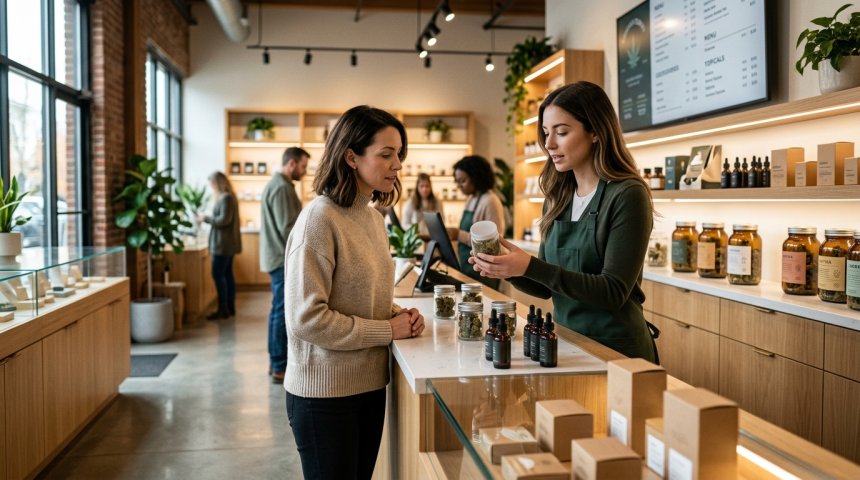
Walking into a cannabis dispensary for the first time in 2026 is nothing like the stereotypes from decades past. There's no sketchy back-alley transaction, no mysterious brown paper bag, no hushed conversation in a parked car. Instead, you're stepping into a brightly lit, professionally designed retail space that looks more like an Apple Store or a high-end boutique than anything from the prohibition era. There are glass display cases, digital menus, uniformed staff with name tags, security cameras, and a queue system that wouldn't feel out of place at a coffee shop.
But here's the thing: even though the environment is modern, clean, and welcoming, the experience can still feel overwhelming if you don't know what to expect. The menu boards list dozens of strains with names like "Blue Dream," "Wedding Cake," and "Gelato #33." The product categories—flower, pre-rolls, vapes, edibles, tinctures, topicals, concentrates—each come with their own terminology, dosing guidelines, and consumption methods. The staff (called "budtenders" in industry parlance) are knowledgeable and eager to help, but if you walk in without any baseline understanding, the conversation can quickly become information overload.
This guide exists to fix that. Whether you're a curious first-timer exploring cannabis for wellness, recreation, or medical purposes, or someone who's been consuming for years but never stepped foot in a legal dispensary, this comprehensive walkthrough will prepare you for exactly what to expect, how to navigate the experience confidently, and how to make smart purchasing decisions that align with your goals, budget, and tolerance level.
We'll cover everything: the legal landscape in 2026, what to bring and how to prepare, the step-by-step dispensary experience from check-in to checkout, how to read product labels and understand cannabinoids, dosing strategies for different consumption methods, how to communicate effectively with budtenders, red flags to watch for, and post-purchase best practices. By the end of this guide, you'll walk into any dispensary in any legal market with the confidence of a seasoned consumer.
Let's demystify the experience.
The Legal Landscape in 2026: What You Need to Know Before You Go
Before we dive into the in-store experience, let's establish the legal context. Cannabis laws vary dramatically by jurisdiction, and what's legal in one state or country may be strictly prohibited in another. As of 2026, the global cannabis landscape looks roughly like this:
United States
As of 2026, 24 states plus Washington D.C. have legalized recreational (adult-use) cannabis for adults 21 and older. An additional 14 states have legalized medical cannabis only, requiring a physician's recommendation and a state-issued medical card. A handful of states maintain full prohibition, though most have decriminalized possession of small amounts.
Key points for U.S. consumers:
- Federal illegality: Cannabis remains a Schedule I controlled substance under federal law, creating conflicts with banking, interstate commerce, and federal property rules. You cannot transport cannabis across state lines, even between two legal states. You cannot possess it on federal land (national parks, military bases, federal buildings). You cannot fly with it on commercial airlines, even for domestic flights between legal states.
- State-by-state variation: Each legal state has its own rules about possession limits (typically 1 ounce of flower and 8 grams of concentrate for recreational users), purchase limits per transaction, where you can consume (almost always private property only), and whether home cultivation is permitted.
- Medical vs. recreational: Medical patients typically enjoy higher possession limits, lower taxes, access to higher-potency products, and sometimes broader product selections. If you qualify for a medical card in your state, the application process is usually straightforward and worth the effort.
- Age verification: Recreational dispensaries require valid government-issued photo ID proving you're 21+. Medical dispensaries require a valid medical card plus ID. No exceptions, no flexibility. Forget your ID, and you're turned away.
Canada
Canada legalized recreational cannabis nationwide in October 2018. As of 2026, adults 18 or 19+ (depending on province) can purchase from licensed retailers, both physical stores and online platforms operated by provincial governments or private licensees. Possession limits are generally 30 grams of dried flower in public. Home cultivation of up to 4 plants per household is permitted federally, though some provinces (Quebec, Manitoba) prohibit it.
International Markets
Beyond North America, legal cannabis markets exist in varying forms:
- Uruguay: Full recreational legalization since 2013; pharmacy-based sales model.
- Germany: Partial decriminalization and medical access; recreational legalization efforts ongoing in 2026.
- Thailand: Decriminalized in 2022; regulatory framework still evolving in 2026.
- Luxembourg, Malta, South Africa: Various forms of personal use decriminalization or limited legalization.
- Netherlands: Famous "coffee shop" model tolerates sales but maintains technical illegality of supply chain.
The universal rule: Research the specific laws of your jurisdiction before visiting any dispensary. What's legal in Colorado is not legal in Texas. What's legal in Toronto is not legal in London. Ignorance of the law is not a defense, and penalties for violations can range from fines to criminal charges depending on jurisdiction.
What This Means for Your First Visit
For the purposes of this guide, we're assuming you're visiting a licensed, legal dispensary in a jurisdiction where adult-use or medical cannabis is permitted. If you're in a prohibited jurisdiction, this guide is for educational purposes only—we strongly advise against violating local laws.
If you're in a legal market, the key takeaways are:
- Bring valid ID. No ID, no entry. Period.
- Know your possession limits. Don't buy more than you're legally allowed to possess.
- Consume responsibly and legally. Almost all jurisdictions prohibit public consumption. Use cannabis in private residences only.
- Don't transport across borders. State lines, national borders, and federal property are off-limits.
- Never drive impaired. DUI laws apply to cannabis just like alcohol. Arrange alternative transportation if you plan to consume.
Preparing for Your First Visit: What to Bring and How to Plan
A little preparation goes a long way toward making your first dispensary visit smooth, efficient, and enjoyable. Here's your pre-visit checklist.
What to Bring
1. Valid Government-Issued Photo ID This is non-negotiable. Acceptable forms typically include:
- Driver's license (any U.S. state or Canadian province)
- State-issued ID card
- Passport (domestic or international)
- Military ID
The ID must be current (not expired) and show your photo, name, and date of birth. Digital photos of your ID on your phone are almost never accepted—you need the physical card. Some dispensaries use ID scanners that verify authenticity and check for flags, so fake IDs or altered documents will be caught.
2. Medical Card (If Applicable) If you're visiting a medical dispensary or seeking medical patient benefits in a dual-license state, bring your valid, unexpired medical cannabis card. Some states issue digital cards accessible via smartphone apps; others require physical cards. Check your state's requirements beforehand.
3. Cash (Recommended) or Debit Card Here's where federal illegality creates practical friction: because cannabis is illegal federally, most banks won't service cannabis businesses. This means many dispensaries operate on a cash-only basis. Even dispensaries that accept debit cards often use workarounds (like pin-based debit processed as ATM transactions) that may incur fees. Credit cards are almost universally not accepted.
Recommendation: Bring enough cash to cover your intended purchase plus a buffer. If you're unsure of pricing, call ahead or check the dispensary's online menu. Most flower prices range from $8–$20 per gram depending on quality and market. Edibles typically run $10–$30 per package. Concentrates range from $25–$80 per gram. Pre-rolls are usually $8–$20 each.
Some dispensaries have ATMs on-site, but they often charge steep fees ($3–$5 per withdrawal). Avoid the hassle—bring cash.
4. Your Questions and Goals This sounds obvious, but many first-time visitors freeze when the budtender asks, "What are you looking for today?" Having a clear answer makes the interaction smoother and helps the budtender give better recommendations.
Before you go, think about:
- Why are you using cannabis? Relaxation? Sleep? Pain relief? Creativity? Social enjoyment? Medical symptom management?
- What effects do you want? Euphoria? Body relaxation? Mental clarity? Sedation? Energy?
- What effects do you want to avoid? Anxiety? Paranoia? Couch-lock? Intense psychoactivity?
- What's your experience level? Complete beginner? Occasional user? Regular consumer?
- What's your preferred consumption method? Smoking? Vaping? Edibles? Tinctures? Topicals?
- What's your budget? How much are you willing to spend on this visit?
You don't need to have perfect answers, but having rough ideas helps the budtender narrow down recommendations from hundreds of options to a manageable few.
5. Patience and an Open Mind Dispensaries can get busy, especially on weekends, evenings, and holidays (4/20 is the industry's Black Friday). You might wait in line outside, wait again inside, and wait while the budtender assists other customers. Bring patience. Use the wait time to browse the menu, observe the products, and formulate questions.
Also bring an open mind. The cannabis industry has evolved dramatically. Products, terminology, and best practices in 2026 look very different from what you might have heard from friends, seen in movies, or read online. Be willing to learn, ask questions, and adjust your expectations based on expert guidance.
What NOT to Bring
1. Don't bring cannabis into the dispensary. Most dispensaries prohibit bringing outside cannabis onto the premises. It creates liability issues, complicates inventory tracking, and violates licensing terms. Leave your existing stash at home.
2. Don't bring minors. Recreational dispensaries are strictly 21+. Medical dispensaries may allow minors with a registered caregiver and physician approval, but general retail spaces prohibit anyone under the legal age. Don't bring kids, even if they stay in the car—many dispensaries have policies against unattended minors on the property.
3. Don't bring weapons. Most dispensaries prohibit firearms and other weapons on the premises, even in states with open carry laws. Security personnel are typically present, and weapons create safety and liability concerns. Leave them at home.
4. Don't bring pets. Service animals excepted, pets are not allowed inside dispensaries. Leave Fido at home.
5. Don't arrive impaired. Showing up visibly high creates safety concerns, complicates the transaction, and may result in being refused service. Budtenders are trained to recognize impairment and have the right to decline service if they believe you're too impaired to make informed purchasing decisions. Consume after you leave, not before you arrive.
Research Before You Go
Spend 10–15 minutes researching before your visit:
1. Choose the right dispensary. Not all dispensaries are created equal. Look for:
- Positive reviews: Google, Yelp, Weedmaps, Leafly—check recent reviews for consistent feedback about product quality, staff knowledge, and customer service.
- Licensed and compliant: Verify the dispensary holds a valid license from your state's cannabis regulatory agency. Licensed dispensaries are subject to strict testing, labeling, and safety requirements.
- Product selection: Browse their online menu (most dispensaries publish menus on their website or platforms like Weedmaps/Leafly). Do they carry products that interest you? Do they offer a range of price points?
- Location and hours: Choose a convenient location with hours that fit your schedule. Some dispensaries offer express pickup or delivery if you prefer minimal in-store time.
- First-time customer deals: Many dispensaries offer discounts for first-time visitors (10–20% off, bonus loyalty points, free pre-roll with purchase). Ask about these when you arrive or check their website beforehand.
2. Familiarize yourself with basic terminology. You don't need to become an expert, but knowing a few key terms helps you follow conversations and read labels:
- Flower/Bud: The dried, smokable cannabis plant material. Also called "nugs," "herb," or "green."
- Pre-roll: A pre-rolled joint, ready to smoke. Convenient for beginners who don't want to roll their own.
- Vape/Vaporizer: Devices that heat cannabis oil or flower to produce vapor instead of smoke. Includes disposable vape pens, refillable cartridges, and dry herb vaporizers.
- Edible: Food or beverage infused with cannabis. Includes gummies, chocolates, baked goods, beverages, and cooking oils.
- Tincture: Liquid cannabis extract, usually oil-based, taken sublingually (under the tongue) with a dropper.
- Topical: Creams, balms, lotions, or patches applied to the skin for localized relief. Non-psychoactive.
- Concentrate: Potent cannabis extracts including wax, shatter, live resin, rosin, and hash. Consumed via dabbing, vaping, or adding to flower.
- THC (Tetrahydrocannabinol): The primary psychoactive compound in cannabis. Responsible for the "high."
- CBD (Cannabidiol): A non-psychoactive compound associated with relaxation, anti-inflammatory effects, and anxiety reduction. Often balanced with THC.
- Indica/Sativa/Hybrid: Traditional strain classifications. Indica = relaxing/sedating. Sativa = energizing/uplifting. Hybrid = blend of both. (Note: Modern science suggests these labels are oversimplified—more on this below.)
- Terpenes: Aromatic compounds that give cannabis its smell and flavor. Also influence effects. Common terpenes: myrcene (relaxing), limonene (uplifting), pinene (focus), linalool (calming).
- MG (Milligrams): The unit of measurement for THC/CBD in edibles and tinctures. Critical for dosing.
3. Set a budget. Decide how much you're willing to spend before you walk in. Dispensaries are designed to encourage upsells, and it's easy to exceed your intended budget when everything looks interesting. A reasonable first-visit budget for a beginner: $30–$60. Enough to try one or two products without overcommitting.
The Dispensary Experience: Step-by-Step Walkthrough
Now let's walk through exactly what happens from the moment you arrive to the moment you leave. Knowing the sequence reduces anxiety and helps you navigate confidently.
Step 1: Arrival and Check-In
You pull up to the dispensary. Depending on the location, you might see:
- Security personnel: Uniformed guards at the entrance are standard. They're there for safety and compliance, not intimidation. A nod or brief greeting is sufficient.
- ID check at the door: Some dispensaries verify ID before allowing entry, especially during busy periods. Have your ID ready.
- Queue/line: If the dispensary is at capacity, you'll wait outside. Use this time to browse the menu on your phone or observe posted signage.
- Parking: Most dispensaries have dedicated parking lots. Park legally—don't block entrances, fire lanes, or accessible spots.
Once inside, you'll typically encounter:
- Lobby/waiting area: A designated space where you check in and wait for a budtender. Some dispensaries use digital queue systems (text notifications when it's your turn). Others use a traditional "next available" approach.
- Check-in desk: A staff member greets you, scans your ID, and enters your information into their point-of-sale (POS) system. First-time visitors may be asked to fill out a brief registration form (name, contact info, preferences).
- Menu boards: Digital screens or printed menus displaying available products, prices, and descriptions. Browse while you wait.
Pro tip: If it's your first visit, tell the check-in staff. They'll often flag your profile so the budtender knows to spend extra time educating you. Some dispensaries assign their most experienced budtenders to first-timers.
Step 2: Meeting Your Budtender
When it's your turn, a budtender calls your name or signals you to their station. Budtenders are the dispensary equivalent of sommeliers, baristas, or pharmacists—they're trained product experts whose job is to match you with the right product for your needs.
A good budtender will start with questions, not recommendations. Expect something like:
- "Have you been to a dispensary before?"
- "What brings you in today? What effects are you hoping for?"
- "Do you have any experience with cannabis? What have you tried before?"
- "Are you looking for something for daytime or nighttime use?"
- "Do you have any preferences for consumption method? Smoking, vaping, edibles?"
- "Any concerns or effects you want to avoid? Anxiety, paranoia, drowsiness?"
- "What's your budget for today?"
How to respond: Be honest. If you're a complete beginner, say so. If you're nervous about getting too high, say so. If you have a medical condition you're hoping to address, share what you're comfortable sharing. The more information you provide, the better the budtender can tailor recommendations.
Red flag: If a budtender immediately pushes the most expensive product without asking questions, that's a sales-driven interaction, not a consultative one. You're entitled to ask for alternatives, request lower-priced options, or ask for more explanation. A good budtender welcomes questions; a bad one gets defensive.
Step 3: Product Recommendations and Education
Based on your answers, the budtender will recommend 2–4 products that match your goals, experience level, and budget. They'll explain why each product fits your needs, how to consume it, what effects to expect, and how to dose appropriately.
What to listen for:
For flower recommendations:
- Strain name and type (indica/sativa/hybrid)
- THC and CBD percentages
- Dominant terpenes and their effects
- Recommended consumption method (joint, pipe, bong, vaporizer)
- Expected onset time and duration
For edible recommendations:
- Total THC content per package and per serving
- Recommended starting dose (critical for beginners—more on this below)
- Onset time (30–90 minutes) and duration (4–8 hours)
- Ingredients and allergens
- Whether it's fast-acting or traditional formulation
For vape recommendations:
- Cartridge potency (THC percentage)
- Extract type (distillate, live resin, CO2 oil, etc.)
- Battery compatibility (510-thread is universal; proprietary batteries are brand-specific)
- Draw activation vs. button activation
- Expected onset and duration
For tincture recommendations:
- MG of THC/CBD per milliliter and per dropper
- Sublingual administration instructions (hold under tongue for 60–90 seconds)
- Onset time (15–45 minutes) and duration (4–6 hours)
- Flavor profile and carrier oil type
Ask questions. No question is stupid. Good questions to ask:
- "Is this a good option for a beginner?"
- "What's the lowest dose I should start with?"
- "How long until I feel effects?"
- "How long do effects last?"
- "Can I mix this with [other product]?"
- "What should I do if I take too much?"
- "Is there a lower-priced alternative with similar effects?"
The Indica/Sativa/Hybrid Debate
Here's where we need to address a controversial topic: the indica/sativa/hybrid classification system is increasingly considered outdated by cannabis scientists and experienced cultivators. The traditional model—indica = relaxing body stone, sativa = energizing head high, hybrid = balanced—oversimplifies a complex reality.
Modern research suggests that effects are influenced more by:
- Cannabinoid profile: THC:CBD ratio, plus minor cannabinoids like CBG, CBN, CBC
- Terpene profile: The aromatic compounds that modulate THC's effects (the "entourage effect")
- Individual biochemistry: Your unique endocannabinoid system, tolerance, metabolism, and even mood/state of mind
Many budtenders in 2026 still use indica/sativa/hybrid labels because they're familiar shorthand for customers, but the best ones will also discuss terpenes, cannabinoid ratios, and expected effects based on the full chemical profile rather than relying solely on strain category.
What this means for you: Don't fixate on whether something is labeled indica or sativa. Instead, ask: "What effects does this typically produce? What terpenes are dominant? Is this better for daytime or nighttime?" Those questions yield more useful answers than "Is this indica or sativa?"
Step 4: Making Your Selection
After the budtender's recommendations, it's decision time. You can:
- Accept a recommendation and proceed to purchase
- Ask for alternatives if the suggestions don't feel right (too expensive, too potent, wrong consumption method)
- Request to see/smell products (most dispensaries have sample jars for flower; you can ask to smell before buying)
- Take your time—there's no pressure to decide immediately
Beginner-friendly product recommendations by category:
If you want to smoke flower:
- Start with a low-to-moderate THC strain (15–20% THC). Avoid anything above 25% THC for your first time.
- Choose a balanced hybrid or indica-dominant strain for relaxation without overwhelming psychoactivity.
- Buy a small amount (1–3.5 grams, aka an "eighth") to start. You can always buy more later.
- Consider a pre-roll instead of loose flower if you don't own smoking accessories or don't want to roll your own.
If you want to try edibles:
- Start with 2.5–5 mg THC. Seriously. Even if you have a high tolerance for other substances, edibles metabolize differently and hit harder than expected.
- Choose a single-serving product (one gummy, one chocolate) rather than a multi-dose package to avoid accidental overconsumption.
- Fast-acting formulations (nanoemulsified) onset in 15–30 minutes; traditional edibles onset in 60–90 minutes. Know which you're buying.
- Avoid mixing edibles with alcohol or other substances on your first try.
If you want to vape:
- Start with a low-potency cartridge (60–70% THC) rather than high-potency distillates (80–90%+).
- Choose a 510-thread battery for maximum compatibility and future flexibility.
- Take one small puff, wait 10–15 minutes, and assess effects before taking more.
- Avoid proprietary cartridge systems that lock you into one brand's ecosystem.
If you want a tincture:
- Start with a low-dose tincture (5–10 mg THC per dropper).
- Use the dropper to measure precisely—don't guess.
- Hold under your tongue for 60–90 seconds before swallowing for fastest onset.
- Tinctures offer the most precise dosing control, making them ideal for beginners and medical users.
If you want a topical:
- Topicals are non-psychoactive—you won't get high regardless of how much you apply.
- Apply to the affected area and massage in thoroughly.
- Effects are localized (pain relief, inflammation reduction) rather than systemic.
- Great for beginners who want therapeutic benefits without psychoactivity.
Step 5: Checkout and Payment
Once you've selected your products, the budtender rings them up in the POS system. Here's what happens:
1. Purchase limit verification. The system checks whether your purchase exceeds legal possession limits for your jurisdiction and customer type (recreational vs. medical). If you're over the limit, the budtender will ask you to remove items.
2. Tax calculation. Cannabis taxes vary by jurisdiction but are typically substantial—15–37% on top of the base price, sometimes layered (excise tax + sales tax + local tax). The final price at checkout is often 20–40% higher than the menu price. Budget accordingly.
3. Payment processing. As mentioned earlier, most dispensaries are cash-only. If they accept debit, the budtender will explain the process (often a pin-based transaction processed as an ATM withdrawal, sometimes with a fee). Credit cards are almost never accepted.
4. Receipt and compliance documentation. You'll receive a detailed receipt showing products purchased, taxes paid, and compliance information. Some jurisdictions require dispensaries to print warnings or educational materials on receipts. Keep your receipt—it's proof of legal purchase if you're ever questioned by law enforcement.
5. Loyalty program enrollment. Most dispensaries offer loyalty programs that earn points toward future discounts. Enrollment is usually free and takes 30 seconds. Worth doing if you plan to return.
6. Bagging and exit. Your products are placed in a sealed, opaque, child-resistant bag (required by law in most jurisdictions). Some dispensaries add branded stickers, educational inserts, or first-time customer perks (free pre-roll, discount coupon for next visit).
Building a Compliant Cannabis Business? Start With the Right Infrastructure
If you're reading this guide as a prospective dispensary owner, operator, or cannabis entrepreneur—not just a consumer—you already know that compliance isn't optional in this industry. It's the foundation everything else is built on. From seed-to-sale tracking to POS systems, inventory management to customer data security, the operational infrastructure you choose in year one determines whether you scale smoothly or drown in regulatory complexity.
For cannabis businesses navigating the unique challenges of 2026—banking restrictions, multi-state compliance, real-time inventory reporting, and evolving tax frameworks—Wicofly offers an integrated business ecosystem designed for regulated industries. Their platform connects operations, compliance, marketing, and customer engagement in one streamlined environment, reducing the vendor sprawl that plagues many cannabis operators. Disclosure: This is a sponsored mention. We only feature resources we believe provide genuine value to cannabis entrepreneurs. Explore Wicofly's compliance-ready solutions → (nofollow)
Whether you're launching your first dispensary or scaling a multi-unit operation, having infrastructure that understands regulatory nuance lets you focus on what matters: serving customers safely, legally, and profitably.
Understanding Product Labels: What All Those Numbers Mean
Every legal cannabis product comes with a label packed with information. Learning to read these labels empowers you to make informed decisions independently, even without a budtender's guidance.
Flower Labels
Strain name: The cultivar name (e.g., "Blue Dream," "OG Kush," "Gelato #33"). Marketing-driven, not scientifically standardized.
Type: Indica, sativa, or hybrid. As discussed, this is a rough heuristic, not a precise predictor of effects.
THC %: The percentage of tetrahydrocannabinol by weight. Higher THC = more potent psychoactive effects. Beginner range: 15–20%. Moderate: 20–25%. High: 25%+. Ultra-high: 30%+ (approach with caution).
CBD %: The percentage of cannabidiol by weight. CBD modulates THC's psychoactivity, often reducing anxiety and paranoia. Balanced THC:CBD ratios (1:1, 2:1) are gentler for beginners.
Terpene profile: Some labels list dominant terpenes (myrcene, limonene, pinene, linalool, caryophyllene). These influence aroma, flavor, and effects. Increasingly common on premium products.
Batch/lot number: Traceability identifier linking the product to its cultivation, testing, and distribution records. Critical for recalls and quality control.
Test date and lab: The date the product was tested and the name of the third-party testing laboratory. All legal cannabis must be tested for potency, pesticides, heavy metals, and microbial contaminants.
Harvest/packaging date: Indicates freshness. Flower is best consumed within 6–12 months of harvest if stored properly.
Net weight: The amount of flower in the package, typically in grams (1g, 3.5g/eighth, 7g/quarter, 14g/half ounce, 28g/ounce).
Edible Labels
Total THC content: The total milligrams of THC in the entire package. A package labeled "100 mg THC" might contain 10 servings of 10 mg each, or 20 servings of 5 mg each. Read carefully.
Serving size and THC per serving: The most critical number for dosing. Standard serving: 5–10 mg THC. Beginner serving: 2.5–5 mg THC. Microdose: 1–2.5 mg THC.
Number of servings per container: How many doses are in the package. A 100 mg package with 10 servings = 10 mg per serving. A 100 mg package with 20 servings = 5 mg per serving.
Ingredients list: Full ingredient disclosure, including allergens (soy, nuts, dairy, gluten). Critical for consumers with dietary restrictions.
Nutritional information: Calories, fat, sugar, etc. Required in most jurisdictions.
Onset time: Some labels indicate expected onset (fast-acting: 15–30 min; traditional: 60–90 min). If not listed, assume traditional onset.
Expiration date: Edibles expire. Consuming expired edibles may result in reduced potency or food safety risks.
Child-resistant packaging: All legal edibles must be sold in child-resistant, resealable packaging. Keep it that way at home, especially if children or pets are present.
Vape/Concentrate Labels
THC %: Concentrates are significantly more potent than flower. Distillates: 80–95% THC. Live resin: 60–80% THC. CO2 oil: 60–80% THC. Rosin: 60–80% THC. Approach with extreme caution if you're a beginner.
Extract type: Distillate (pure THC, minimal terpenes), live resin (full-spectrum, terpene-rich), CO2 oil (clean, moderate terpene retention), rosin (solventless, full-spectrum). Each has different flavor, effect, and purity profiles.
Strain name: The source strain for the extract. Influences terpene profile and effects.
Battery compatibility: 510-thread (universal) or proprietary (brand-specific). Important for determining whether you need to buy a separate battery.
Volume/weight: Measured in grams (0.5g, 1g) or milliliters (0.5ml, 1ml). Determines how long the cartridge lasts.
Testing information: Same as flower—batch number, test date, lab name, contaminant screening results.
Tincture Labels
Total THC/CBD content: Total milligrams in the bottle. A 30ml bottle with 300 mg THC = 10 mg per ml.
MG per dropper: The most useful dosing metric. A "full dropper" might deliver 10 mg, 25 mg, or 50 mg depending on concentration. The label should specify.
Ratio: THC:CBD ratio (e.g., 1:1, 2:1, 20:1). Balanced ratios are gentler; high-THC ratios are more psychoactive.
Carrier oil: MCT oil, olive oil, hemp seed oil, etc. Influences absorption rate and flavor.
Suggested use: Instructions for sublingual administration (hold under tongue for 60–90 seconds).
Volume: Total milliliters in the bottle (15ml, 30ml, 60ml).
Dosing Strategies: The Golden Rule of Cannabis Consumption
If you remember only one thing from this guide, let it be this: Start low, go slow.
More first-time dispensary visitors end up uncomfortable, anxious, or paralyzed on their couch not because cannabis is inherently dangerous, but because they consumed too much too quickly. Cannabis has an extremely low risk of fatal overdose (there are zero documented cases of lethal cannabis overdose in medical literature), but overconsumption can produce intensely unpleasant experiences: anxiety, paranoia, rapid heart rate, nausea, dizziness, and dissociation. These effects are temporary and not medically dangerous, but they're scary and can traumatize beginners into avoiding cannabis entirely.
Here's how to dose responsibly by consumption method.
Smoking Flower
Onset: 2–10 minutes Peak: 30–60 minutes Duration: 1–3 hours
Beginner dosing strategy:
- Take one small puff (2–3 seconds).
- Wait 10–15 minutes. Assess effects.
- If no effects, take one more small puff. Wait another 10–15 minutes.
- Repeat until you reach your desired effect level.
- Stop when you feel "good enough." More is not better.
Common mistake: Taking multiple hits in rapid succession because "I don't feel anything yet." Flower onset is fast, but peak effects take 30–60 minutes. If you take 5 hits in 5 minutes, you won't feel the cumulative effect until 45 minutes later—when it's too late to undo it.
Vaping
Onset: 2–10 minutes Peak: 20–40 minutes Duration: 1–3 hours
Beginner dosing strategy:
- Take one small puff (1–2 seconds). Vapor is more concentrated than smoke.
- Wait 10–15 minutes.
- Assess effects before taking another puff.
- Vapes deliver THC more efficiently than flower, so smaller doses produce stronger effects.
Common mistake: Treating vapes like cigarettes and chain-hitting. Vape cartridges are potent—one or two puffs is often sufficient for beginners.
Edibles
Onset: 30–90 minutes (fast-acting: 15–30 minutes) Peak: 2–4 hours Duration: 4–8 hours (sometimes longer)
Beginner dosing strategy:
- Start with 2.5–5 mg THC. Not 10 mg. Not "half a gummy that's probably 5 mg but might be 10 mg." Precisely measured 2.5–5 mg.
- Wait 90 minutes before considering more. Edibles take time to metabolize. The biggest mistake beginners make is eating more after 45 minutes because "it's not working," then getting hit by the full dose of both servings simultaneously.
- If 5 mg produces no effects after 2 hours, try 7.5–10 mg next time. Increase gradually across separate sessions, not within the same session.
- Consume on a full stomach for milder, more gradual onset. Empty stomach = faster, more intense onset.
Common mistake: Impatience. Edibles are the #1 cause of cannabis-related emergency room visits, almost always due to overconsumption from impatience. If you take an edible and don't feel anything after 60 minutes, do not take more. Wait the full 90 minutes. If you still feel nothing, note that dose and try slightly more next time.
Fast-acting vs. traditional edibles: Nanoemulsified or "fast-acting" edibles use technology to break THC into smaller particles that absorb faster. Onset: 15–30 minutes. These are easier to titrate (adjust dose in real-time) but still require patience. Don't assume "fast-acting" means "instant"—wait at least 30 minutes before redosing.
Tinctures
Onset: 15–45 minutes (sublingual); 60–90 minutes (swallowed) Peak: 1–2 hours Duration: 4–6 hours
Beginner dosing strategy:
- Start with 2.5–5 mg THC (usually 0.25–0.5 ml depending on concentration).
- Hold under your tongue for 60–90 seconds before swallowing. This allows direct absorption into the bloodstream for faster, more predictable onset.
- Wait 45 minutes before considering more.
- Tinctures offer the most precise dosing control—use the dropper markings to measure exact amounts.
Common mistake: Swallowing immediately instead of holding sublingually. Swallowed tinctures metabolize like edibles (slower, less predictable). Sublingual administration is faster and more controllable.
Topicals
Onset: 15–30 minutes Duration: 2–4 hours
Beginner dosing strategy:
- Apply a dime-to-quarter-sized amount to the affected area.
- Massage in thoroughly.
- Reapply every 2–4 hours as needed.
- Topicals are non-psychoactive—you cannot overdose or get high from topical application.
Common mistake: Expecting systemic effects. Topicals work locally (on the skin and underlying tissues), not systemically (throughout the body). They won't produce psychoactive effects or whole-body pain relief.
The "Too High" Protocol
Even with careful dosing, you might occasionally take too much. Here's what to do:
1. Remember: You are not dying. Cannabis overdose is not lethal. The discomfort is temporary and will pass. Repeat this mantra.
2. Change your environment. Move to a comfortable, quiet, familiar space. Dim lights. Put on calming music or a familiar movie. Avoid stimulating or stressful environments.
3. Hydrate. Drink water. Dry mouth (cottonmouth) is a common side effect, and hydration helps.
4. Eat something. Especially fatty foods (nuts, cheese, avocado). Fat can help metabolize THC and may reduce intensity.
5. Try CBD. If you have a CBD tincture or capsule, take it. CBD can counteract some of THC's psychoactive effects, reducing anxiety and paranoia.
6. Practice deep breathing. Slow, deliberate breaths activate the parasympathetic nervous system, countering anxiety. Inhale for 4 counts, hold for 4, exhale for 6. Repeat.
7. Distract yourself. Watch a comedy, play a simple game, talk to a trusted friend. Engagement redirects attention away from discomfort.
8. Sleep it off. If all else fails, lie down and rest. You'll likely fall asleep and wake up feeling normal.
9. Avoid alcohol and other substances. Mixing substances amplifies unpredictability and discomfort.
10. Seek medical help if truly distressed. If you experience severe chest pain, uncontrollable vomiting, or extreme psychological distress, seek emergency medical care. Medical professionals can provide supportive care (IV fluids, anti-anxiety medication) to help you through the experience. They've seen this before—they won't judge you.
How long does "too high" last?
- Smoking/vaping: 1–3 hours, with peak intensity in the first hour.
- Edibles: 4–8 hours, with peak intensity in hours 2–4.
- Tinctures: 4–6 hours, with peak intensity in hours 1–2.
The discomfort will pass. You will be okay. Start lower next time.
Communicating Effectively with Budtenders
Budtenders are your allies in the dispensary. They want you to have a positive experience, find products that work for you, and return as a loyal customer. But they can only help if you communicate effectively.
What to Tell Your Budtender
Be honest about your experience level. "I've never tried cannabis before" is a perfectly acceptable answer. Good budtenders appreciate honesty—it helps them calibrate recommendations appropriately. Pretending to be experienced when you're not leads to mismatched products and uncomfortable experiences.
Be specific about your goals. "I want to relax" is vague. "I want something to help me unwind after work without making me too sleepy to finish dinner" is specific. "I need help falling asleep and staying asleep" is specific. "I want something for social situations that won't make me anxious" is specific. The more specific you are, the better the recommendations.
Share relevant medical information (if comfortable). If you're using cannabis for pain, anxiety, insomnia, nausea, or another medical concern, share that context. Budtenders aren't doctors and can't give medical advice, but they can recommend products that other customers with similar concerns have found helpful.
Disclose medications and health conditions. Cannabis can interact with certain medications (blood thinners, antidepressants, sedatives, etc.) and health conditions. If you're on prescription medications or have chronic health conditions, mention this. A responsible budtender will either adjust recommendations or advise you to consult your physician first.
State your budget clearly. "I'd like to spend around $40 today" helps the budtender narrow options. Without a budget anchor, they might recommend premium products that exceed your comfort zone.
Questions to Ask Your Budtender
- "Is this a good option for a beginner?"
- "What's the lowest effective dose for this product?"
- "How long until I feel effects, and how long do they last?"
- "What effects should I expect? What should I avoid expecting?"
- "Can you recommend something lower in THC with similar effects?"
- "What's the difference between these two products?"
- "Do you have any first-time customer discounts?"
- "What would you personally recommend for [your specific goal]?"
- "If I take too much, what should I do?"
- "How should I store this product at home?"
Red Flags in Budtender Interactions
Red flag 1: Pushing the most expensive product without justification. Premium products aren't always better—they're just more expensive. A good budtender recommends the right product for your needs and budget, not the one with the highest margin.
Red flag 2: Dismissing your concerns. If you say "I'm worried about getting too anxious" and the budtender responds "Don't worry, you'll be fine" without adjusting recommendations, that's dismissive. A good budtender acknowledges concerns and suggests lower-THC, higher-CBD, or indica-dominant options known for relaxation over stimulation.
Red flag 3: Making medical claims. Budtenders cannot legally claim that cannabis cures, treats, or prevents specific diseases. If a budtender says "This will cure your arthritis" or "This treats cancer," that's a compliance violation and a sign of unprofessionalism. They can say "Some customers with arthritis find relief with this product" or "This strain is commonly used for pain management," but not definitive medical claims.
Red flag 4: Refusing to answer questions or rushing you. You're entitled to ask questions and take time to decide. A budtender who seems annoyed by questions or pressures you to decide quickly is providing poor service. Take your business elsewhere.
Red flag 5: Recommending high-THC products to obvious beginners. If you clearly state you're a first-timer and the budtender recommends a 30% THC concentrate or a 100 mg edible, that's irresponsible. Beginners need low-dose, gentle products. High-potency recommendations for novices suggest the budtender prioritizes sales over customer safety.
Post-Purchase: Storage, Consumption, and Safety Best Practices
You've made your purchase. Now what? Here's how to store, consume, and manage your cannabis responsibly after leaving the dispensary.
Storage Best Practices
Flower:
- Store in an airtight, opaque container (glass jar with密封 lid is ideal).
- Keep in a cool, dark, dry place (60–70°F, away from sunlight and humidity).
- Avoid plastic bags (they trap moisture and promote mold) and refrigerators/freezers (temperature fluctuations degrade trichomes).
- Use humidity packs (Boveda, Integra Boost) to maintain 58–62% relative humidity for optimal freshness.
- Consume within 6–12 months for best quality. After that, potency and flavor degrade.
Edibles:
- Store in original child-resistant packaging.
- Keep in a cool, dry place away from direct sunlight.
- Refrigerate if the label recommends it (some baked goods, chocolates).
- Keep out of reach of children and pets—edibles look like regular candy/food and are a leading cause of accidental pediatric cannabis exposure.
- Consume before the expiration date. Expired edibles may have reduced potency or food safety risks.
Vapes/Concentrates:
- Store cartridges upright to prevent clogging and leaking.
- Keep in a cool, dark place (heat degrades oil quality).
- Avoid extreme temperatures (don't leave in hot cars or freezing conditions).
- Keep batteries charged but not overcharged.
- Store concentrates in airtight containers away from light and air.
Tinctures:
- Store in original amber glass bottle (protects from light degradation).
- Keep in a cool, dark place.
- Ensure the dropper is clean and dry before returning to the bottle.
- Consume within 6–12 months for best potency.
Topicals:
- Store in original container with lid tightly sealed.
- Keep in a cool, dry place.
- Avoid contamination—don't double-dip fingers into jars; use clean applicators.
Universal storage rules:
- Keep all cannabis products locked away from children and pets. Child-resistant packaging is required at point of sale, but it's not child-proof once opened. Use a lockbox or high cabinet.
- Label everything clearly. If you transfer products to different containers, label them with contents, potency, and date.
- Don't store in vehicles. Heat, cold, and visibility create safety and legal risks. Transport purchases directly home in a sealed, opaque bag.
Consumption Best Practices
Know your local consumption laws. Almost all jurisdictions prohibit public cannabis consumption. "Public" includes streets, parks, sidewalks, restaurants, bars, hotels (unless explicitly cannabis-friendly), and rental properties (unless the landlord permits it). Consume in private residences only, with the property owner's permission.
Start low, go slow. We covered this extensively above. It bears repeating because it's the single most important safety principle.
Don't mix with alcohol. Alcohol amplifies cannabis effects unpredictably and increases the risk of nausea, dizziness, and blackouts. Especially for beginners, keep substances separate.
Don't drive impaired. Cannabis impairs reaction time, coordination, and judgment. DUI laws apply to cannabis just like alcohol. If you've consumed, arrange alternative transportation (ride-share, public transit, designated driver, stay overnight). There is no reliable "breathalyzer" for cannabis impairment—law enforcement uses field sobriety tests and drug recognition experts. Don't risk it.
Be mindful of secondhand exposure. If consuming around others, ensure they consent to secondhand smoke/vapor exposure. Some people are sensitive or opposed to cannabis exposure. Respect their boundaries.
Stay hydrated and nourished. Cannabis can cause dry mouth, increased appetite ("munchies"), and occasional nausea. Keep water and snacks nearby.
Have a sober companion for your first few experiences. Especially for edibles, having a trusted, sober friend present provides reassurance and practical support if you overconsume.
Travel and Transportation
Don't transport across state or national borders. Even between two legal states, interstate transport violates federal law. International transport violates both federal and international law. Penalties range from fines to criminal charges.
Don't fly with cannabis. TSA operates under federal law. Even for domestic flights between legal states, cannabis is prohibited in checked and carry-on luggage. Some airports in legal states have amnesty boxes where you can discard cannabis before security, but don't count on it.
Store securely in vehicles. If transporting legally purchased cannabis within your jurisdiction, keep it in a sealed, opaque container in the trunk or locked glove compartment. Some states require cannabis to be inaccessible to the driver and passengers during transport.
Don't consume in vehicles. Driving under the influence is illegal. Passenger consumption is also illegal in most jurisdictions, even if the vehicle is parked.
Disposal
Dispose of unused or expired cannabis responsibly. Don't flush it (contaminates water systems) or throw it in regular trash where children or pets might access it. Mix with undesirable substances (coffee grounds, cat litter) in a sealed container before discarding. Some dispensaries offer take-back programs for unused products.
Recycle packaging where possible. Glass jars, cardboard boxes, and some plastics are recyclable. Child-resistant plastic containers often aren't—check local recycling guidelines.
Advanced Topics for Beyond Your First Visit
Once you've completed your first dispensary visit and gained some experience, you'll likely want to explore more advanced topics. Here's a preview of what's beyond the basics.
Cultivation and Home Growing
In jurisdictions where home cultivation is legal (most U.S. recreational states allow 4–12 plants per household), growing your own cannabis is a rewarding hobby that reduces costs and gives you full control over strain selection, cultivation methods, and product quality. Home growing requires significant upfront investment (lights, ventilation, nutrients, growing medium), ongoing maintenance, and 3–5 months from seed to harvest. It's not trivial, but it's deeply satisfying for those inclined.
Concentrates and Dabbing
Concentrates (wax, shatter, live resin, rosin) offer significantly higher potency than flower and are consumed via "dabbing"—vaporizing a small amount on a heated surface (quartz, titanium, ceramic) using a specialized rig. Dabbing delivers intense, immediate effects and is popular among experienced consumers. Beginners should approach concentrates with extreme caution due to their potency (60–95% THC). Start with tiny amounts (the size of a grain of rice) and low temperatures.
Medical Cannabis Programs
If you have a qualifying medical condition (chronic pain, cancer, epilepsy, PTSD, multiple sclerosis, glaucoma, HIV/AIDS, and many others depending on jurisdiction), applying for a medical cannabis card unlocks significant benefits: higher possession limits, lower taxes, access to higher-potency products, broader product selections, and sometimes insurance coverage (rare but emerging). The application process typically requires a physician's recommendation and a state application fee ($25–$200). If you qualify, the benefits usually outweigh the effort.
Cannabinoid Science and the Entourage Effect
Beyond THC and CBD, cannabis contains 100+ cannabinoids (CBG, CBN, CBC, THCV, etc.) and 200+ terpenes. Emerging research suggests these compounds work synergistically—the "entourage effect"—where the combined effect of the full chemical profile differs from isolated compounds. Full-spectrum products (whole-plant extracts) may produce different effects than isolates (pure THC or CBD). This science is still evolving, but it's reshaping how products are formulated and marketed.
Tolerance, Dependence, and Responsible Use
Regular cannabis use builds tolerance—you need more to achieve the same effects. Tolerance is reversible; taking a break (a "tolerance break" or "T-break") for 1–4 weeks resets sensitivity. Cannabis dependence (withdrawal symptoms upon cessation: irritability, insomnia, decreased appetite, anxiety) affects approximately 9% of users, higher among daily users. Responsible use includes monitoring your consumption patterns, taking regular breaks, and being honest about whether cannabis is enhancing or interfering with your life.
Cannabis and Mental Health
The relationship between cannabis and mental health is complex and individual. Some people find cannabis helps manage anxiety, depression, PTSD, and insomnia. Others experience worsened anxiety, paranoia, or mood disturbances. High-THC products are associated with increased risk of adverse psychological effects, especially in predisposed individuals. If you have a history of mental health conditions (especially psychosis, schizophrenia, or bipolar disorder), consult a mental health professional before using cannabis. Start with low-THC, high-CBD products if you proceed.
The Future of Cannabis Retail in 2026 and Beyond
The cannabis retail landscape continues to evolve rapidly:
- Delivery and express pickup: Many markets now permit cannabis delivery via licensed services. Express pickup (order online, grab in-store without waiting) reduces in-store time.
- Personalization and AI recommendations: Some dispensaries use AI-powered recommendation engines that analyze your purchase history, stated preferences, and product chemistry to suggest personalized products.
- Experiential retail: Premium dispensaries are incorporating lounges, consumption areas (where legal), educational events, and community programming to differentiate from commodity competitors.
- Vertical integration: Brands that control cultivation, processing, and retail (seed-to-sale) are gaining market share by ensuring quality consistency and capturing margin at every stage.
- Social equity programs: Many jurisdictions mandate that a percentage of licenses go to communities disproportionately impacted by prohibition. Supporting social equity businesses is a way to contribute to restorative justice in the industry.
- Banking and financial services: Federal reform efforts continue, but as of 2026, most cannabis businesses still operate with limited banking access. SAFE Banking Act passage would be a game-changer for the industry's financial infrastructure.
Frequently Asked Questions (FAQs)
Is it legal to visit a dispensary in any U.S. state?
No. As of 2026, 24 states plus Washington D.C. have legalized recreational cannabis for adults 21+. An additional 14 states allow medical cannabis only with a physician's recommendation and state-issued card. A handful of states maintain full prohibition, though most have decriminalized possession of small amounts. Always verify the laws in your specific jurisdiction before visiting a dispensary. Even in legal states, federal property (national parks, military bases, federal buildings) remains off-limits for cannabis possession and consumption.
What ID do I need to enter a dispensary?
A valid, unexpired government-issued photo ID showing your name, photo, and date of birth. Acceptable forms include driver's licenses (any U.S. state or Canadian province), state ID cards, passports, and military IDs. Digital photos of your ID on your phone are almost never accepted—you need the physical card. Medical dispensaries additionally require a valid, unexpired medical cannabis card. No ID means no entry, with no exceptions.
Can I use a credit card at a dispensary?
Almost never. Because cannabis remains federally illegal, most banks won't service cannabis businesses, forcing dispensaries to operate cash-only. Some dispensaries accept pin-based debit cards processed as ATM transactions, often with a fee ($3–$5). Credit cards are universally rejected. Bring enough cash to cover your intended purchase plus taxes (which add 20–40% to menu prices). Some dispensaries have on-site ATMs, but fees are steep.
How much should I spend on my first dispensary visit?
A reasonable first-visit budget for a beginner is $30–$60. This is enough to purchase one or two products (a small amount of flower, a low-dose edible, or a starter vape cartridge) without overcommitting. Remember to factor in taxes, which add 20–40% to menu prices. Set your budget before you walk in and stick to it—dispensaries are designed to encourage upsells, and it's easy to exceed your intended spend when everything looks interesting.
What's the difference between indica, sativa, and hybrid?
Traditionally, indica strains are associated with relaxing, sedating body effects; sativa strains with energizing, uplifting cerebral effects; and hybrids with a blend of both. However, modern cannabis science suggests this classification is oversimplified. Effects are influenced more by the full cannabinoid and terpene profile, individual biochemistry, tolerance, and set/setting than by indica/sativa labels alone. Many budtenders in 2026 still use these labels as familiar shorthand, but the best ones will also discuss terpenes, THC:CBD ratios, and expected effects based on the full chemical profile. Ask "What effects does this typically produce?" rather than fixating on the indica/sativa label.
How much THC should a beginner consume?
It depends on the consumption method. For smoking flower: start with one small puff of a 15–20% THC strain, wait 10–15 minutes, and assess before taking more. For edibles: start with 2.5–5 mg THC, wait 90 minutes before considering more. For vapes: take one small puff of a 60–70% THC cartridge, wait 10–15 minutes. For tinctures: start with 2.5–5 mg THC held sublingually for 60–90 seconds, wait 45 minutes. The universal rule: start low, go slow. You can always take more next time; you can't undo taking too much this time.
How long do cannabis effects last?
Smoking/vaping: 1–3 hours, peaking at 30–60 minutes. Edibles: 4–8 hours, peaking at 2–4 hours. Tinctures (sublingual): 4–6 hours, peaking at 1–2 hours. Topicals: 2–4 hours of localized relief, no psychoactive effects. Duration varies based on dose, individual metabolism, tolerance, and whether you've eaten. Edibles last longest and are most variable—plan accordingly and don't schedule important activities for 6–8 hours after consuming an edible.
What should I do if I get too high?
Remember: you are not dying. Cannabis overdose is not lethal. Move to a comfortable, quiet space. Hydrate. Eat something (especially fatty foods). Try CBD if available—it can counteract THC's psychoactive effects. Practice deep breathing. Distract yourself with a familiar movie or music. Lie down and rest if needed. Avoid alcohol and other substances. The discomfort will pass: smoking/vaping peaks in 1 hour and fades in 3; edibles peak in 2–4 hours and fade in 8. If you experience severe distress (uncontrollable vomiting, chest pain, extreme psychological panic), seek emergency medical care—professionals can provide supportive care and won't judge you.
Can I bring my own cannabis into a dispensary?
No. Most dispensaries prohibit outside cannabis on the premises due to liability, inventory tracking, and licensing compliance issues. Leave your existing stash at home. Additionally, don't bring minors, weapons, or pets (service animals excepted). Don't arrive visibly impaired—budtenders can refuse service if they believe you're too high to make informed purchasing decisions.
How do I store cannabis at home?
Flower: airtight opaque glass jar in a cool, dark, dry place (60–70°F). Use humidity packs (58–62% RH) for optimal freshness. Avoid plastic bags, refrigerators, and freezers. Edibles: original child-resistant packaging in a cool, dry place, locked away from children and pets. Vapes/concentrates: upright in a cool, dark place; avoid extreme temperatures. Tinctures: original amber glass bottle in a cool, dark place. Universal rule: keep all cannabis products locked away from children and pets, label everything clearly, and don't store in vehicles.
Is it safe to consume cannabis if I'm on prescription medications?
Cannabis can interact with certain medications, including blood thinners, antidepressants, sedatives, benzodiazepines, and some heart medications. If you're on prescription medications, consult your physician or pharmacist before using cannabis. Disclose your medications to your budtender—they can adjust recommendations or advise you to seek medical guidance first. Start with low-THC, high-CBD products if you proceed, and monitor for unexpected interactions.
Can I travel with cannabis between legal states?
No. Transporting cannabis across state lines violates federal law, even between two states where cannabis is legal. You also cannot fly with cannabis on commercial airlines (TSA operates under federal law), possess it on federal property (national parks, military bases, federal buildings), or transport it internationally. Penalties range from fines to criminal charges. Consume your purchases in the jurisdiction where you bought them, or dispose of them responsibly before traveling.
What's the difference between recreational and medical dispensaries?
Recreational (adult-use) dispensaries serve anyone 21+ with valid ID. Medical dispensaries serve registered medical cannabis patients with valid medical cards, often offering higher possession limits, lower taxes, access to higher-potency products, and broader product selections. Some states have dual-license dispensaries that serve both populations with separate menus and pricing. If you qualify for a medical card (chronic pain, cancer, epilepsy, PTSD, MS, glaucoma, HIV/AIDS, and many other conditions depending on jurisdiction), the application process is usually straightforward and worth the effort for the benefits.
How do I know if a dispensary is legitimate and compliant?
Look for: a valid license displayed prominently (issued by your state's cannabis regulatory agency), third-party lab testing results for all products (potency, pesticides, heavy metals, microbial contaminants), child-resistant packaging, clear labeling with batch numbers and test dates, professional staff who ask questions before recommending products, and positive recent reviews on Google, Yelp, Weedmaps, or Leafly. Avoid dispensaries that sell untested products, lack visible licensing, make medical claims, or pressure you into expensive purchases without consultation.
Can I get a refund or exchange if I don't like a product?
Policies vary by dispensary and jurisdiction. Most dispensaries do not accept returns on opened cannabis products due to health and safety regulations. Some offer exchanges or store credit for unopened products within a limited window. Some will replace products that are defective (leaking cartridges, moldy flower, mislabeled edibles). Ask about the return/exchange policy before purchasing, especially for expensive items. Keep your receipt—it's required for any return or exchange and serves as proof of legal purchase.
Is cannabis addictive?
Cannabis dependence affects approximately 9% of users, higher among daily users (approximately 25–50%). Withdrawal symptoms upon cessation include irritability, insomnia, decreased appetite, anxiety, and restlessness, typically peaking in the first week and resolving within 2–4 weeks. Responsible use includes monitoring your consumption patterns, taking regular tolerance breaks, and being honest about whether cannabis is enhancing or interfering with your life, relationships, and responsibilities. If you find yourself unable to cut back despite wanting to, or experiencing negative consequences from use, consider speaking with a healthcare professional or addiction specialist.
Can I consume cannabis in public?
Almost universally, no. Nearly all legal jurisdictions prohibit public cannabis consumption, including streets, parks, sidewalks, restaurants, bars, hotels (unless explicitly cannabis-friendly), and rental properties (unless the landlord permits it). Consumption is generally restricted to private residences with the property owner's permission. Some jurisdictions have licensed cannabis lounges or consumption establishments where on-site use is permitted—check local laws. Public consumption can result in fines, citations, or criminal charges depending on jurisdiction.
How do I choose between smoking, vaping, edibles, tinctures, and topicals?
It depends on your goals, preferences, and experience level. Smoking flower offers fast onset (2–10 minutes), short duration (1–3 hours), and ritual/taste appeal, but involves combustion and smoke inhalation. Vaping offers fast onset, short duration, discretion, and no smoke, but requires hardware investment and carries some respiratory considerations. Edibles offer long duration (4–8 hours), discretion, and no inhalation, but have delayed onset (30–90 minutes) and higher overconsumption risk. Tinctures offer precise dosing, moderate onset (15–45 minutes), moderate duration (4–6 hours), and discretion. Topicals offer localized relief with no psychoactive effects, ideal for pain/inflammation without intoxication. Beginners often start with low-dose edibles or tinctures for precise control, or low-THC flower for fast, adjustable effects.
Conclusion: Confidence Comes From Preparation
Your first dispensary visit doesn't have to be intimidating. With the knowledge in this guide, you now understand:
- The legal landscape and what's required to enter and purchase legally
- How to prepare (ID, cash, goals, budget, research)
- The step-by-step in-store experience from check-in to checkout
- How to read product labels and understand cannabinoids, terpenes, and potency
- Dosing strategies for every consumption method, plus the "too high" protocol
- How to communicate effectively with budtenders and spot red flags
- Post-purchase storage, consumption, and safety best practices
- Advanced topics for beyond your first visit
The cannabis industry in 2026 is professional, regulated, and increasingly sophisticated. Dispensaries are designed to be welcoming, educational, and safe. Budtenders are trained to guide beginners. Products are tested, labeled, and packaged with consumer safety in mind. The stereotypes from the prohibition era don't apply anymore.
But the responsibility still rests with you. Start low, go slow. Know your limits. Consume legally and privately. Don't drive impaired. Store securely away from children and pets. Be honest with your budtender about your experience level and goals. Ask questions. Take your time. And remember: cannabis is a tool, not a competition. There's no prize for consuming the most or the strongest. The goal is to find what works for you—whether that's a low-dose edible for sleep, a balanced tincture for anxiety, a mild flower for social relaxation, or a topical for localized pain relief.
Your first dispensary visit is the beginning of a learning journey. Every experience teaches you something about your preferences, tolerance, and goals. Over time, you'll develop intuition about what works for you, build relationships with trusted budtenders, and navigate the dispensary experience with the confidence of a seasoned consumer.
Welcome to the legal cannabis market. Shop smart, consume responsibly, and enjoy the journey.
Share
What's Your Reaction?
 Like
0
Like
0
 Dislike
0
Dislike
0
 Love
0
Love
0
 Funny
0
Funny
0
 Angry
0
Angry
0
 Sad
0
Sad
0
 Wow
0
Wow
0