AI Rendering Tools: Transforming Architecture Visualization
Discover how AI rendering tools like XImagineAI transform architecture and real estate visualization through faster iterations, accessibility, and creativity.

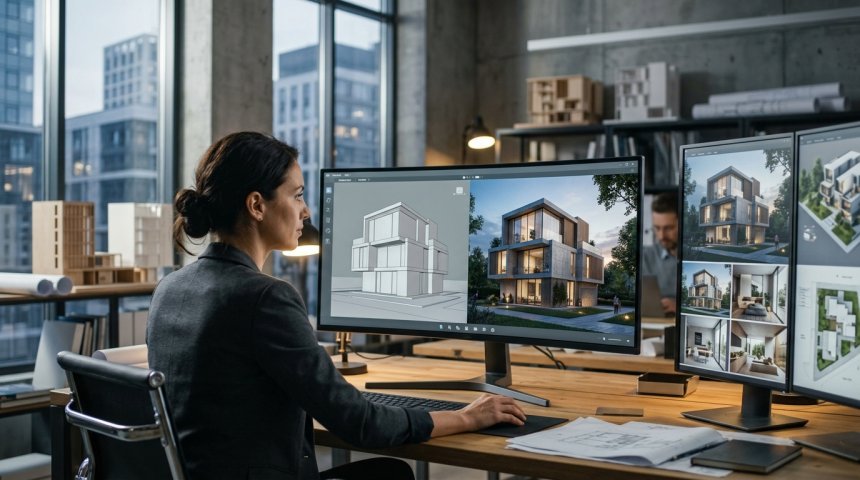
For decades, architectural visualization existed in a fundamental tension with the design process itself. Architects and developers needed visual representations to communicate ideas, secure approvals, attract investors, and sell properties—but producing those representations required specialized skills, expensive software, and significant time investment that conflicted with the rapid iteration demands of early-stage design. A concept sketch could be produced in minutes; a photorealistic rendering took days or weeks. This temporal mismatch forced professionals into uncomfortable choices: present crude visuals that failed to convey design intent, delay decisions while waiting for polished renderings, or invest heavily in visualization resources before design direction was validated.
AI rendering tools have collapsed this tension entirely. Platforms like XImagineAI and their competitors have reduced the gap between conceptual thought and visual representation from weeks to minutes, fundamentally altering how architecture and real estate projects move from imagination to realization. This isn't merely an efficiency improvement—it's a structural transformation of the design and development process itself. When visualization becomes instant, iteration becomes continuous. When photorealism becomes accessible, stakeholder communication becomes more effective. When rendering costs drop by orders of magnitude, projects that were previously economically unviable become feasible. The implications cascade through every stage of architectural practice and real estate development.
This guide examines how AI rendering is reshaping early-stage architecture and real estate visualization across technical, operational, economic, and creative dimensions. We'll explore the underlying technologies enabling this transformation, map specific applications across project phases, analyze platform capabilities including XImagineAI's distinctive approach, evaluate business model disruptions, address ethical and professional concerns, and project future trajectories. Whether you're an architect integrating AI into design workflows, a developer leveraging visualization for pre-sales and investor relations, a visualization studio adapting to technological disruption, or a technology professional building next-generation tools, this deep dive provides the comprehensive understanding needed to navigate and capitalize on this transformative moment.
Let's begin by understanding what AI rendering actually is and how it differs from traditional visualization methods.
Chapter 1: The Technology Behind AI Rendering — From Neural Networks to Photorealism
Understanding AI rendering requires distinguishing it from conventional rendering while appreciating the hybrid approaches emerging in production tools.
Traditional Rendering vs. AI Rendering
Traditional Rendering Pipeline: Conventional architectural visualization follows deterministic physics-based simulation. 3D geometry is constructed with precise materials, lighting is calculated through ray tracing or path tracing algorithms simulating photon behavior, and images are computed pixel-by-pixel through mathematical equations governing light transport. Results are physically accurate but computationally expensive—high-quality renders require hours to days of processing time even on powerful hardware. The pipeline demands specialized expertise in 3D modeling, texturing, lighting, camera composition, and post-processing. Each iteration requires re-rendering from scratch or complex scene adjustments.
AI Rendering Approach: AI rendering uses machine learning models trained on millions of image-text pairs and architectural datasets to generate or enhance visualizations through pattern recognition and synthesis rather than physics simulation. Instead of calculating how light bounces through a virtual scene, AI models predict what a rendered image should look like based on learned patterns from training data. Generation happens in seconds to minutes rather than hours to days. The process accepts diverse inputs—sketches, massing models, text descriptions, reference images—and produces photorealistic outputs without requiring complete 3D scene construction.
Hybrid Approaches (Current Production Reality): Most production AI rendering tools, including XImagineAI, combine AI generation with traditional rendering elements. AI accelerates or enhances specific pipeline stages rather than replacing the entire workflow. Common hybrid patterns include: AI-generated textures applied to traditional geometry, AI-enhanced lighting calculations accelerating ray tracing, AI upscaling lower-resolution renders to high resolution, AI style transfer applying artistic treatments to base renders, and AI inpainting filling gaps or modifying elements within traditionally rendered scenes. Hybrid approaches balance AI's speed advantages with traditional rendering's precision and controllability.
Core AI Technologies Enabling Architectural Visualization
Diffusion Models: The foundation of current AI image generation. Diffusion models learn to reverse a noise-addition process, progressively denoising random input into coherent images conditioned on prompts, sketches, or reference images. For architectural visualization, diffusion models generate building forms, interior spaces, landscapes, and atmospheric effects from minimal input. Fine-tuning on architectural datasets improves domain specificity over general-purpose models.
Neural Radiance Fields (NeRFs) and Gaussian Splatting: Emerging technologies reconstructing 3D scenes from 2D image collections. NeRFs learn volumetric scene representations enabling novel view synthesis from sparse photographs. Gaussian Splatting offers faster training and real-time rendering with comparable quality. Applications include existing condition documentation, heritage preservation, site context capture, and converting photograph collections into navigable 3D environments without manual modeling.
Super-Resolution and Upscaling Networks: AI models enhancing image resolution beyond native capture or render resolution. Enable faster rendering at lower resolutions followed by AI upscaling to final output quality. Reduce render times by 4-16x while maintaining visual fidelity. Critical for real-time preview workflows and rapid iteration cycles.
Semantic Segmentation and Scene Understanding: AI models identifying and labeling architectural elements (walls, windows, doors, furniture, vegetation, sky) within images. Enable selective editing, automated material assignment, intelligent masking, and context-aware generation. Foundation for tools allowing users to modify specific elements without affecting entire scene.
Text-to-Image and Image-to-Image Generation: Natural language prompting enabling non-specialists to generate architectural visualizations through descriptive text. Image-to-image transformation allowing style transfer, season changes, time-of-day adjustments, and material swaps from existing renders. Democratizes visualization access beyond trained specialists.
Generative Adversarial Networks (GANs): Earlier AI architecture still relevant for specific tasks: texture synthesis, facade generation, plan-to-elevation translation, and super-resolution. GANs excel at structured generation tasks where spatial relationships matter more than open-ended creativity. Often combined with diffusion models in hybrid architectures.
What Makes Architectural AI Different from General Image Generation
General-purpose AI image generators produce visually appealing but architecturally nonsensical outputs: impossible geometries, inconsistent perspectives, non-functional layouts, and structurally implausible forms. Architectural-specific AI tools address these limitations through:
Domain-Specific Training: Models trained exclusively or primarily on architectural imagery, floor plans, sections, and BIM data learn valid architectural conventions, proportional relationships, material behaviors, and spatial logic that general models lack.
Geometric Constraints: Integration with CAD/BIM platforms ensures AI outputs respect actual geometry rather than hallucinating forms. Constrained generation maintains design intent while applying visual enhancement.
Material and Lighting Accuracy: Architectural AI understands material properties (reflectivity, transparency, texture scale) and lighting physics sufficiently to produce believable results even when not computing full physics simulation.
Regulatory and Code Awareness: Emerging tools incorporate building code knowledge preventing generation of non-compliant configurations (egress violations, accessibility failures, zoning conflicts). Still early-stage but increasingly important for professional applications.
Iterative Refinement Workflows: Unlike one-shot general image generation, architectural AI supports progressive refinement through feedback loops, mask-based editing, parameter adjustment, and version history enabling designers to evolve outputs toward specific intentions rather than accepting single stochastic results.
Key Insight: For comprehensive technical documentation on XImagineAI's specific AI rendering capabilities, supported input formats, integration options, and workflow guides, XImagineAI Platform Features and Documentation (nofollow) provides official resources covering platform functionality, API access, and best practices for architectural and real estate visualization professionals.
Chapter 2: Early-Stage Architecture — How AI Rendering Transforms Design Exploration
The most profound impact of AI rendering occurs during early design phases when uncertainty is highest, iteration needs are greatest, and traditional visualization economics are most prohibitive.
Concept Development and Ideation
Rapid Visual Prototyping: AI rendering enables architects to visualize dozens of conceptual directions in the time previously required for one. Sketch-to-image workflows transform rough massing studies into atmospheric visualizations instantly. Text-prompted generation explores stylistic variations without manual modeling. This acceleration expands the solution space considered during ideation, reducing premature convergence on suboptimal designs simply because they were easiest to visualize.
Style and Atmosphere Exploration: Early design often involves exploring aesthetic directions before committing to detailed geometry. AI rendering excels at atmospheric visualization—mood, lighting, materiality, landscape integration—independent of precise dimensional accuracy. Architects can test Scandinavian minimalism against brutalist monumentality against biophilic warmth within hours, gathering stakeholder feedback on directional preferences before investing in detailed development of rejected approaches.
Contextual Integration Studies: Site-specific visualization historically required extensive context modeling. AI rendering generates plausible contextual environments from minimal input—photographs, satellite imagery, or simple massing blocks—enabling rapid assessment of how proposed designs relate to surroundings. Multiple contextual scenarios (seasonal variations, adjacent development possibilities, vegetation maturity stages) can be explored without rebuilding context models repeatedly.
Client Communication During Uncertainty: Early-stage clients struggle to evaluate abstract diagrams and massing models. AI rendering bridges the comprehension gap by translating conceptual ideas into relatable visualizations while maintaining appropriate abstraction levels signaling design fluidity. Clients engage more productively when they can see atmospheric intent without mistaking preliminary visualization for finalized design. Managing expectation calibration remains critical; AI's photorealism can misleadingly suggest resolution that doesn't exist.
Design Development and Iteration
Material and Finish Exploration: Traditional material visualization requires texture sourcing, UV mapping, shader configuration, and test rendering for each variation. AI rendering enables near-instantaneous material swapping and combination testing. Explore ten cladding options across three color palettes under four lighting conditions in an afternoon rather than weeks. Material exploration breadth directly correlates with design quality; AI removes the economic penalty of thorough investigation.
Lighting Design Integration: Daylighting and artificial lighting design traditionally required separate analysis and visualization workflows. AI rendering integrates lighting exploration into visual iteration, enabling simultaneous evaluation of spatial form and luminous environment. Test fenestration strategies, shading devices, and fixture layouts visually while assessing quantitative performance through integrated analysis tools. Lighting becomes a design variable explored continuously rather than a technical validation performed after form is fixed.
Stakeholder Feedback Cycles: Design review processes stall when stakeholders cannot evaluate proposals effectively. AI rendering accelerates feedback cycles by producing discussion-ready visualizations between meetings rather than requiring week-long rendering sprints. Real-time visualization during collaborative sessions enables immediate exploration of stakeholder suggestions, transforming reviews from presentation-and-wait cycles into active co-creation sessions. Faster feedback loops compress overall design timelines.
Regulatory and Community Review Support: Planning approvals and community consultations require visualizations communicating design intent to non-specialist audiences. AI rendering produces accessible visualizations quickly enough to respond to review comments within regulatory timelines rather than requesting extensions for rendering production. Multiple viewpoint generation from consistent models ensures comprehensive representation without selective framing accusations. Transparency in AI usage maintains trust with review bodies increasingly aware of visualization technologies.
Quantitative Impact on Design Process
Industry surveys and firm case studies document measurable impacts:
- Iteration Volume: Firms using AI rendering report 5-15x increase in design alternatives explored during concept phase compared to pre-AI workflows.
- Timeline Compression: Early-stage visualization phases compressed 40-70% on average, with greater compression for projects requiring extensive stakeholder consultation.
- Cost Reduction: Visualization costs per design alternative reduced 60-85% through AI augmentation, enabling broader exploration within fixed budgets.
- Stakeholder Satisfaction: Client and community approval rates improve when visualization responsiveness enables genuine dialogue rather than deferred feedback cycles.
- Design Quality Correlation: Firms correlating exploration breadth with design outcomes report improved competition win rates and post-occupancy evaluations when AI-enabled exploration expands considered solution space.
These metrics vary significantly by firm size, project type, and implementation maturity. Early adopters capturing competitive advantages may see diminishing returns as adoption broadens. Sustainable advantage comes from integrating AI into design thinking rather than treating it as isolated production tool.
Chapter 3: Real Estate Development and Marketing — Visualization as Business Infrastructure
Real estate development operates on different incentives than pure architectural practice. Visualization serves commercial objectives: securing financing, obtaining entitlements, pre-selling units, attracting tenants, and managing investor relations. AI rendering transforms visualization from marketing expense into strategic business infrastructure.
Pre-Construction Marketing and Sales
Off-Plan Sales Enablement: Residential and commercial developers sell unbuilt inventory based on visualization quality and credibility. AI rendering accelerates marketing asset production enabling earlier sales launches before traditional rendering pipelines complete. Faster market entry captures demand cycles and improves cash flow timing. Cost reduction enables marketing budgets stretching across more unit types, amenity spaces, and lifestyle scenarios rather than concentrating on hero shots only.
Customization and Personalization: Buyer customization programs traditionally required individual rendering for each option combination, limiting personalization scope due to cost. AI rendering enables real-time or near-real-time visualization of finish selections, layout modifications, and furnishing options during sales presentations. Buyers see their specific choices rather than generic representations, increasing emotional connection and purchase confidence. Customization breadth becomes competitive differentiator enabled by visualization economics transformation.
Virtual Tours and Immersive Experiences: AI-enhanced 360° panoramas, virtual staging, and interactive walkthroughs extend marketing reach beyond physical showrooms. Generate multiple room configurations, seasonal variations, and furnishing styles from base photography or minimal 3D data. Virtual experiences serve remote buyers, international investors, and time-constrained prospects who cannot visit physically. Production cost reduction makes immersive marketing viable for mid-market projects previously limited to luxury developments.
Marketing Asset Velocity: Real estate marketing campaigns require continuous content refresh maintaining audience engagement across months or years of sales periods. AI rendering enables rapid generation of seasonal updates, event tie-ins, demographic-targeted variations, and platform-specific formats from core assets. Content velocity sustains campaign momentum without proportional budget increases. A/B testing visual variations identifies highest-performing imagery optimizing conversion rates empirically rather than intuitively.
Investment and Financing Support
Investor Pitch Materials: Development feasibility depends on capital commitment based on projected outcomes. AI rendering produces compelling pitch materials quickly enough to match investment decision timelines. Multiple scenario visualization (base case, upside, downside) communicates risk-adjusted return profiles more effectively than static projections. Rapid iteration enables responsive refinement during investor discussions rather than delayed follow-up meetings.
Entitlement and Approval Processes: Municipal approvals require visualizations demonstrating compliance with design guidelines, contextual compatibility, and community benefit. AI rendering accelerates submission preparation and enables responsive revision during review cycles. Multiple alternative visualizations address reviewer concerns proactively rather than reactively. Speed matters when approval timelines affect land holding costs and market window capture.
Joint Venture and Partnership Communications: Complex development structures involve multiple stakeholders with varying expertise levels and interests. AI rendering translates technical design information into accessible visualizations facilitating alignment among financial partners, operating partners, public agencies, and community stakeholders. Shared visual understanding reduces miscommunication risks and accelerates consensus-building.
Property Management and Leasing
Tenant Improvement Visualization: Commercial leasing requires prospective tenants to envision customized spaces within base building shells. AI rendering enables rapid tenant-specific fit-out visualization during leasing negotiations. Multiple layout and finish options generated quickly support iterative space planning conversations. Visualization responsiveness shortens leasing cycles and improves tenant satisfaction with selected configurations.
Renovation and Repositioning Marketing: Property repositioning requires communicating transformation potential to prospective tenants or buyers before physical work begins. AI rendering visualizes renovated states from existing condition photography without extensive demolition or temporary staging. Before/after comparisons generated quickly support marketing narratives and justify renovation premiums. Phased renovation visualization communicates transition plans minimizing occupancy disruption concerns.
Facility Management and Space Planning: Operational space management benefits from accurate visualization of existing conditions and proposed modifications. AI-enhanced photographic documentation creates navigable visual records supporting maintenance planning, space allocation, and renovation scoping. As-built visualization from photographs reduces survey costs and improves accuracy over outdated drawings.
Chapter 4: Platform Capabilities and Comparative Analysis — Understanding XImagineAI in Context
The AI rendering landscape includes diverse platforms with varying strengths, specializations, and integration approaches. Understanding XImagineAI's positioning requires comparative context.
XImagineAI's Distinctive Approach
Based on available documentation and user reports, XImagineAI emphasizes several differentiating characteristics:
Sketch-to-Render Workflow Optimization: XImagineAI prioritizes sketch-input workflows recognizing that architects think through drawing. The platform accepts rough hand sketches, digital massing studies, and simplified line drawings as primary inputs, generating photorealistic outputs that preserve original design intent rather than imposing AI-generated forms. This sketch-fidelity focus distinguishes XImagineAI from text-prompt-dominant platforms where designer control is weaker.
Architectural Domain Specificity: Training data and model architecture emphasize architectural validity over general image aesthetics. Outputs demonstrate better understanding of structural logic, material behavior, proportional relationships, and functional spatial arrangements than general-purpose generators. Domain specificity reduces post-generation correction effort and increases usable output ratio.
Integration with Professional Workflows: XImagineAI targets integration with existing architectural software ecosystems rather than standalone operation. Plugin architectures, file format compatibility, and API access enable embedding AI rendering within established workflows rather than requiring parallel processes. Integration depth determines whether AI becomes adopted tool or abandoned novelty.
Iterative Refinement Controls: Beyond single-generation outputs, XImagineAI provides controls for progressive refinement: regional regeneration, parameter adjustment, style blending, and version comparison. Designers maintain agency throughout generation process rather than accepting stochastic outputs passively. Refinement capability distinguishes professional tools from consumer-grade generators.
Real Estate Marketing Specialization: Alongside architectural design support, XImagineAI addresses real estate marketing needs: virtual staging, lifestyle imagery, amenity visualization, and marketing asset generation. Dual focus serves integrated design-development workflows common in real estate organizations where design and marketing teams collaborate closely.
Comparative Landscape
Midjourney / Stable Diffusion / DALL-E: General-purpose generators with strong artistic capabilities but limited architectural validity. Excellent for mood boards, conceptual inspiration, and atmospheric exploration. Poor for design-specific visualization requiring geometric accuracy and functional coherence. Best used as complementary inspiration tools rather than primary visualization platforms.
Veras / ArkoAI / LookX: Architecture-specific AI rendering platforms competing directly with XImagineAI. Varying strengths in sketch fidelity, BIM integration, material accuracy, and output consistency. Evaluation requires project-specific testing; no universal "best" exists across all use cases. Trial multiple platforms against representative project requirements before committing.
Enscape / Lumion / Twinmotion: Traditional real-time rendering platforms integrating AI features incrementally. Stronger geometric accuracy and BIM integration than pure AI generators. Slower than pure AI for conceptual exploration but more reliable for design development and documentation. Hybrid workflows combining traditional real-time rendering with AI enhancement represent current professional sweet spot for many firms.
NVIDIA Omniverse / Unreal Engine 5: High-end platforms incorporating AI-accelerated rendering, NeRF integration, and generative capabilities. Maximum quality and flexibility with steeper learning curves and higher hardware requirements. Suited for large firms and specialized visualization studios rather than individual practitioners or small developers.
Selection Framework
Platform selection should consider:
Workflow Integration: Does the platform connect with your existing software ecosystem or require parallel workflows? Integration friction determines adoption likelihood regardless of output quality.
Input Flexibility: What input types does the platform accept effectively? Sketch-dominant workflows need sketch-fidelity platforms; BIM-centric workflows need geometry-aware platforms; marketing-focused workflows need photographic input support.
Output Control: Can you refine outputs iteratively toward specific intentions, or must you accept stochastic results? Professional applications require controllability; inspirational exploration tolerates randomness.
Domain Alignment: Does the platform understand architectural conventions, material behaviors, and spatial logic relevant to your work? General platforms produce aesthetically pleasing but architecturally invalid outputs requiring extensive correction.
Cost Structure: Pricing models vary significantly (subscription, per-generation, enterprise licensing). Match cost structure to usage patterns; high-volume users need different economics than occasional users.
Community and Support: Active user communities, documentation quality, and responsive support accelerate learning and problem resolution. Emerging platforms may offer superior technology but lack support infrastructure.
For authoritative industry benchmarking on AI adoption trends, tool preferences, and workflow integration patterns across architectural visualization professionals, the Chaos Group State of Architectural Visualization Report (dofollow) provides annual survey data covering technology adoption, workflow evolution, and industry sentiment essential for contextualizing platform selection decisions.
Chapter 5: Business Model Disruption and Economic Implications
AI rendering doesn't just change how visualizations are made; it changes who makes them, what they cost, and how value is captured across the architecture and real estate ecosystem.
Cost Structure Transformation
Traditional Visualization Economics: High-quality architectural visualization traditionally required $500-$3,000+ per rendered image or $2,000-$10,000+ per animation minute. Specialist firms employed teams of 3D artists, modelers, and post-production specialists. Turnaround times ranged from days to weeks. Costs justified limiting visualization to critical milestones and hero shots.
AI-Augmented Economics: AI rendering reduces per-image costs to $5-$50 for AI-generated outputs or $50-$200 for AI-enhanced traditional renders. Turnaround compresses to minutes or hours. Cost reduction enables visualization at every design stage rather than selective milestones. Budget reallocation shifts from production to exploration, strategy, and refinement.
Implications for Stakeholders:
Architects: In-house visualization becomes economically viable for firms previously outsourcing entirely. Design teams produce their own exploratory visualizations reserving specialist engagement for final presentation quality. Reduced outsourcing costs improve project margins or enable expanded services within fixed fees.
Visualization Studios: Pure production studios face margin compression and volume displacement. Survival requires moving upmarket into strategic consulting, creative direction, post-production refinement, and complex animation where human expertise remains differentiated. Studios integrating AI into workflows reduce costs while maintaining quality, capturing value from efficiency rather than labor hours.
Developers: Marketing visualization budgets stretch further enabling more assets, faster campaigns, and broader market testing. Pre-sales acceleration improves cash flow timing. Reduced visualization dependency lowers project risk during entitlement and financing phases.
Clients: Lower visualization costs reduce professional service fees or expand deliverables within existing budgets. Faster visualization accelerates decision-making compressing overall project timelines. Greater visualization accessibility democratizes design participation for smaller clients previously priced out of comprehensive visualization services.
Service Model Evolution
From Production to Strategy: As AI commoditizes basic rendering production, value shifts toward strategic application: knowing what to visualize, when, for whom, and how to interpret results. Professionals who combine AI fluency with design judgment, marketing insight, and stakeholder communication skills command premiums over pure production providers.
From Deliverables to Processes: Traditional visualization sold discrete deliverables (images, animations). AI-enabled visualization sells continuous processes (iterative exploration, real-time collaboration, dynamic customization). Billing models shift from per-image pricing to retainer, subscription, or value-based arrangements reflecting ongoing engagement rather than transactional output.
From Specialist to Integrated: Visualization expertise distributes across design teams rather than concentrating in specialist silos. Architects, developers, and marketers develop baseline AI visualization literacy reserving specialist engagement for advanced applications. Integration reduces handoff friction and accelerates feedback loops.
Market Access Democratization
AI rendering lowers barriers to entry across multiple dimensions:
Small Firms and Solo Practitioners: Previously unable to compete with larger firms' visualization capabilities, small practices now produce competitive visualizations independently. Market access expands enabling participation in competitions, client pitches, and marketing activities previously requiring visualization budgets beyond small firm means.
Emerging Markets: Regions with limited visualization specialist availability gain access through AI platforms requiring less local expertise. Global talent distribution becomes less constrained by geographic concentration of specialized skills.
Non-Traditional Stakeholders: Community groups, advocacy organizations, and individual citizens can produce visualizations supporting participatory planning processes previously dominated by professionally-resourced developers and agencies. Democratization carries both positive (broader participation) and challenging (misinformation risk) implications.
Education and Training: Students and early-career professionals develop visualization skills through accessible AI tools before mastering traditional techniques. Pedagogical approaches evolve integrating AI as foundational literacy alongside traditional rendering education. Risk of skill gaps if AI replaces rather than complements fundamental understanding.
Chapter 6: Ethical, Legal, and Professional Considerations
Technological capability doesn't automatically confer ethical appropriateness or legal safety. AI rendering introduces considerations requiring proactive management.
Authenticity and Misrepresentation
The Photorealism Trap: AI rendering produces photorealistic images from incomplete or speculative design information. This creates risk of stakeholders mistaking conceptual visualization for resolved design. Misaligned expectations lead to disappointment, disputes, and eroded trust when built reality diverges from AI-generated imagery.
Mitigation Strategies:
- Clearly label AI-generated visualizations as conceptual, illustrative, or preliminary
- Maintain appropriate abstraction levels matching design resolution stage
- Include disclaimers specifying what is and isn't resolved in visualizations
- Educate stakeholders on interpreting AI visualization appropriately
- Reserve photorealism for design stages where detail resolution justifies fidelity
- Document design intent separately from visualization to maintain clarity
Regulatory and Legal Exposure: Misleading visualizations in real estate marketing can trigger consumer protection violations, false advertising claims, and contractual disputes. Regulatory bodies increasingly scrutinize AI-generated marketing materials. Maintain documentation distinguishing conceptual visualization from guaranteed specifications. Legal review of marketing materials incorporating AI rendering advisable before publication.
Intellectual Property and Training Data
Copyright Ambiguity: AI models trained on copyrighted architectural imagery raise unresolved questions about derivative work status, fair use applicability, and creator compensation. Legal frameworks lag behind technological capability. Users face uncertain liability exposure depending on jurisdiction and evolving case law.
Best Practices:
- Use platforms transparent about training data sources and licensing
- Prefer platforms trained on licensed or public domain datasets
- Document AI tool usage and output generation processes
- Avoid generating outputs closely resembling identifiable copyrighted works
- Monitor legal developments adjusting practices as clarity emerges
- Consider contractual protections when engaging AI visualization services
Authorship and Attribution: AI-generated visualization authorship remains contested. Professional credentials, liability responsibility, and credit attribution require clear agreements among designers, AI platform providers, and clients. Establish attribution protocols before project commencement avoiding disputes upon completion.
Professional Standards and Competency
Skill Evolution Requirements: Professional competency definitions evolve as AI reshapes practice. Architects and visualization professionals must develop AI literacy alongside traditional skills. Continuing education, certification programs, and professional development adapt to incorporate AI competencies. Maintaining relevance requires active skill updating.
Quality Assurance Challenges: AI outputs require critical evaluation against professional standards. Automated generation doesn't guarantee code compliance, structural validity, or functional adequacy. Professionals retain responsibility for verification regardless of generation method. QA processes must adapt to AI-specific failure modes.
Educational Implications: Architecture and design education faces curriculum adaptation pressure. Balance AI tool proficiency with fundamental design understanding ensuring graduates can evaluate AI outputs critically rather than accepting them uncritically. Risk of skill atrophy if AI replaces rather than augments foundational learning.
Bias and Representation
Training Data Bias: AI models reflect biases present in training data. Architectural training datasets historically overrepresent Western, male-dominated, and socioeconomically privileged design traditions. Generated outputs may perpetuate exclusionary aesthetics, cultural erasure, or stereotypical representations unless actively mitigated.
Mitigation Approaches:
- Audit outputs for representational bias across cultural, geographic, and socioeconomic dimensions
- Supplement AI generation with diverse reference materials expanding stylistic range
- Critically evaluate default outputs rather than accepting uncritically
- Support platforms addressing training data diversity explicitly
- Incorporate diverse perspectives in design review processes catching bias before dissemination
Chapter 7: Implementation Strategy — Integrating AI Rendering Into Practice
Successful AI rendering adoption requires deliberate integration strategy rather than ad hoc experimentation.
Assessment and Planning
Current State Audit: Map existing visualization workflows identifying bottlenecks, pain points, cost drivers, and quality gaps. Understand where AI could add value versus where traditional methods remain superior. Baseline metrics enable impact measurement post-implementation.
Use Case Prioritization: Identify highest-value AI rendering applications specific to your practice. Early-stage concept exploration, client communication, marketing asset generation, and iterative design refinement typically offer strongest initial ROI. Complex technical documentation, construction documentation, and regulatory submissions may remain traditional-rendering-dominant longer. Prioritize implementations delivering measurable value quickly building organizational confidence.
Platform Evaluation: Test multiple platforms against representative project requirements. Evaluate output quality, workflow integration, learning curve, cost structure, and support responsiveness. Involve end-users in evaluation ensuring selected platforms match actual workflow needs rather than feature checklists. Pilot with low-risk projects before organization-wide deployment.
Skill Development Planning: Assess team AI literacy identifying training needs. Develop structured learning pathways combining platform-specific training with conceptual understanding of AI capabilities and limitations. Allocate dedicated learning time rather than expecting absorption alongside production workload. Identify internal champions supporting peer learning.
Phased Implementation
Phase 1: Exploration and Validation (Months 1-3)
- Pilot AI rendering on 2-3 representative projects
- Test multiple platforms and workflows
- Document successes, failures, and learnings
- Establish quality benchmarks and acceptance criteria
- Build internal knowledge base and best practices
- Validate ROI assumptions against actual results
Phase 2: Integration and Standardization (Months 4-8)
- Deploy validated workflows across applicable project types
- Develop standardized processes, templates, and quality controls
- Train broader team members on adopted platforms and workflows
- Integrate AI rendering into project planning and budgeting
- Establish vendor relationships and licensing agreements
- Measure performance against baseline metrics
Phase 3: Optimization and Expansion (Months 9-18)
- Refine workflows based on accumulated experience
- Expand AI rendering to additional use cases validated through piloting
- Develop advanced capabilities (custom model training, API integrations, automation)
- Share learnings internally and externally building thought leadership
- Evaluate emerging platforms and technologies for next-generation adoption
- Continuously measure ROI and adjust strategy accordingly
Change Management
Cultural Resistance Anticipation: AI adoption triggers legitimate concerns about skill obsolescence, quality degradation, and professional identity. Acknowledge concerns openly rather than dismissing them. Position AI as augmentation enabling professionals to focus on higher-value activities rather than replacement eliminating roles. Celebrate early wins building momentum.
Role Evolution Communication: Clearly communicate how roles evolve with AI integration. Designers gain exploration capacity; visualization specialists shift toward strategy and refinement; marketers gain content velocity. Evolution creates opportunity alongside disruption. Transparent communication reduces anxiety and builds alignment.
Feedback Mechanisms: Establish channels for ongoing feedback during implementation. Frontline users identify issues and opportunities invisible to leadership. Regular check-ins, surveys, and open forums surface problems early enabling course correction. Feedback incorporation demonstrates organizational commitment to successful adoption.
Chapter 8: Future Trajectories — What Comes Next
AI rendering continues evolving rapidly. Anticipating trajectories enables proactive positioning.
Near-Term Developments (1-2 Years)
Improved Geometric Fidelity: AI models increasingly respect input geometry reducing hallucination and improving design intent preservation. Tighter BIM/CAD integration enables AI rendering directly from design models without export/import friction.
Real-Time Interactive Visualization: AI-accelerated real-time rendering enables interactive design exploration with photorealistic quality. Designers manipulate parameters seeing immediate visual feedback. Client presentations become collaborative exploration sessions rather than static slide shows.
Multimodal Input Expansion: Platforms accept increasingly diverse inputs: voice descriptions, gesture sketches, spatial computing inputs, sensor data. Natural interaction modalities reduce learning curves and expand accessibility beyond trained specialists.
Regulatory and Code Integration: AI tools incorporate building code knowledge flagging non-compliant configurations during generation. Automated compliance checking integrated with visualization streamlines approval processes. Still early but trajectory clear.
Medium-Term Evolution (2-5 Years)
Generative Design Integration: AI rendering merges with generative design creating closed-loop systems where visual evaluation feeds back into design generation. Systems propose, visualize, evaluate, and iterate autonomously within defined constraints. Human role shifts to constraint definition, evaluation criteria setting, and final selection.
Personalized and Adaptive Visualization: Visualizations adapt dynamically to viewer preferences, contexts, and devices. Prospective buyers see personalized finish options; community reviewers see contextual integration; technical reviewers see performance overlays. Single source assets generate tailored outputs automatically.
Cross-Disciplinary Integration: AI rendering connects architectural visualization with engineering analysis, environmental simulation, cost estimation, and facility management. Unified digital twins integrate visual, performance, and operational data enabling holistic decision-making across project lifecycle.
Democratization Acceleration: Continued cost reduction and usability improvement expand AI rendering access to smaller firms, emerging markets, educational institutions, and non-professional stakeholders. Participation barriers lower enabling broader involvement in design and development processes.
Long-Term Transformation (5-10+ Years)
Autonomous Design Assistance: AI systems function as collaborative design partners proposing solutions, identifying issues, and generating visualizations proactively rather than reactively. Human-AI collaboration becomes normative rather than exceptional. Professional roles evolve toward curation, judgment, and relationship management.
Immersive and Spatial Computing Integration: AI rendering powers AR/VR/MR experiences enabling embodied spatial understanding beyond screen-based visualization. Design evaluation occurs within simulated environments at full scale. Remote collaboration happens within shared virtual spaces indistinguishable from physical presence.
Sustainability and Performance Integration: Visualization inherently linked to environmental performance data enabling design decisions balancing aesthetics, function, and sustainability simultaneously. Carbon footprint, energy performance, and lifecycle impacts visible alongside visual appearance informing integrated decision-making.
Cultural and Contextual Intelligence: AI systems develop deeper understanding of cultural, historical, and social contexts generating visualizations respectful of local traditions, community values, and place-specific identities. Global technology adapts to local specificity rather than imposing homogenized aesthetics.
Conclusion: Embracing Transformation Responsibly
AI rendering represents one of the most significant technological shifts in architectural visualization history. Tools like XImagineAI and their competitors have democratized photorealistic rendering, accelerated design iteration, transformed stakeholder communication, and reshaped business economics across architecture and real estate development. The transformation is real, substantial, and irreversible.
But technological capability alone doesn't determine outcomes. How professionals, firms, and organizations integrate AI rendering determines whether transformation elevates practice or undermines it. Thoughtful integration enhances human creativity, expands exploration capacity, improves communication effectiveness, and creates new value. Careless adoption risks quality degradation, skill atrophy, misrepresentation, and ethical compromise.
The path forward requires balancing enthusiasm with discernment. Embrace AI rendering's possibilities while maintaining critical judgment about its limitations. Develop new skills while preserving foundational understanding. Accelerate workflows while protecting quality standards. Democratize access while maintaining professional responsibility. Innovate boldly while respecting ethical boundaries.
The professionals and organizations thriving in this transformed landscape won't be those with the most advanced AI tools. They'll be those who integrate AI thoughtfully into deeper understanding of design, development, communication, and human experience. Technology enables; wisdom directs. Combine both.
The future of architectural visualization is being written now. Write it well.
Frequently Asked Questions (FAQs)
Can AI rendering completely replace traditional architectural visualization?
Not currently, and likely not comprehensively in foreseeable future. AI rendering excels at early-stage exploration, rapid iteration, atmospheric visualization, and marketing asset generation. Traditional rendering remains superior for precise geometric accuracy, technical documentation, construction-level detail, and legally binding representations. Most professional workflows adopt hybrid approaches leveraging AI for speed and exploration while retaining traditional methods for precision and validation. Complete replacement would require AI advances in geometric fidelity, code compliance, and deterministic accuracy that don't yet exist. Treat AI as powerful complement rather than wholesale substitute.
How accurate are AI-generated architectural visualizations for decision-making?
Accuracy varies significantly by platform, input quality, and application. AI rendering produces atmospherically convincing but geometrically approximate outputs suitable for conceptual exploration and stakeholder communication. Dimensions, material specifications, structural details, and code compliance cannot be trusted without verification against authoritative sources. Use AI visualization for directional decisions and communication; use validated BIM/CAD documentation for technical decisions and contractual commitments. Always clearly communicate accuracy limitations to stakeholders preventing misaligned expectations. Accuracy improves continuously but critical evaluation remains essential.
What skills do architects and designers need to use AI rendering effectively?
Effective AI rendering requires combination of traditional and new competencies: foundational architectural understanding enabling critical evaluation of AI outputs; prompt engineering and input preparation skills for effective AI communication; visual literacy distinguishing quality outputs from flawed ones; workflow integration knowledge connecting AI tools with existing design processes; ethical awareness regarding authenticity, bias, and professional responsibility; and continuous learning orientation adapting to rapidly evolving capabilities. AI doesn't eliminate need for design expertise; it shifts expertise toward curation, evaluation, and strategic application. Professionals lacking foundational design knowledge produce aesthetically appealing but architecturally invalid outputs regardless of AI fluency.
How do I choose between XImagineAI and other AI rendering platforms?
Selection depends on specific workflow requirements rather than universal superiority. Evaluate platforms against your primary use cases: sketch-fidelity for concept exploration, BIM integration for design development, marketing specialization for real estate applications, or general versatility for diverse needs. Test multiple platforms with representative project inputs comparing output quality, workflow integration, iteration control, learning curve, and cost structure. Involve end-users in evaluation ensuring selected platforms match actual workflows. Consider vendor stability, support quality, and roadmap alignment with long-term needs. No single platform excels universally; optimal choice is context-dependent. Trial periods and pilot projects provide empirical basis for selection superior to feature comparison alone.
What are the legal risks of using AI-generated architectural visualizations?
Primary legal risks include: misrepresentation claims if stakeholders mistake conceptual AI visualization for guaranteed specifications; copyright infringement if AI outputs substantially reproduce protected works; intellectual property ambiguity regarding ownership of AI-generated content; consumer protection violations in real estate marketing using misleading visualizations; and professional liability if reliance on inaccurate AI outputs causes harm. Mitigation includes clear labeling of AI-generated content, disclaimers specifying resolution level, documentation distinguishing conceptual from guaranteed elements, legal review of marketing materials, platform selection with transparent training data practices, and professional judgment verifying AI outputs against authoritative sources. Legal frameworks continue evolving; consult qualified counsel for jurisdiction-specific guidance. Proactive risk management prevents reactive crisis response.
Share
What's Your Reaction?
 Like
0
Like
0
 Dislike
0
Dislike
0
 Love
0
Love
0
 Funny
0
Funny
0
 Angry
0
Angry
0
 Sad
0
Sad
0
 Wow
0
Wow
0