Stargazing Tour Business: The 2026 Dark Sky Guide
How to build a profitable stargazing micro-tour business in 2026. Site scouting, telescope gear, premium pricing, marketing hooks, and scaling operations.

There is a specific kind of vertigo that hits you when you look through a properly aligned telescope at the rings of Saturn for the first time. It isn't just visual; it's existential. Your brain, which has spent its entire life navigating the flat, two-dimensional screens of modern existence, suddenly confronts the raw, three-dimensional depth of the cosmos. You see the shadow of the planet cast across the ice rings. You realize that the light hitting your retina left the gas giant an hour and a half ago. For a fleeting, breathless second, the mortgage, the unread emails, the political noise, and the relentless grind of the 24-hour news cycle simply evaporate. You are standing on a wet rock spinning through an infinite void, and you have never felt more alive.
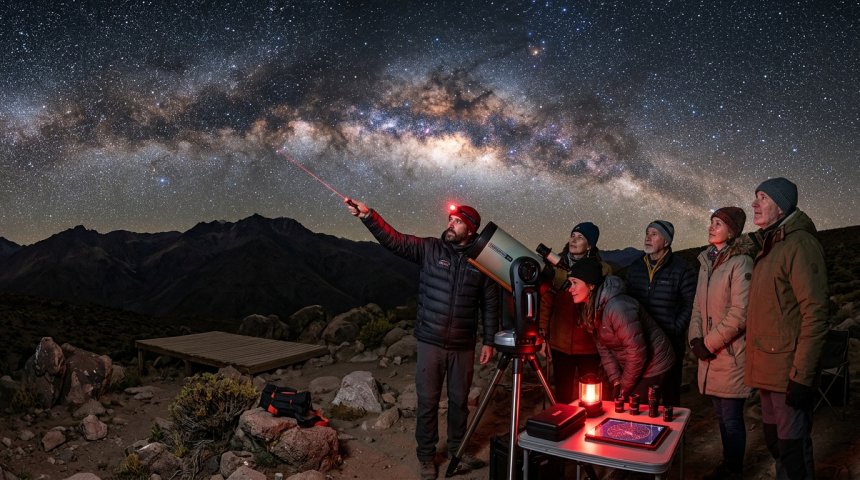
Now, imagine you are the person who orchestrated that exact moment. Imagine you are the one who scouted the dark-sky site away from the city glow, who set up the equatorial mount in the freezing dark, who aligned the finder scope, and who guided a group of six shivering strangers into a profound encounter with the universe. You didn't just point at a dot in the sky; you curated a psychological reset. And for that two-hour window of time, you were paid $95 per person to do it.
This is the essence of the Stargazing Micro-Tour business.
In the landscape of 2026 entrepreneurship, where digital markets are saturated, software margins are compressing, and the hustle culture has left an entire generation burned out and craving genuine connection, the micro-adventure economy is booming. But within that economy, the stargazing tour occupies a unique, almost magical niche. It requires moderate capital to start (mostly in optical equipment), it boasts profit margins north of 80%, and it sells an emotional and spiritual transformation rather than a physical commodity.
Light pollution has robbed an entire generation of the Milky Way. Most urban dwellers have never seen more than a dozen stars at once. They are starved for the dark, for the quiet, and for perspective. They want someone else to handle the logistics of escaping the city glow so they can just show up and experience the awe.
This guide is the operational manual for turning a love of the night sky into a highly profitable, scalable, and legally protected enterprise. We are going to cover everything from the topography of dark-sky site selection to the psychology of premium pricing, from the optical physics of choosing your telescopes to the marketing hooks that sell out your new-moon weekends months in advance. Let’s look up.
The Psychology of the Dark: Why People Pay for the Void
To sell this experience effectively, you must first understand the deeply irrational, beautifully human reasons why someone would willingly drive an hour into the middle of nowhere on a Tuesday night, stand in the freezing cold, and stare into the blackness.
They aren't paying you for astronomy lessons. If they wanted a lecture, they would watch a documentary on Netflix in climate-controlled comfort. They are paying you for a combination of four powerful psychological drivers:
1. The Antidote to Hyper-Stimulation
Modern life is a relentless assault of artificial light and digital noise. We are chronically overstimulated. Our circadian rhythms are shattered by blue light, and our attention spans are fractured by constant notifications. A stargazing tour is a radical act of sensory deprivation. When you turn off the red lights and let the group sit in absolute silence for five minutes to let their eyes adapt, you are giving their nervous systems permission to power down. The darkness isn't empty; it's a relief. You are selling a vacation from the artificial world.
2. The Overview Effect (Grounded)
Astronauts famously report experiencing the "Overview Effect"—a cognitive shift in awareness when viewing the Earth from space, realizing its fragility and unity. You cannot take your guests to orbit, but you can induce a grounded version of this effect. When you show them the Andromeda Galaxy—a smudge of light that contains a trillion suns and is 2.5 million light-years away—you force a perspective shift. Their personal problems don't disappear, but they are instantly resized. This cosmic humility is deeply therapeutic, and people will pay a premium for a guided experience that safely induces it.
3. The Exclusivity of the Unseen
The daytime sky belongs to everyone. The night sky, in its true glory, belongs to a secret society. By driving past the light domes of the city, your guests gain access to a VIP section of the universe that 90% of the population will never witness. They get to see the Milky Way arching overhead like a river of diamond dust. This exclusivity is highly Instagrammable (even if the photos rarely do it justice), but more importantly, it feeds a deep human desire to be part of the "in-crowd" who are willing to put in the effort to witness the extraordinary.
4. Shared Awe and Instant Community
Awe is a pro-social emotion. When a group of strangers looks through a telescope at the Orion Nebula and collectively gasps, a bond is formed. They share stories of what they remember about the stars from childhood. They point out constellations to each other. You are facilitating deep human connection through a shared encounter with the infinite. In an era of profound loneliness, this communal experience of wonder is incredibly valuable.
Site Topography: Scouting the Perfect Dark Sky
Your entire business hinges on the quality of your dark-sky site. If the site is too close to the city, the skyglow will wash out the Milky Way and the deep-sky objects, leaving your guests disappointed. If it's too far, the drive becomes a barrier to entry. If it's unsafe or legally ambiguous, you are building a liability nightmare.
The perfect stargazing site is a carefully engineered compromise. Here are the non-negotiable criteria for selecting your flagship location:
The Bortle Scale Benchmark
The Bortle Dark-Sky Scale is a nine-level numeric scale that measures the night sky's brightness. Class 9 is inner-city sky (you can see maybe 10 stars). Class 1 is a pristine, world-class dark site (you can see the zodiacal light and the Milky Way casts shadows). You need a site that is consistently Bortle 4 or lower. At Bortle 4, the Milky Way is highly structured and impressive, but you might still see a faint glow on the horizon from a distant city. At Bortle 3 or 2, the experience is transcendent. Use light pollution maps (like lightpollutionmap.info) to identify the dark pockets within a 60-to-90-minute drive of your target metropolitan area.
The Horizon and Topography
You want a site with a relatively flat, open horizon, especially to the south and west (where the galactic center and most deep-sky objects reside in the Northern Hemisphere). Avoid sites nestled in deep valleys where the trees or mountains block 30% of the sky. However, a slight elevation (a hilltop or a plateau) is beneficial because it gets you above the low-lying ground fog and atmospheric turbulence.
The Legal and Safety Framework
Do not just pull over on the side of a rural road. That is illegal, dangerous, and unprofessional. You need a sanctioned location.
- State Parks and National Forests: Many have designated amphitheaters or open fields. You will likely need a Commercial Use Authorization (CUA) or a Special Use Permit. The application process can take months, but it provides legal cover and legitimacy.
- Private Land Partnerships: This is often the fastest route. Approach farmers, ranchers, or owners of large rural properties (vineyards, event barns, remote Airbnbs) located in dark-sky zones. Offer them a flat fee per tour (e.g., $100 per night) or a percentage of ticket sales in exchange for using their pasture or field. They get passive income; you get a private, secure, legally cleared location with zero public interference.
- Safety and Accessibility: The site must be accessible by a standard sedan (no 4x4 required unless you are specifically marketing an extreme adventure). The ground must be relatively flat and free of hidden holes, gopher burrows, or tripping hazards. There must be a safe, paved or gravel area to park vehicles so guests aren't walking through muddy fields in the dark. Crucially, there must be zero risk of stray light—no nearby streetlights, no illuminated billboards, and no neighbors who leave their porch lights on.
The Scouting Process
Never, ever run a commercial trip to a site you haven't personally tested under the exact conditions you will be hosting. You need to visit the site during a new moon phase. Set up your gear. Measure the sky quality with a Sky Quality Meter (SQM). Note the wind patterns (wind kills telescope stability). Identify the nearest restroom facilities (or plan for a portable solution). Map out exactly where the telescopes will go, where the guests will gather, and where the vehicles will park to ensure no headlights accidentally blind the group during the session.
The Gear Arsenal: Optics as Your Inventory
Your equipment is your inventory. If you bring a cheap, wobbly department store telescope, you will destroy your reputation and your margins. You need professional-grade, reliable, and visually stunning optical equipment. But you also need to balance aperture (light-gathering power) with portability and setup speed.
The Visual Workhorses: Dobsonian Telescopes
For a stargazing tour, your primary goal is visual impact. You want guests to look through the eyepiece and see crisp, bright, detailed views of planets, star clusters, and galaxies. The undisputed king of visual astronomy is the Dobsonian reflector.
- The 8-inch or 10-inch Dobsonian: This is your bread and butter. An 8-inch Dobsonian (like the Apertura AD8 or Zhumell Z8) costs around $500-$700. It gathers enough light to show spectacular views of Saturn's rings, Jupiter's cloud bands, the Orion Nebula, and hundreds of deep-sky objects. It uses a simple alt-azimuth mount that is incredibly intuitive for beginners to use.
- Why not computerized GoTo mounts? Computerized mounts (which automatically slew to objects) are expensive, require precise alignment, need power sources, and are prone to software glitches in the cold. For a tour, you want reliability. You will learn the sky well enough to use a star-hopping method or a simple red-dot finder to locate objects manually. It’s faster, more reliable, and allows you to control the narrative.
The Wide-Field Wonder: Binoculars on a Tripod
Not everything requires high magnification. Some of the most breathtaking views in the night sky—the Pleiades star cluster, the Milky Way star clouds, the double cluster in Perseus—are best seen with wide-field optics. Invest in two or three pairs of high-quality 10x50 or 15x70 astronomical binoculars (Vortex, Nikon, or Celestron). Crucially, mount them on sturdy photography tripods with a binocular adapter. Handholding binoculars at 10x magnification is shaky and fatiguing. A tripod-mounted pair provides a rock-solid, immersive view that often elicits louder gasps than the telescopes.
The Astrophotography Rig (The Marketing Engine)
While your guests are looking through the visual telescopes, you need a camera capturing the sky. Human eyes cannot see color in deep-sky objects (galaxies appear grey/greenish through an eyepiece because our rod cells dominate in low light). But a camera can. Set up a dedicated DSLR or mirrorless camera on a star tracker (like the Sky-Watcher Star Adventurer) with a fast wide-angle lens. Throughout the night, capture long-exposure images of the Milky Way or the Orion Nebula. These vibrant, colorful images are your marketing gold. You will share them with your guests after the tour, and they will post them on social media, tagging your business. You are selling the visual experience, but you are marketing the photographic result.
The Hospitality and Safety Kit
Your backpack is a mobile basecamp. Here is what you must carry on every single trip, without exception:
- Lighting: High-quality red-light headlamps for yourself and every guest. Red light preserves night vision. White light destroys it for 20 minutes. Bring a few backup red flashlights.
- Comfort: Zero-gravity camping chairs or thick foam sitting pads. Standing in the cold for two hours is miserable. Provide hand warmers for guests who forgot gloves.
- Hospitality: A high-quality, insulated thermos filled with hot herbal tea, hot cider, or coffee. A stack of reusable or compostable cups. The ritual of sharing a warm drink in the freezing dark is a massive part of the hospitality experience.
- Tech: A fully charged tablet or smartphone with a offline astronomy app (like Stellarium or SkySafari) to use as a reference. A portable Bluetooth speaker for playing low-volume, ambient space music during the arrival/setup phase (turn it off once the serious observing begins). A laser pointer (green, 5mW) for pointing out constellations—use sparingly and responsibly, never near aircraft.
The Operational Mechanics: Choreographing the Cosmos
A successful stargazing tour looks effortless to the guest, but behind the scenes, it is a tightly choreographed operation dependent on celestial mechanics and weather patterns. When you are dealing with tired people, cold temperatures, and absolute darkness, there is zero room for improvisation.
The Lunar Calendar: Your Master Schedule
You cannot run this business on a standard calendar. Your schedule is dictated by the moon.
- New Moon Phase: This is your prime time. The sky is darkest. The Milky Way is visible. Deep-sky objects (galaxies, nebulae) are at their best. You schedule your flagship tours exclusively during the 5 days before and 5 days after the new moon.
- First/Third Quarter: The moon sets early or rises late, giving you a few hours of dark sky. You can run modified tours focusing on planets or bright star clusters before the moon interferes.
- Full Moon: The sky is washed out. Deep-sky observing is impossible. Do not run standard tours. Instead, pivot to "Lunar Observation" tours (focusing entirely on craters and lunar geology) or take the week off to rest and handle admin work.
The Pre-Trip Communication Sequence
The experience begins 48 hours before the tour. Your automated booking system should trigger a sequence of emails that manage expectations and reduce anxiety.
- 48 Hours Out: The detailed prep guide. Emphasize WARMTH. "If you think you are dressed warmly enough, add another layer. Standing still in the dark is colder than you expect." Recommend thermal base layers, heavy coats, hats, and gloves. Tell them to avoid white clothing. Include a precise Google Maps pin for the meeting point and a photo of what the parking area looks like.
- 24 Hours Out: The weather check. This is the most critical email. Astronomy is entirely weather-dependent. If the forecast calls for >50% cloud cover, high humidity, or poor transparency, you must make the call to cancel or reschedule. Be decisive. Guests will secretly thank you for not making them drive an hour into the dark to stare at the bottom of a grey cloud. If the weather is clear but cold, reiterate the temperature so they can dress appropriately.
- 3 Hours Out: The final reminder. "The sky is clearing. The telescopes are coming out. See you at the coordinates."
The Pacing Strategy: From Light to Dark
When the group arrives, it will likely still be twilight or early evening. Do not rush them into the telescopes. Their eyes are still adapted to daylight.
- Phase 1: Arrival and Orientation (30 mins): Welcome them. Serve the hot drinks. Let them stretch their legs. Play low ambient music. Give a brief safety talk (stay on the path, don't trip over the tripod legs, use only red lights). Point out the brightest objects visible to the naked eye (Venus, Jupiter, the first appearing stars).
- Phase 2: The Naked Eye Tour (20 mins): Turn off all lights. Enforce a strict 5-minute silence to allow everyone's eyes to fully dark-adapt. Use the green laser to trace the major constellations visible that season. Tell the mythological stories behind them. This grounds the group and builds anticipation.
- Phase 3: The Telescope Rotation (60-75 mins): This is the main event. Have 2-3 telescopes set up, each pointed at a different type of object (e.g., Scope 1: Saturn/Jupiter, Scope 2: Orion Nebula, Scope 3: A globular cluster). Move the group in small batches between the scopes. Spend 2-3 minutes at each scope explaining what they are seeing, the distance, the scale. Keep the rotation moving so nobody is waiting in the cold for more than 5 minutes.
- Phase 4: The Binocular Immersion and Q&A (20 mins): Bring out the tripod-mounted binoculars. Let people scan the Milky Way freely. Gather the group around the fire pit or the vehicles for a final Q&A session. Answer questions about aliens, black holes, and space travel. This is where the community bonding happens.
- Phase 5: Departure: Thank them. Remind them to drive carefully (their night vision will make the headlights of oncoming cars blinding for a few minutes). Send them off with a promise of the photo gallery.
Legal Armor and Risk Management: Protecting the Livelihood
Let’s have a brutally honest conversation about liability. You are taking people into remote, unlit environments in the middle of the night. People trip over tripod legs in the dark. People wander off paths and twist ankles. People drive home on dark rural roads with compromised night vision. If someone gets hurt on your watch, they will look for someone to blame, and their lawyer will look for someone to sue.
You cannot eliminate risk entirely—that's the nature of the adventure—but you can mitigate it to a level where your business is protected.
The Corporate Structure
Do not operate as a sole proprietorship. Form a Limited Liability Company (LLC) in your state immediately. This creates a legal firewall between your personal assets (your house, your car, your personal savings) and the liabilities of the business. If the business gets sued, they can only go after the assets inside the LLC. It costs a few hundred dollars and takes a week to set up online. There is no excuse not to do this.
Specialized Insurance
General liability insurance is not enough. You need Outdoor Recreation / Guide Insurance. Standard business policies often have exclusions for "nighttime activities" or "remote guiding." Companies like World Nomads, Adventure Insurance, or specialized brokers offer policies specifically designed for outdoor guides. Expect to pay between $600 and $1,200 per year for a policy that covers up to $1-$2 million in liability. This is the cheapest peace of mind you will ever buy. Do not lead a single paying trip without it.
The Ironclad Waiver
Your Assumption of Risk and Liability Waiver is your shield. Do not download a generic template from the internet. Pay a local attorney who specializes in outdoor recreation law $500 to draft a bulletproof waiver tailored to your specific state laws and your specific activity. The waiver must clearly state:
- Stargazing involves inherent risks (darkness, uneven terrain, tripping hazards, remote location, wildlife).
- The guest acknowledges they are responsible for their own safe navigation in the dark.
- The guest assumes all risks, including injury.
- The guest agrees not to sue the company or its guides.
- The guest grants permission for you to use photos taken during the trip for marketing.
Use a digital waiver platform like Smartwaiver, DocuSign, or the waiver integration built into your booking software (like FareHarbor or Peek Pro). The waiver must be signed digitally before they can complete the booking. No waiver, no tour. If someone shows up at the site and says "I didn't get the email," you politely turn them away. No exceptions. Ever.
Wilderness First Aid Certification
You need to be medically competent. Get certified in Wilderness First Aid (WFA). These courses teach you how to handle medical emergencies when you are an hour away from an ambulance. You will learn how to splint a broken leg, manage hypothermia, and triage a head injury. Beyond the practical skills, having this certification looks incredible to insurance underwriters and builds immense trust with your clients.
Pricing for Profit: The Economics of the Dark
New outdoor entrepreneurs consistently underprice their experiences. They think, "It's only two hours, and I'm just pointing at the sky. I'll charge $40 so I can get a lot of people."
This is a fundamental misunderstanding of the value exchange. You are not charging for two hours of pointing. You are charging for the years of experience that allow you to find a faint galaxy in seconds. You are charging for the $2,000 worth of optical equipment you brought into the field. You are charging for the convenience of the curated logistics. You are charging for the hot tea in the freezing dark. You are charging for the emotional transformation.
The Pricing Tiers
- The Standard Group Ticket ($85 - $120 per person): This is your bread and butter. You cap the group at 8 to 10 people. At $95 per person, a full group of 8 generates $760 in revenue for a 2.5-hour commitment. Your hard costs are maybe $10 for tea and cups, plus $15 in gas. Your profit margin is over 95%.
- The Private Group Buyout ($650 - $950 flat rate): Allow corporate teams, families, or friend groups to book the entire tour privately. They pay a premium for exclusivity and the ability to ask unlimited questions. This is highly lucrative and requires the exact same amount of effort from you as a standard group.
- The Astrophotography Add-On (+$75 per person): Offer a package where, in addition to the visual tour, they receive a professionally edited, high-resolution astrophotograph of the night's best target (e.g., the Milky Way core or Orion) within 48 hours. People will pay a massive premium for a tangible, beautiful artifact of their experience.
The Math of Scale vs. Intimacy
Always resist the urge to increase your group size to 20 or 30 people to make more money per trip. Managing 30 people in the dark is exhausting, loud, and dangerous. Your attention is diluted, the lines for the telescopes become unbearable, and the intimate, magical atmosphere is destroyed. Eight people at $95 ($760 total) is vastly superior to twenty-five people at $45 ($1,125 total). With eight people, you deliver a premium, five-star experience that results in glowing reviews and repeat customers. With twenty-five people, you deliver a chaotic, mediocre experience that results in burnout and refunds. Price for the experience you want to deliver.
Marketing the Magic: Selling Without Being Salesy
You don't need a massive advertising budget to sell out your stargazing tours. You are selling a highly visual, emotionally resonant product. Your marketing needs to reflect that.
The Visual Engine: User-Generated Content (UGC) and Astrophotography
Your primary marketing asset is the photos taken during your trips. As mentioned earlier, set up your camera rig every single tour. Capture the silhouettes of your guests looking through the telescopes against the backdrop of the Milky Way. Capture the vibrant, colorful long-exposures of the nebulae. Within 48 hours of the tour, send a follow-up email with a link to a shared Google Drive or Dropbox folder containing 5-10 high-quality photos from the night. Tell them explicitly: "Feel free to share these on Instagram and tag us!" When a guest posts a stunning photo of themselves under the Milky Way, their friends see it. Their friends think, "Wow, I didn't know you could see the Milky Way here. How did you find that?" The guest replies, "I booked this stargazing guide, it was amazing." That is organic, high-converting word-of-mouth marketing, and it costs you nothing but the time it takes to upload photos.
Search Engine Optimization (SEO) for Local Intent
People don't search for "celestial micro-adventures." They search for "stargazing near [City Name]" or "dark sky tour [Region]" or "where to see the Milky Way near me." Build a simple, clean website (using Squarespace, Carrd, or WordPress). Create a dedicated landing page for your stargazing tour. Optimize the title tags, meta descriptions, and headers for those exact local search terms. Write a blog post detailing "The Top 5 Dark Sky Sites Near [City]," and make sure your guided tour is prominently featured as the hassle-free, expert-led option. Capture the traffic of people actively looking for this exact experience in your geographic area.
Strategic Partnerships
Identify the businesses in your area that cater to your target demographic (wellness enthusiasts, romantics, tourists) and propose mutually beneficial partnerships.
- Glamping Sites and Remote Airbnbs: Approach high-end, remote accommodations located in dark-sky zones. Offer their guests a 15% discount, and offer the host a 15% commission. The guests are already in the right location and in the right mindset; you just provide the expert and the telescopes.
- Corporate HR Departments: Pitch the stargazing tour as a unique team-building exercise. Instead of the boring trust-fall seminar, offer a "Perspective at Night" package for corporate groups. It gets teams out of the office, forces them to disconnect from their phones, and provides a shared, humbling experience.
- Local Observatories and Planetariums: This sounds counterintuitive, but they are your allies, not your competitors. They are often underfunded, rely on volunteers, and get overwhelmed with demand. Partner with them. They refer the overflow crowds to you for private, premium tours; you donate a portion of your proceeds back to their educational programs.
The "Waitlist" Psychology
Once you start getting traction, intentionally limit your supply. You are constrained by the lunar calendar anyway—only 10 nights a month are truly dark. Only open bookings for the next 4 weeks at a time. When a popular date (like a weekend near a meteor shower or the summer solstice) sells out, prominently display a "Join the Waitlist" button. Scarcity drives demand. When people see that your dark-sky nights are booked solid, the perceived value of the experience skyrockets.
The Tech Stack: Automating the Back Office
If you are managing bookings, waivers, and payments via text messages and Venmo, you will quickly drown in administrative chaos. You need a tech stack that handles the friction so you can focus on the experience.
Booking and Payment Processing
Use an industry-standard tour booking platform like FareHarbor, Peek Pro, or Checkfront. These platforms are designed specifically for outdoor operators.
- They provide a real-time calendar that syncs with your website.
- They process credit cards securely and handle the payouts to your bank account.
- They allow you to require 100% payment upfront at the time of booking. (Never allow "pay at the site." No-shows will destroy your revenue model).
- They integrate directly with waiver software, ensuring nobody can book without signing the legal release. Yes, they take a cut (usually 3% to 6% per transaction), but the hours they save you in admin work and the liability they protect you from are worth every penny.
Communication Automation
Set up automated email sequences within your booking platform or using a tool like Mailchimp.
- Immediate Confirmation: Receipt of payment and the signed waiver.
- 7 Days Prior: A gentle reminder with the prep guide attached.
- 48 Hours Prior: The detailed logistics email (what to wear, what to bring, exact GPS coordinates).
- 24 Hours Prior: The weather check and final confirmation/cancellation notice.
- 48 Hours Post-Trip: The thank you email with the astrophotography gallery link and a direct link to leave a Google Review.
By automating this sequence, you ensure every guest receives the exact same high level of communication, regardless of whether you're busy, tired, or setting up telescopes in the dark. It makes your one-person operation look like a polished, professional agency.
Review Generation
Google Reviews are the lifeblood of local search visibility. A tour with 40 five-star reviews will rank higher and convert better than a tour with zero reviews, even if the zero-review tour has a better website. Don't just hope people leave reviews. Ask for them strategically. In your post-trip email, include a direct, one-click link to your Google Business Profile. Say something like: "As a small local business, reviews mean the world to us. If you enjoyed the cosmos, would you mind taking 30 seconds to share your experience here?" You will be shocked by how many people are happy to do it when you make it frictionless.
Scaling the Summit: From Solo Guide to Celestial Enterprise
The trap of the stargazing business is that it is incredibly fun, highly profitable, and physically exhausting. If you rely solely on your own two legs to generate revenue, you will hit a hard ceiling around $8,000 to $10,000 a month, and your sleep schedule will eventually rebel. You cannot guide seven nights a week, 52 weeks a year, without burning out or getting injured.
To build a real business, you must eventually remove yourself from the eyepiece.
Phase 1: The Solo Operator (Months 1-6)
You do everything. You scout the sites, you write the copy, you manage the social media, you brew the tea, and you lead the tours. You cap your availability to 3-4 nights a week (strictly around the new moon). You are validating the model, building your review base, and generating $3,000-$6,000 a month in pure profit. This is the apprenticeship phase.
Phase 2: The Contractor Model (Months 6-18)
Your new-moon weekends are consistently selling out. You are turning away money because you physically cannot guide two groups at the same time. It's time to hire. You don't need full-time employees yet. You hire 2-3 part-time, contract guides. Look for experienced amateur astronomers, astronomy grad students, or science teachers who already love being outside at night. You pay them a flat rate per trip (e.g., $200 for a 2.5-hour tour) or a percentage of the ticket sales (e.g., 30%). You train them extensively on your exact script, your telescope setup, your safety protocols, and your hospitality standards. They use your gear, your waivers, and your booking system. Now, you can run 6-8 trips per new-moon window. Your revenue doubles, but your personal time on the trail remains the same. You transition from being a guide to being an Operations Manager. You spend your time on marketing, partnership development, and quality control (occasionally shadowing your new guides to ensure they meet your standards).
Phase 3: Product Expansion (Months 18-36)
With a roster of reliable guides, you can now expand your catalog. The stargazing tour is your flagship, but you can launch complementary micro-adventures using the same operational infrastructure:
- Sunset Astro-Tours: Combining a golden-hour hike with a twilight planet-viewing session.
- Meteor Shower Watch Parties: Large-scale, ticketed events during the Perseids or Geminids, featuring multiple telescopes, bonfires, and food trucks.
- Daytime Solar Observation Tours: Using specialized solar telescopes (like a Lunt or Coronado) to safely view sunspots and solar prominences during the day. You are now running a diversified astronomy adventure agency. Your guides can rotate through different offerings based on their skills and the seasonal demand.
Phase 4: The Franchise or Licensing Play (Year 3+)
Your systems are documented. Your SOPs are bulletproof. Your marketing funnel is automated. You have proven that this model works profitably in your specific geographic market. Now, you package the playbook. You create a comprehensive operations manual detailing everything from how to scout a dark-sky site to the exact email scripts to use. You license this playbook to other astronomy enthusiasts in different cities—Flagstaff, Joshua Tree, Mauna Kea, the Dark Sky Reserves of the world. They pay you an initial licensing fee and a small ongoing royalty (e.g., 5% of revenue) to operate under your brand name, using your proven systems. You have transformed a local guiding service into a scalable national brand.
The Seasonal Reality: Managing the Feast and Famine
One of the harsh realities of the outdoor business is that nature dictates your revenue calendar. You must plan for the seasons to avoid cash flow crises.
The Peak Seasons (Summer and Early Autumn)
In most temperate climates, summer and early autumn are your absolute peak seasons. The nights are warm enough to stand outside comfortably, the Milky Way core is high in the sky, and the major meteor showers (Perseids in August) drive massive demand. During these months, you run maximum capacity. You save aggressively. You do not blow your peak season profits on lifestyle inflation; you hoard them for the lean months.
The Winter Freeze
Winter brings freezing temperatures, high winds, and a general reluctance from the public to leave their warm beds. Revenue will naturally dip. Adaptation: Lean into the extreme. Market the winter stargazing tours as "Type 2 Fun" challenges for the hardcore crowd. The winter sky is actually the best for viewing bright planets and the Orion constellation because the cold, dry air provides incredible atmospheric stability (seeing). Equip yourself with hand warmers and emphasize the brutal, crystalline beauty of a frozen night sky. Alternatively, use the winter months (when guiding is slow) to focus entirely on B2B sales, corporate team-building packages for Q1 planning, and backend business administration (updating the website, renewing insurance, refining SOPs).
The Spring Slump
Spring can be tricky. The weather is highly variable, with frequent cloud cover and rain storms. The Milky Way core isn't visible yet. Adaptation: Shift your spring focus to "Galaxy Season" marketing. Spring is the best time to view external galaxies (like Andromeda and the Whirlpool) because they are high in the sky. Pivot your messaging to target the serious hobbyists and the couples looking for a unique spring date night.
Conclusion: The Business of Perspective
Building a stargazing micro-tour business is a masterclass in modern entrepreneurship. It forces you to be a marketer, a logistician, a risk manager, a hospitality expert, and an amateur astronomer all at once. It demands that you respect the power of nature and the mechanics of the cosmos while simultaneously mastering the mechanics of commerce.
But beyond the margins, the waivers, and the tech stacks, there is a deeper reason to build this business. We live in an era of profound disconnection. People are starved for silence, for darkness, for perspective, and for moments of shared awe that cannot be digitized.
When you stand in that dark field at 9:00 PM, adjusting the focus knob on a Dobsonian telescope for a stranger who is seeing the rings of Saturn for the first time in their life, you aren't just running a transaction. You are facilitating a moment of pure, unadulterated humanity. You are reminding people that the universe is still massive, still mysterious, and still capable of surprising them, if they are just willing to drive past the city lights to see it.
The dark sky is waiting. The telescopes are aligned. The tea is brewing. Go build the business that helps people find their place in the cosmos.
FAQs
Do I need formal astronomy certifications to start? No. You do not need a degree in astrophysics to run a stargazing tour. You need a deep, practical knowledge of the night sky, the ability to operate your equipment flawlessly in the dark, and the charisma to explain complex concepts simply. Join your local astronomy club, attend star parties, and learn from the veterans. Your expertise is proven by your ability to deliver a seamless, awe-inspiring experience, not by a piece of paper. However, you DO need formal Wilderness First Aid certification and proper liability insurance.
How do I handle bad weather cancellations? Weather is the biggest variable in this business. You must have a crystal-clear cancellation policy stated on your website and in your booking terms. A standard policy is: "If the guide determines that weather conditions (cloud cover >50%, rain, high winds, poor transparency) make the tour impossible, the tour will be canceled 24 hours in advance. Guests will be offered a full refund or the option to reschedule to another available dark-sky date." Do not wait until the last minute to cancel; give people their evening back. Conversely, if a guest cancels within 48 hours due to their own change of plans, no refund is given.
What if a guest brings a bright white flashlight and ruins everyone's night vision? This is why your pre-trip communication and your on-site orientation are vital. Explicitly state in the prep guide: "NO WHITE LIGHTS. We will provide red-light headlamps for everyone." If someone shows up with a white light, politely but firmly confiscate it for the duration of the tour and hand them a red one. If they refuse or accidentally shine a white light (like a phone screen), stop the tour, gather the group, and re-explain the rule calmly but seriously. Protecting the dark-adapted vision of the majority is your responsibility as the guide.
Can I run this business part-time while keeping my day job? Absolutely. In fact, it's the recommended way to start. The stargazing model is perfectly designed for part-time operation because you are strictly limited by the lunar calendar. You only have 8-10 viable nights per month. You can work your corporate job Monday through Friday, and run 3-4 tours during the new-moon window on the weekends. Four tours a week at $760 revenue per tour is $3,000 a week, or $12,000 a month during peak season, with minimal overhead. Many operators run this successfully as a part-time venture for years before deciding to go full-time.
How do I protect my dark-sky sites from being copied by competitors? You can't, and you shouldn't try to. Public lands are public resources. If a competitor wants to guide at the same state park, they can. Your moat is not the field; your moat is your brand, your hospitality, your equipment, and your operational excellence. Anyone can buy a telescope and stand in a dark field. Not everyone can make a stranger feel safe, welcomed, and profoundly moved while doing it. Focus on delivering a five-star experience, and the market will reward you, regardless of who else is under the stars.
Share
What's Your Reaction?
 Like
0
Like
0
 Dislike
0
Dislike
0
 Love
0
Love
0
 Funny
0
Funny
0
 Angry
0
Angry
0
 Sad
0
Sad
0
 Wow
0
Wow
0