How Generative AI Is Transforming Games From the Inside Out
Generative AI is rewriting game development. Deep dive into AI-powered asset creation, NPC intelligence, procedural worlds, audio synthesis, and the future of interactive entertainment.

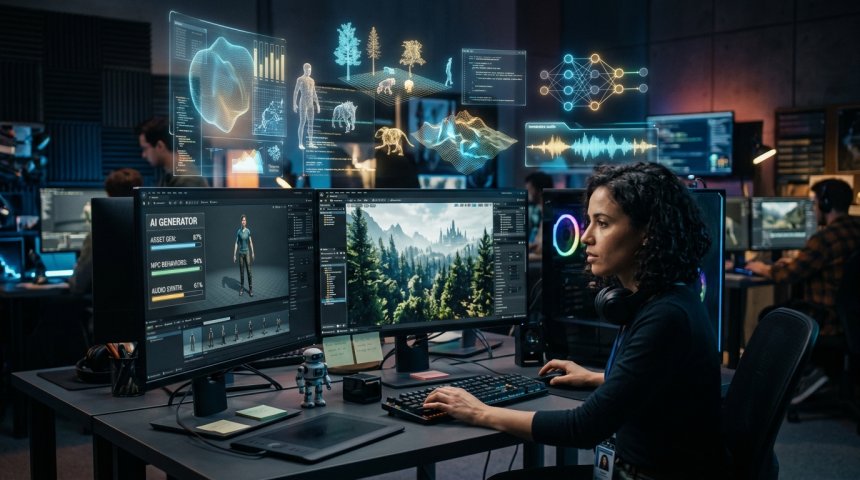
The video game industry is experiencing its most profound transformation since the shift from 2D sprites to 3D polygons in the mid-1990s. But this time, the revolution isn't happening at the surface level—it's happening inside the production pipeline, inside the creative process, inside the very definition of what a game can be. Generative AI isn't just making games faster or cheaper to produce. It's fundamentally restructuring how games are conceived, built, tested, operated, and experienced. And the implications extend far beyond cost savings or efficiency gains—they're reshaping the creative possibilities, the economic models, the team structures, and the player expectations that define the entire medium.
For anyone involved in the games industry—developers, publishers, investors, players, or observers—understanding this transformation isn't optional. It's existential. The studios that internalize generative AI as core infrastructure will produce games that were previously impossible: worlds too vast for human teams to build, characters too nuanced for scripted dialogue to capture, experiences too personalized for static content to deliver. The studios that treat generative AI as a peripheral tool—a nice-to-have plugin bolted onto existing workflows—will find themselves outpaced, outspent, and outcreated by competitors who rebuilt their pipelines from the ground up around AI-native production.
This guide is your comprehensive map of the transformation. We'll dissect every stage of the game development lifecycle—concept, pre-production, production, testing, launch, and live operations—and examine exactly how generative AI is rewriting each stage from the inside out. We'll analyze the economic implications for studios of every size, the creative opportunities that emerge when production constraints dissolve, the risks and ethical questions that accompany the technology, and the strategic frameworks for navigating the transition. Whether you're an indie developer with a three-person team, a AAA studio managing hundreds of artists and engineers, or a player trying to understand why the games of 2027 look nothing like the games of 2023, this deep dive will give you the technical understanding and strategic context to make sense of the most significant shift in interactive entertainment in three decades.
Let's start at the beginning: the production pipeline, where the transformation is most visible and most immediate.
Chapter 1: The Production Pipeline Revolution — How AI Rewrites Game Development
Game development has always been constrained by a fundamental equation: scope × quality ÷ budget = feasibility. Every studio, from solo indies to thousand-person AAA teams, operates within this equation. Want a bigger world? Cut quality or increase budget. Want higher fidelity? Reduce scope or raise costs. Want both scope and quality on a fixed budget? You can't. The equation doesn't allow it.
Generative AI breaks the equation. Not by changing the variables—scope, quality, and budget still matter—but by introducing a new factor that multiplies the output of every human hour invested in the pipeline. A concept artist who previously produced five character designs per week now produces fifty. A 3D environment artist who previously built one building per week now generates twenty variations. A writer who previously scripted ten NPC dialogue trees per month now generates two hundred. The feasibility equation shifts from "what can we afford?" to "what can we imagine?"
But the transformation goes deeper than productivity multiplication. Generative AI is restructuring the pipeline itself—collapsing stages that were previously sequential, enabling iterations that were previously impossible, and creating feedback loops between disciplines that were previously siloed. Let's walk through each stage of the pipeline and examine exactly what's changing.
Concept and Pre-Production: From Mood Boards to Infinite Iteration
The Old Way: Pre-production begins with mood boards—collections of reference images, color palettes, and aesthetic touchstones assembled by art directors to communicate the game's visual direction. Concept artists then produce hand-drawn or digitally painted sketches exploring characters, environments, props, and key moments. Each concept takes days to weeks. Iteration is expensive—every revision consumes artist hours. The team converges on a final direction after months of exploration, and that direction locks the production pipeline for the next 2–4 years.
The AI-Transformed Way: Generative AI collapses the concept phase from months to days. Art directors feed prompt descriptions—"cyberpunk samurai, neon-lit rain, weathered armor, melancholic expression"—into image generation models and receive dozens of variations in minutes. The team explores hundreds of directions instead of dozens. Iteration is nearly free—regenerate, refine, remix. The convergence happens faster, but more importantly, the exploration is deeper. Directions that would have been cut for budget reasons get explored. Happy accidents become foundational design decisions.
What changes structurally:
- Concept artist role evolution: Concept artists shift from production (drawing every variation) to curation and direction (guiding AI generation, refining outputs, establishing visual language). The skill set moves from manual execution to creative judgment and prompt engineering.
- Faster greenlight decisions: Publishers and studio heads can evaluate dozens of visual directions in the time it previously took to evaluate three. Greenlight decisions happen faster, with more data, and with lower sunk cost.
- Democratized ideation: Non-artists—designers, writers, producers—can generate visual concepts to communicate their ideas. The barrier between "I have an idea" and "here's what it looks like" drops to near zero. Cross-disciplinary collaboration intensifies.
- Risk reduction: Studios can prototype visual directions before committing production resources. The risk of investing millions in a direction that doesn't resonate with players decreases dramatically.
The creative implication: When concept exploration becomes nearly free, the creative ceiling rises. Studios can pursue more ambitious, more unusual, more risky visual directions because the cost of exploration has collapsed. The games that emerge from AI-augmented pre-production will look different—not just higher fidelity, but more diverse, more experimental, more visually surprising—because the economic penalty for creative risk has been reduced by an order of magnitude.
For developers looking to integrate generative AI into their concept and pre-production workflows, tools like Unity Muse (dofollow) provide AI-powered asset generation, texture synthesis, and animation assistance directly within the Unity editor, enabling rapid iteration from concept to playable prototype without leaving the development environment.
3D Asset Production: The End of the Polygon Bottleneck
The Old Way: 3D asset production is the most labor-intensive stage of game development. A single AAA-quality character requires 4–8 weeks of work: high-poly sculpting, retopology, UV unwrapping, texturing, rigging, and animation setup. A single environment module (a building, a room, a terrain section) requires 2–4 weeks. A AAA game with thousands of unique assets requires hundreds of artists working for years. This is the polygon bottleneck—the primary constraint on game scope and visual fidelity for three decades.
The AI-Transformed Way: Generative 3D models collapse asset production timelines by 70–90%. Text-to-3D and image-to-3D models generate base meshes from prompts or reference images in minutes. AI-assisted retopology converts high-poly sculpts to game-ready topology automatically. AI texture generation produces PBR (Physically Based Rendering) material sets from text descriptions or style references. AI-assisted rigging auto-generates skeletons and weight maps for characters. The human artist's role shifts from manual execution to quality control, artistic direction, and refinement.
Specific transformations across asset categories:
Characters:
- AI generates base character meshes from concept art or text descriptions
- Auto-retopology creates game-ready topology from high-poly sculpts
- AI texture synthesis generates skin, fabric, armor, and material textures
- Auto-rigging generates skeletons and skin weights for animation
- AI-assisted facial animation generates realistic expressions from audio or text
- Human artists refine proportions, fix artifacts, establish style consistency, and add the final 10% of polish that separates AI output from production-ready assets
Environments:
- AI generates terrain, vegetation, architecture, and props from layout sketches or procedural parameters
- Style transfer applies consistent art direction across generated assets
- AI populates environments with contextually appropriate details (clutter, wear, lighting)
- Procedural generation + AI curation creates vast, varied worlds that feel hand-crafted
- Human artists establish the art direction, curate AI outputs, fix structural issues, and ensure gameplay functionality (collision, navigation, interaction points)
Props and Items:
- AI generates weapon, vehicle, furniture, and item meshes from descriptions or reference images
- Variant generation creates dozens of stylistic variations from a single base asset
- AI texture generation produces material variations (rust, wear, damage states) automatically
- Human artists establish the prop language, curate variants, and ensure gameplay readability
The economic implication: The polygon bottleneck was the primary driver of AAA game budgets. When a studio needs 200 artists for 3 years to produce assets, the budget must support 600 artist-years of salaries, overhead, and management. When AI reduces the artist requirement to 40 artists for 2 years, the budget drops to 80 artist-years—an 87% reduction. This doesn't mean studios will necessarily spend less; it means they can spend the same budget on vastly more ambitious scope, or redirect savings to other areas (marketing, live ops, talent retention, R&D).
The creative implication: When asset production ceases to be the binding constraint, game design is liberated from the tyranny of asset budgets. Open worlds can be genuinely open—not corridor-based illusions of openness constrained by asset production capacity. RPGs can feature hundreds of unique characters instead of dozens with shared face templates. Environments can be dense with detail instead of sparse and repetitive. The games of the next generation will feel qualitatively different—not just bigger, but richer, denser, more varied—because the production bottleneck that forced homogeneity has been removed.
Animation and Motion: From Keyframes to Generated Movement
The Old Way: Animation is one of the most skilled and time-consuming disciplines in game development. A senior animator produces 5–10 seconds of polished character animation per day. A AAA game requiring thousands of animation sequences (locomotion, combat, interactions, cinematics) needs dozens of animators working for years. Motion capture accelerates cinematic animation but requires expensive studios, actors, and cleanup artists. Procedural animation (ragdoll, IK) handles basic movement but lacks the expressiveness of hand-keyed animation.
The AI-Transformed Way: Generative AI transforms animation across every category:
Locomotion and Gameplay Animation:
- AI motion generation creates walk, run, jump, climb, and combat animations from text descriptions or motion parameters
- Motion matching databases expand exponentially—AI generates thousands of motion clips that blend seamlessly during gameplay
- AI-assisted motion cleanup accelerates mocap processing by 60–80%
- Style transfer applies consistent animation style across generated and hand-keyed sequences
- Human animators establish the movement language, refine AI outputs, and create hero animations for key moments
Cinematic and Narrative Animation:
- AI generates facial animation from voice audio, producing realistic lip sync and emotional expressions
- Body language generation creates contextually appropriate gestures and postures from dialogue scripts
- AI-assisted scene composition suggests camera angles, blocking, and staging based on narrative beats
- Human directors and animators refine performances, establish emotional tone, and direct the final cinematic vision
Procedural and Reactive Animation:
- AI-driven animation systems generate context-aware movement in real-time—characters react to terrain, obstacles, combat situations, and social contexts dynamically
- Emotion-driven animation modulates movement based on character state (tired, injured, afraid, confident)
- Player-driven animation adapts to player input patterns, creating responsive, personalized movement
- Human animators establish the animation vocabulary and behavioral rules that the AI system operates within
The creative implication: When animation ceases to be a bottleneck, characters move with a fluidity and responsiveness that was previously impossible. NPCs don't repeat the same three idle animations—they fidget, stretch, react to weather, respond to nearby events, and express personality through movement. Combat animations adapt to context—terrain, weapons, injuries, fatigue—creating emergent variety that hand-keyed animation libraries can't match. The gap between cinematic quality and gameplay quality narrows because the production cost of high-quality animation has collapsed.
World Building and Level Design: From Hand-Crafted to AI-Augmented Vastness
The Old Way: Level design is a painstaking craft. Level designers block out spaces, script encounters, place assets, tune pacing, and iterate through playtesting. Every square meter of playable space represents hours of human labor. Open-world games compromise between scope and density—vast worlds feel empty because filling them with hand-crafted content is prohibitively expensive. Linear games sacrifice freedom for density because every path must be manually constructed.
The AI-Transformed Way: Generative AI enables a new paradigm: AI-generated foundations with human-designed highlights.
Procedural Generation + AI Curation:
- AI generates terrain, vegetation, architecture, and point-of-interest layouts from high-level design parameters
- AI populates worlds with contextually appropriate encounters, loot, environmental storytelling, and ambient detail
- AI ensures spatial coherence—generated content respects navigation, sightlines, pacing, and gameplay flow
- Human level designers establish the design pillars, curate AI outputs, design hero moments, and tune the critical path
- The result: worlds that are both vast (AI-generated breadth) and dense (human-designed depth)
Dynamic World Systems:
- AI-driven world simulation generates emergent narratives—factions compete, economies fluctuate, ecosystems evolve, weather patterns shift
- AI populates worlds with autonomous agents pursuing goals, creating emergent stories that players discover rather than being scripted through
- Environmental storytelling generates itself—abandoned camps tell stories through AI-placed objects, notes, and environmental cues
- Human designers establish the simulation rules, faction motivations, and narrative frameworks that the AI operates within
Personalized Level Adaptation:
- AI analyzes player behavior and adapts level layouts, encounter difficulty, pacing, and content to individual play styles
- Dynamic difficulty adjustment goes beyond enemy health pools—AI restructures encounters, modifies terrain, and adjusts pacing in real-time
- Replayability increases exponentially because the world regenerates meaningfully different experiences on each playthrough
- Human designers establish the adaptation parameters and guardrails that ensure the experience remains coherent and fair
The creative implication: The binary choice between "open world" (vast but empty) and "linear" (dense but constrained) dissolves. AI-augmented world building enables games that are simultaneously vast and dense, open and curated, systemic and authored. The next generation of open-world games won't feel like checklist exercises across empty landscapes—they'll feel like living, breathing worlds that surprise even their creators because the AI systems generate emergent complexity beyond what any design document could specify.
Audio and Music: From Licensed Tracks to Generated Soundscapes
The Old Way: Game audio production involves recording, editing, and implementing thousands of sound effects, composing and recording original scores or licensing existing music, recording voice acting for every line of dialogue, and mixing everything into a cohesive soundscape. AAA audio budgets run into millions of dollars. Indie studios compromise on audio quality because professional audio production is expensive. Dynamic audio systems (adaptive music, contextual sound effects) require complex implementation and extensive content libraries.
The AI-Transformed Way: Generative AI transforms every audio discipline:
Sound Effects:
- AI generates sound effects from text descriptions—"sword clash on stone," "footsteps on wet gravel," "distant thunder"
- Variant generation creates dozens of variations from a single base sound, eliminating repetition
- AI synthesizes contextually appropriate ambient soundscapes that adapt to environment, weather, and player actions
- Human sound designers establish the sonic palette, curate AI outputs, and design hero sounds for key moments
Music:
- AI generates adaptive music stems that layer and transition based on gameplay state (exploration, combat, tension, victory)
- Style transfer applies consistent musical identity across generated tracks
- AI composes variations and transitions that eliminate repetitive looping
- Human composers establish the musical themes, harmonic language, and emotional arc that the AI system operates within
- Licensing costs drop dramatically as AI-generated music replaces licensed tracks for ambient and functional music
Voice Acting:
- AI voice synthesis generates NPC dialogue from text scripts with emotional nuance, regional accents, and character-consistent delivery
- Real-time voice generation enables dynamic dialogue that responds to player choices without pre-recording every permutation
- AI-assisted voice cloning enables consistent character voices across massive dialogue trees
- Human voice actors perform hero lines, establish character voices, and provide the emotional benchmark that AI voices aspire to
- Localization accelerates dramatically—AI generates dubbed dialogue in dozens of languages from a single performance
The economic implication: Audio was historically the discipline where indie studios compromised most visibly. AI-generated audio democratizes professional-quality sound design, music, and voice acting for studios of every size. An indie team can now produce audio that rivals AAA productions—not identical in quality, but sufficient to eliminate the audio gap that previously separated indie and AAA experiences.
The creative implication: When audio production ceases to be a budget constraint, games become sonically richer. Ambient soundscapes adapt dynamically to player actions and environmental states. Music transitions seamlessly between emotional states without audible loops or hard cuts. NPC dialogue expands from hundreds of pre-recorded lines to thousands of dynamically generated responses. The games of the next generation won't just look better—they'll sound better, in ways that deepen immersion and emotional resonance.
For developers exploring AI-driven NPC intelligence and dynamic dialogue systems, platforms like Inworld AI (nofollow) provide character engine infrastructure that enables NPCs with persistent memory, dynamic personalities, and real-time conversational abilities—transforming static dialogue trees into living, responsive characters that remember past interactions and adapt to player behavior.
Chapter 2: NPC Intelligence and Narrative — The Death of the Dialogue Tree
If the production pipeline revolution is the most visible transformation, the NPC intelligence revolution is the most profound. For four decades, game characters have been trapped in dialogue trees—branching scripts written by human writers, offering players the illusion of choice within a finite set of predetermined responses. Every conversation, every interaction, every relationship in a game has been bounded by what the writers anticipated and scripted. Generative AI dissolves those boundaries entirely.
From Scripted Responses to Generated Conversation
The Old Way: A writer scripts 10–50 dialogue options for each NPC interaction. Players choose from these options, and the NPC responds with a pre-written response. The branching tree expands combinatorially, but practical constraints limit it to a few hundred lines per character. Beyond those lines, the NPC has nothing to say. Relationships are simulated through flags and variables—"if player chose option 3 in conversation 7, set relationship variable to +10"—but the underlying interaction is always a selection from a predetermined menu.
The AI-Transformed Way: Large language models enable NPCs to generate responses dynamically, in real-time, based on the full context of the conversation, the character's personality, their knowledge, their emotional state, their relationship with the player, and the broader game state. The dialogue tree is replaced by a dialogue engine.
What this enables:
Unlimited Conversational Depth: Players can ask NPCs about anything within the character's knowledge domain. The blacksmith knows about metallurgy, local politics, and the player's previous purchases. The merchant remembers the player's haggling history and adjusts pricing accordingly. The companion comments on the player's recent decisions and expresses evolving opinions. The conversation never hits a wall where the NPC has nothing to say.
Persistent Memory and Relationship Evolution: NPCs remember past interactions and reference them in future conversations. "Last time you were here, you promised to clear the wolves from the northern pass. Did you manage that?" Relationships evolve organically based on cumulative interactions, not discrete flag triggers. Trust, friendship, rivalry, and romance develop through natural conversation rather than menu-selected dialogue options.
Emergent Narrative: When NPCs can generate dialogue dynamically, they can also generate narrative. An NPC might reveal information the writers didn't explicitly script because the AI inferred it from the character's knowledge, personality, and context. Players discover stories through conversation rather than being funneled through predetermined narrative paths. The narrative becomes partially emergent—shaped by the unique interactions between each player and the AI-driven characters.
Contextual Awareness: NPCs respond to the game state dynamically. If the player just completed a difficult battle, NPCs comment on their appearance, injuries, or reputation. If the player is carrying a rare weapon, NPCs react to it. If the player has a notorious reputation, NPCs behave differently—fearfully, deferentially, or hostilely. The world feels aware of the player's actions because the characters within it are genuinely responsive.
The creative implication: The death of the dialogue tree is the death of the illusion of choice and the birth of genuine interaction. When players can say anything and receive a contextually appropriate response, the boundary between "game" and "simulation" blurs. Role-playing games become actual role-playing—not selecting from predetermined roles but inhabiting a character whose words and actions shape the world in unpredictable ways. The narrative designer's role shifts from scripting every possibility to designing the systems, personalities, and constraints that generate infinite possibilities.
The risk: Generated dialogue can hallucinate, contradict established lore, break character, or produce inappropriate content. Guardrails—content filters, lore databases, personality constraints, human oversight—are essential. The challenge isn't generating dialogue; it's generating dialogue that's consistent, coherent, and aligned with the game's creative vision. This requires sophisticated prompt engineering, fine-tuning, and runtime monitoring that's still maturing.
Procedural Narrative and Emergent Storytelling
Beyond individual conversations, generative AI enables procedural narrative at the macro level—entire storylines, quest chains, and world events that generate themselves based on player actions, world state, and systemic rules.
Dynamic Quest Generation:
- AI generates quests based on the current world state, player history, and available NPCs
- Quests adapt to player choices—fail a quest and the consequences generate new quests
- Side quests emerge from NPC motivations and world events rather than being pre-scripted
- Human narrative designers establish the quest archetypes, moral frameworks, and narrative pillars that the AI operates within
Emergent Faction Dynamics:
- AI-driven factions pursue goals, form alliances, declare wars, and negotiate treaties based on systemic rules
- Player actions influence faction dynamics, which generate new narrative opportunities
- Faction leaders generate diplomatic correspondence, propaganda, and public statements dynamically
- Human narrative designers establish faction motivations, historical context, and the rules of engagement
Personalized Story Arcs:
- AI analyzes player behavior, preferences, and choices to generate personalized narrative arcs
- Companion characters develop storylines that respond to the player's relationship with them
- The main narrative adapts its pacing, tone, and emphasis based on player engagement patterns
- Human narrative designers establish the core story, thematic pillars, and emotional beats that the AI personalizes
The creative implication: Procedural narrative doesn't replace authored narrative—it augments it. The best games of the next generation will combine hand-crafted hero moments (the meticulously designed set pieces, the emotionally pivotal scenes, the carefully paced revelations) with AI-generated connective tissue (the dynamic conversations, the emergent side quests, the personalized pacing). The authored content provides the skeleton; the AI-generated content provides the flesh. The result is games that feel both carefully designed and endlessly surprising.
Chapter 3: Testing, QA, and Live Operations — AI as the Invisible Workforce
The production pipeline and NPC intelligence transformations are the most visible changes. But some of the most impactful AI transformations are happening in the less glamorous corners of game development: testing, quality assurance, and live operations. These are the functions that determine whether a game ships on time, launches without catastrophic bugs, and retains players over months and years of live service.
Automated Testing and QA: From Manual Playthroughs to AI Agents
The Old Way: QA testing is labor-intensive and repetitive. Testers play through builds manually, following test cases, documenting bugs, and verifying fixes. A AAA game requires hundreds of testers working for months to achieve acceptable bug coverage. Even with large QA teams, bugs slip through—edge cases, rare hardware configurations, and emergent interactions that no test case anticipated. Post-launch patches address the worst offenders, but the reputation damage from a buggy launch is often irreversible.
The AI-Transformed Way: AI agents play the game autonomously, exploring every corner, testing every interaction, and identifying bugs at scale.
Automated Playtesting:
- AI agents play through builds 24/7, exploring paths no human tester would think to try
- Agents test edge cases systematically—every weapon combination, every physics interaction, every UI element under every condition
- AI identifies crashes, softlocks, visual glitches, balance issues, and progression blockers
- Human QA leads define test priorities, review AI findings, and investigate complex bugs that require human judgment
Balance and Economy Testing:
- AI agents simulate thousands of playthroughs to identify balance issues—overpowered weapons, broken economy loops, trivialized challenges
- AI models player progression curves and identifies difficulty spikes, grinding walls, and reward deserts
- AI tests monetization mechanics for fairness, sustainability, and player sentiment impact
- Human designers interpret AI findings, adjust balance parameters, and make creative decisions about intended difficulty
Compatibility and Performance Testing:
- AI agents test builds across hardware configurations, driver versions, and network conditions
- AI identifies performance bottlenecks—frame rate drops, memory leaks, loading stalls—and pinpoints their causes
- AI tests network code for latency issues, desync bugs, and exploit vulnerabilities
- Human engineers prioritize fixes, architect solutions, and optimize critical paths
The economic implication: QA is typically 15–25% of a AAA game's development budget. AI-augmented QA reduces the human QA requirement by 50–70% while improving bug coverage. The savings are significant, but the bigger impact is quality: games ship with fewer bugs, fewer post-launch patches, and less reputation damage. The ROI of AI-augmented QA isn't just cost savings—it's revenue protection through better launch quality.
Live Operations: From Reactive Patches to Predictive Management
The Old Way: Live operations for games-as-a-service titles involve reactive problem-solving: monitoring player metrics, responding to community feedback, patching bugs, balancing mechanics, and releasing content updates on a fixed schedule. Teams operate on monthly or quarterly content cadences, hoping that each update addresses player needs and retains engagement. Churn is managed through intuition, surveys, and retrospective analysis of engagement data.
The AI-Transformed Way: AI transforms live operations from reactive to predictive, from scheduled to dynamic, from one-size-fits-all to personalized.
Predictive Churn Prevention:
- AI models identify players at risk of churning based on behavioral signals—declining session frequency, abandoned quests, negative social interactions, frustration indicators
- AI triggers personalized interventions—targeted rewards, adjusted difficulty, social connection prompts, content recommendations—before the player disengages
- AI predicts which content updates will resonate with which player segments, enabling targeted content deployment
- Human live ops managers define intervention strategies, review AI recommendations, and handle edge cases requiring human empathy
Dynamic Content Generation:
- AI generates seasonal events, limited-time modes, cosmetic items, and narrative content based on player engagement data and community sentiment
- AI personalizes content recommendations for individual players based on their play history, preferences, and social connections
- AI generates patch notes, community communications, and marketing materials from development updates
- Human content designers establish the creative direction, quality standards, and brand voice that the AI operates within
Automated Community Management:
- AI monitors community channels (forums, Discord, social media) for sentiment, emerging issues, and feature requests
- AI categorizes feedback, identifies trends, and surfaces actionable insights to development teams
- AI generates draft responses to common community questions, escalating complex issues to human community managers
- AI detects toxic behavior, cheating, and exploitation patterns in real-time, enabling faster moderation
- Human community managers handle nuanced situations, build relationships with key community members, and make judgment calls about policy enforcement
The economic implication: Live operations is where games-as-a-service titles generate the majority of their lifetime revenue. AI-augmented live ops improves retention (reducing churn by 15–30%), increases engagement (extending session length and frequency), and optimizes monetization (personalizing offers and content). The revenue impact compounds over the multi-year lifespan of a live service title. A 20% improvement in retention on a game generating $100M/year translates to $20M/year in incremental revenue—far exceeding the cost of AI live ops infrastructure.
Chapter 4: The Economic Restructuring — How AI Changes the Business of Games
The production pipeline, NPC intelligence, and operational transformations aren't just technical changes—they're economic earthquakes that reshape the business models, team structures, and competitive dynamics of the entire games industry.
The Cost Structure Revolution
AAA Studios: Traditional AAA budgets of $100–$300M are driven primarily by headcount: 200–500 people working for 3–5 years. Generative AI reduces the headcount required for asset production, animation, audio, and QA by 50–70%. The implications are profound:
- Option A: Same budget, more ambition. Studios maintain current budgets but produce games with 3–5x the scope, fidelity, and content density. Open worlds become genuinely vast. RPGs feature hundreds of unique characters. Every surface tells a story. The AAA ceiling rises dramatically.
- Option B: Lower budget, same ambition. Studios reduce budgets by 40–60% while maintaining current scope and quality. Margins expand. Risk decreases. More projects get greenlit. The middle class of AAA grows.
- Option C: Hybrid approach. Studios reduce budgets modestly (20–30%) while increasing ambition moderately (2x scope). The sweet spot for most studios—lower risk, higher ambition, sustainable margins.
Indie Studios: Indie studios have always been constrained by budget. Generative AI is the great equalizer—enabling small teams to produce assets, audio, and content that previously required AAA-scale resources.
- Asset production: A 3-person indie team can now produce visual fidelity that rivals mid-tier AA studios from five years ago.
- Audio: Professional-quality sound design, music, and voice acting become accessible at indie budgets.
- Content volume: Indie RPGs can feature dozens of unique NPCs with dynamic dialogue instead of five NPCs with scripted lines.
- Scope: Indie open-world games become feasible for the first time—AI generates the breadth while the small team designs the depth.
The competitive implication: The gap between indie and AAA narrows significantly. Indie studios can compete on visual quality, audio fidelity, and content volume in ways that were previously impossible. The differentiator shifts from production capacity to creative vision, design innovation, and community building. The best indie games of the next generation won't look like indie games—they'll look like AAA games with indie souls.
The Team Structure Transformation
The Old Team Structure: Hierarchical, discipline-siloed, headcount-heavy. Art directors manage teams of concept artists, 3D artists, texture artists, and animators. Lead designers manage teams of level designers, systems designers, and narrative designers. Technical directors manage teams of engine programmers, gameplay programmers, and tools programmers. Communication flows through leads. Iteration is slow because cross-discipline coordination requires meetings, documents, and approvals.
The AI-Transformed Team Structure: Flatter, cross-functional, AI-augmented. Smaller teams of generalists who use AI tools to execute across disciplines. A "world builder" might use AI to generate terrain, populate environments, script encounters, and tune pacing—tasks that previously required four specialists. A "character creator" might use AI to generate meshes, textures, animations, and dialogue—tasks that previously required four specialists.
New roles emerge:
- AI Pipeline Architect: Designs and maintains the AI tools, workflows, and integrations that power the production pipeline.
- Prompt Engineer / AI Director: Develops prompt libraries, style guides, and quality standards for AI-generated content.
- AI Output Curator: Reviews, refines, and approves AI-generated assets, ensuring quality and consistency.
- AI Ethics and Safety Lead: Establishes guardrails for AI-generated content, manages bias mitigation, and ensures compliance with evolving regulations.
- Player Data Scientist: Analyzes player behavior data to inform AI-driven personalization, balance, and live ops decisions.
Roles that evolve:
- Concept Artist → Creative Director + AI Curator: Less manual drawing, more creative direction and AI output curation.
- 3D Artist → Asset Director + Quality Controller: Less manual modeling, more art direction and AI output refinement.
- Animator → Motion Director + AI Trainer: Less manual keyframing, more motion language design and AI motion system training.
- Writer → Narrative Designer + AI Personality Architect: Less line-by-line scripting, more system design and AI personality configuration.
- QA Tester → QA Strategist + AI Supervisor: Less manual playtesting, more test strategy and AI agent oversight.
Roles that diminish:
- Production Artists: Roles focused on repetitive execution (UV unwrapping, texture tiling, animation cleanup) are largely automated.
- Junior-Level Execution Roles: Entry-level positions focused on manual production tasks shrink as AI handles baseline production.
- Middle Management: Flatter team structures reduce the need for hierarchical coordination layers.
The human implication: The transformation is disruptive for individuals whose skills center on manual execution. Studios, industry organizations, and governments face a responsibility to manage this transition through retraining, role evolution, and social safety nets. The industry's long-term health depends on converting displaced production artists into AI-augmented creative directors—not discarding them.
The Market Structure Shift
Consolidation Pressure: AI amplifies the advantages of scale. Large studios with capital to invest in AI infrastructure, proprietary models, and specialized talent pull further ahead of smaller competitors. Expect accelerated consolidation as mid-tier studios struggle to compete with AI-augmented AAA giants and AI-equalized indies simultaneously.
New Entrants: AI lowers the barrier to entry for new studios. Small teams with strong creative vision can produce games that compete with established players. Expect a surge of new studios founded by veterans who left large studios to pursue AI-augmented indie development.
Platform Dynamics: Platform holders (Steam, Epic, console manufacturers, mobile stores) face new dynamics. AI-generated content floods storefronts, making discovery harder. Platforms invest in curation, recommendation algorithms, and quality signals to surface the best AI-augmented games. The relationship between platforms and developers evolves as AI changes production economics and content volume.
Publisher Models: Publishers reconsider their value proposition. When AI reduces production costs and risk, developers need publishers less for funding and more for marketing, distribution, and live ops infrastructure. Publishing deals shift from funding-heavy to services-heavy. Some publishers pivot to AI infrastructure providers—offering AI tools, pipelines, and expertise as a service to independent studios.
Chapter 5: Risks, Ethics, and the Questions Nobody Has Answered
The transformation isn't uniformly positive. Generative AI introduces risks, ethical dilemmas, and unresolved questions that the industry must confront honestly.
Creative Homogenization Risk
The risk: If every studio uses the same foundation models trained on the same datasets, will games converge toward a homogeneous aesthetic? Will AI-generated content produce a sameness—a recognizable "AI look"—that undermines the diversity and distinctiveness that makes games culturally valuable?
The mitigation: Fine-tuning foundation models on studio-specific datasets. Developing proprietary models trained on unique art styles. Using AI as a starting point that human artists push in distinctive directions. Establishing strong art direction that guides AI output toward unique visual identities. The risk is real but manageable—studios that invest in distinctive AI pipelines will differentiate; those that rely on default model outputs will homogenize.
Labor Displacement and Industry Responsibility
The risk: AI automation displaces production artists, junior developers, and QA testers. Thousands of talented professionals face career disruption. The industry benefits from cost reduction while individuals bear the displacement cost.
The mitigation: Proactive retraining programs that convert production artists into AI-augmented creative directors. Internal mobility programs that redeploy displaced staff into emerging AI-related roles. Industry-wide initiatives (funded by studios benefiting from AI cost savings) to support displaced workers. Transparent communication about workforce transitions. The industry has a moral obligation to manage this transition responsibly—not just maximize efficiency.
Copyright and Training Data
The risk: Generative AI models are trained on copyrighted works—concept art, 3D models, textures, animations, music, and writing created by human artists. The legal status of training on copyrighted works is unresolved in most jurisdictions. Studios using AI-generated assets face potential copyright claims from artists whose works were included in training datasets.
The mitigation: Using models trained on licensed or public-domain datasets. Developing proprietary models trained on studio-owned content. Supporting industry-wide licensing frameworks that compensate artists whose works are used for training. Monitoring evolving copyright law and adjusting practices accordingly. The legal landscape is uncertain—studios should proceed with caution and legal counsel.
Content Safety and Guardrails
The risk: AI-generated dialogue, narratives, and content can produce harmful, biased, inappropriate, or off-brand outputs. Without robust guardrails, AI-generated content can damage player experience, brand reputation, and regulatory compliance.
The mitigation: Multi-layered content filtering (pre-generation prompt screening, post-generation output filtering, runtime monitoring). Lore databases and personality constraints that keep AI outputs consistent with the game's world and tone. Human oversight for high-stakes content (main narrative, monetization messaging, community communications). Continuous monitoring and refinement of guardrails based on player feedback and emerging failure modes.
Player Trust and Transparency
The risk: Players may react negatively to AI-generated content, perceiving it as inauthentic, lazy, or deceptive. Over-reliance on AI could erode the human creative connection that players value in games.
The mitigation: Transparency about AI usage—players respect honesty more than perfection. Using AI as a tool that amplifies human creativity, not replaces it. Maintaining human authorship for hero moments, emotional beats, and signature creative elements. Engaging with player feedback about AI usage and adjusting accordingly. The key is positioning AI as enabling human creativity to reach further, not substituting for it.
Environmental Impact
The risk: Training and running large generative AI models consumes significant computational resources and energy. The environmental cost of AI-augmented game development could offset some of the efficiency gains.
The mitigation: Using efficient model architectures (like the optimizations discussed in MiniMax H3's cost breakthrough). Running inference on energy-efficient hardware. Offsetting computational carbon footprint. Optimizing AI workflows to minimize redundant generation. The environmental impact is real but decreasing as model efficiency improves rapidly.
Chapter 6: The Player Experience — What Changes for the Person Holding the Controller
All the production pipeline, NPC intelligence, operational, and economic transformations ultimately serve one purpose: changing the experience of the person playing the game. Let's translate the technical and business transformations into player-facing outcomes.
Worlds That Feel Alive
Before: Open worlds are beautiful but static. NPCs repeat the same routines. Environments don't change. The world is a backdrop for the player's story, not a living system with its own momentum.
After: Worlds simulate themselves. Factions pursue goals. Economies fluctuate. Weather patterns shift. NPCs remember the player and react to their reputation. The world continues evolving whether the player engages with it or not. The player's story is one thread in a larger tapestry that exists independently.
Player impact: Immersion deepens. The suspension of disbelief strengthens. The world feels like a place, not a level. Players return to games not just for new content updates but to see how the world has evolved since their last visit.
Characters That Feel Real
Before: NPCs are quest dispensers and lore repositories. Dialogue trees offer the illusion of choice within predetermined boundaries. Relationships are simulated through flags, not felt through interaction. Companions are scripted personalities, not responsive partners.
After: NPCs converse naturally about anything within their knowledge. They remember past interactions and reference them. Relationships evolve through cumulative conversation, not menu selections. Companions express opinions, disagree with the player, and develop independently. Characters feel like people, not puppets.
Player impact: Emotional investment deepens. Role-playing becomes genuine role-playing. Players form attachments to characters that surprise even the developers. The narrative becomes personal—shaped by the unique interactions between each player and the AI-driven cast.
Stories That Feel Personal
Before: Every player experiences the same narrative. Choices branch the story along predetermined paths. Replayability comes from seeing the other branches, not from genuinely different experiences.
After: The narrative adapts to each player's behavior, preferences, and choices. Pacing adjusts to engagement patterns. Side quests emerge from the player's unique history. Companion arcs respond to the player's relationship with them. No two playthroughs are identical.
Player impact: Agency feels real. Choices feel consequential. Replayability becomes infinite—not because there are more branches to see, but because the story regenerates meaningfully different experiences each time. Players share stories not about what happened in the game, but about what happened in their version of the game.
Games That Feel Responsive
Before: Difficulty is static or crudely adjustable. Content updates arrive on fixed schedules. Bug fixes come in patches weeks after discovery. The game is a finished product delivered to the player.
After: Difficulty adapts dynamically to player skill and engagement. Content generates continuously based on player behavior and community sentiment. Bugs are identified and patched faster through AI-augmented QA. The game is a living service that evolves with its players.
Player impact: Frustration decreases. Engagement extends. The game feels like it's listening—responding to how the player plays, not forcing the player to conform to how the game was designed. The relationship between player and game becomes collaborative rather than transactional.
Chapter 7: The Strategic Playbook — Navigating the Transformation
Understanding the transformation is essential. Navigating it strategically is what separates winners from casualties. Here's the playbook for studios, publishers, and investors navigating the generative AI transition.
For AAA Studios: Scale Ambition, Not Just Efficiency
Don't: Use AI solely to reduce headcount and cut costs. This is a race to the bottom that competitors can match.
Do: Use AI to increase ambition. Produce games with 3–5x the scope, density, and fidelity at the same budget. Raise the ceiling on what AAA games can be. Build proprietary AI pipelines that competitors can't replicate. Invest in AI talent—pipeline architects, prompt engineers, AI curators—as core competitive advantages.
Timeline: Begin AI pipeline integration immediately. Expect 12–18 months to fully transform production workflows. Expect 24–36 months to ship the first AI-augmented AAA title. The studios that start today will ship in 2027–2028. The studios that wait will ship in 2029–2030—and the market will have moved on.
For Indie Studios: Leverage Equality, Compete on Vision
Don't: Try to out-produce AAA studios on volume. Even with AI, small teams can't match AAA scale.
Do: Use AI to eliminate the production gaps that previously separated indie from AAA. Compete on visual quality, audio fidelity, and content density that was previously impossible at indie budgets. Differentiate through creative vision, design innovation, and community building—areas where small teams excel. Use AI to amplify your unique voice, not to imitate AAA conventions.
Timeline: Adopt AI tools immediately. The barrier to entry is low—most AI tools are accessible to small teams. Expect 6–12 months to integrate AI into your workflow. Ship AI-augmented titles in 2026–2027. The indie wave powered by AI arrives before the AAA wave because small teams move faster.
For Publishers: Pivot from Funding to Infrastructure
Don't: Continue operating as pure funding vehicles. When AI reduces production costs and risk, developers need funding less.
Do: Pivot to AI infrastructure provision. Offer AI tools, pipelines, training, and expertise as publisher services. Help portfolio studios integrate AI faster and more effectively than they could independently. Compete on AI infrastructure quality, not just check size. The publishers that become AI infrastructure providers will retain developer relationships; those that remain pure financiers will lose them.
Timeline: Begin building AI infrastructure capabilities immediately. Acquire or partner with AI tool companies. Hire AI pipeline architects and prompt engineers. Offer AI services to portfolio studios within 6–12 months. The publisher landscape consolidates around AI infrastructure providers by 2028.
For Investors: Evaluate AI Maturity, Not Just Track Record
Don't: Evaluate studios solely on past shipped titles and traditional metrics. Past success doesn't predict AI-augmented future success.
Do: Evaluate studios on AI maturity—pipeline integration, AI talent, proprietary models, workflow transformation. Ask: How has AI changed your production pipeline? What percentage of assets are AI-generated or AI-augmented? What AI-specific roles have you hired? What's your AI roadmap for the next 24 months? Studios with high AI maturity will outproduce and outcompete studios with low AI maturity, regardless of past track record.
Timeline: AI maturity becomes a primary investment criterion within 12 months. Studios without credible AI strategies face valuation discounts by 2027. The investment landscape bifurcates between AI-native studios and legacy studios struggling to adapt.
For Players: Demand Transparency, Reward Creativity
Don't: Reject AI-generated content categorically. AI is a tool, not a moral category. The question isn't "was AI used?" but "was the result good?"
Do: Demand transparency about AI usage. Support studios that use AI to amplify human creativity, not replace it. Reward games that feel distinctive, personal, and alive—regardless of how they were produced. Provide feedback about AI-generated content to help studios improve. Your engagement and spending vote for the kind of games the industry produces.
Timeline: Player awareness of AI in games grows rapidly through 2026–2027. By 2028, AI usage is ubiquitous and the conversation shifts from "is AI used?" to "how well is AI used?" Players who engage thoughtfully with the transition shape the industry's trajectory.
Conclusion: The Inside-Out Transformation Is Just Beginning
Generative AI isn't transforming games from the outside in—bolting new features onto existing production models. It's transforming games from the inside out—rewriting the production pipeline, the creative process, the economic model, the team structure, and the player experience from their foundations upward. The games of 2028 won't be 2024 games with AI features. They'll be fundamentally different artifacts—built by different processes, created by different teams, operating on different economics, and delivering experiences that 2024 technology couldn't have produced at any price.
For the games industry, this is the most consequential transformation in three decades. Bigger than the shift from 2D to 3D. Bigger than the shift from cartridges to discs. Bigger than the shift from retail to digital. Because those shifts changed the surface—the rendering, the distribution, the business model. This shift changes the engine—the very mechanism by which games are conceived, built, and experienced.
The studios that recognize this—and rebuild their pipelines, teams, and strategies from the inside out—will define the next era of interactive entertainment. The studios that bolt AI onto existing workflows and call it transformation will be outpaced, outcreated, and ultimately irrelevant.
The transformation is happening now. The only question is whether you're shaping it or being shaped by it.
Start rebuilding from the inside out. The future of games is being written today.
Frequently Asked Questions (FAQs)
How is generative AI actually being used in game development right now?
Generative AI is being used across every stage of the game development pipeline in 2026. In concept and pre-production, AI image generation enables rapid exploration of visual directions—art directors generate dozens of concept variations in minutes instead of weeks. In 3D asset production, text-to-3D and image-to-3D models generate base meshes, auto-retopology creates game-ready topology, and AI texture synthesis produces PBR material sets—reducing asset production timelines by 70–90%. In animation, AI generates locomotion, facial animation from voice audio, and context-aware procedural movement. In world building, AI generates terrain, vegetation, architecture, and populates environments with contextually appropriate detail. In audio, AI synthesizes sound effects, generates adaptive music stems, and produces NPC voice acting from text scripts. In QA, AI agents playtest builds autonomously 24/7, identifying bugs at scale. In live operations, AI predicts churn, generates dynamic content, and automates community management. The adoption rate varies by studio size and maturity—progressive AAA studios and AI-native indies are deeply integrated, while conservative studios are still experimenting.
Will generative AI replace game developers?
Generative AI will transform game development roles, not eliminate them wholesale. Roles centered on repetitive manual execution—production artists doing UV unwrapping, texture tiling, animation cleanup, junior QA testers following scripted test cases—will diminish significantly as AI automates these tasks. But roles centered on creative direction, design judgment, technical architecture, and human oversight will grow. Concept artists evolve into creative directors who guide AI generation. 3D artists evolve into asset directors who curate and refine AI outputs. Writers evolve into narrative designers who configure AI personality systems. New roles emerge: AI pipeline architects, prompt engineers, AI output curators, AI ethics leads, player data scientists. The net effect is a shift from execution-focused roles to direction-focused roles, with a smaller total headcount producing vastly more output. The industry's responsibility is to manage this transition through retraining and internal mobility—not to pretend displacement isn't happening.
How does generative AI affect indie game developers specifically?
Generative AI is the great equalizer for indie developers. Previously, indie studios competed with AAA on design innovation and creative vision while accepting significant gaps in visual fidelity, audio quality, and content volume. AI closes those gaps. A 3-person indie team can now produce visual quality that rivals mid-tier AA studios from five years ago. Professional-quality sound design, music, and voice acting become accessible at indie budgets. Indie RPGs can feature dozens of unique NPCs with dynamic dialogue instead of five NPCs with scripted lines. Indie open-world games become feasible for the first time—AI generates the breadth while the small team designs the depth. The competitive differentiator shifts from production capacity to creative vision, design innovation, and community building—areas where small teams inherently excel. The best indie games of the next generation won't look like indie games—they'll look like AAA games with indie souls.
What are the biggest risks of using generative AI in game development?
The major risks fall into six categories: (1) Creative homogenization—if every studio uses the same foundation models, games may converge toward a homogeneous "AI look." Mitigation: fine-tune models on studio-specific datasets, develop proprietary models, invest in distinctive art direction. (2) Labor displacement—production artists and junior developers face career disruption. Mitigation: proactive retraining, internal mobility, industry-wide transition support. (3) Copyright uncertainty—AI models trained on copyrighted works face unresolved legal status. Mitigation: use licensed/public-domain training data, develop proprietary models, monitor evolving law. (4) Content safety—AI-generated dialogue and content can produce harmful, biased, or off-brand outputs. Mitigation: multi-layered content filtering, lore databases, personality constraints, human oversight. (5) Player trust—audiences may perceive AI content as inauthentic. Mitigation: transparency about AI usage, AI as amplifier of human creativity not replacement, maintain human authorship for hero moments. (6) Environmental impact—AI training and inference consume significant energy. Mitigation: efficient model architectures, energy-efficient hardware, carbon offsetting, workflow optimization.
How will generative AI change the player experience in games?
The player experience transforms across four dimensions: (1) Worlds feel alive—NPCs pursue goals, economies fluctuate, weather shifts, factions compete, and the world evolves independently of the player. Immersion deepens because the world is a living system, not a static backdrop. (2) Characters feel real—NPCs converse naturally about anything within their knowledge, remember past interactions, and develop relationships through cumulative conversation rather than menu selections. Emotional investment deepens because characters feel like people, not puppets. (3) Stories feel personal—the narrative adapts to each player's behavior, preferences, and choices. Pacing adjusts, side quests emerge from player history, companion arcs respond to relationships. No two playthroughs are identical because the story regenerates meaningfully different experiences each time. (4) Games feel responsive—difficulty adapts dynamically, content generates continuously, bugs are patched faster through AI-augmented QA. The game feels like it's listening—responding to how the player plays, not forcing conformity to a fixed design.
What should studios do right now to prepare for the generative AI transformation?
Immediate action items for studios: (1) Audit your production pipeline—identify every stage where AI can augment or automate work. Prioritize high-impact, low-risk integrations first (concept art, texture generation, QA testing). (2) Hire AI talent—pipeline architects, prompt engineers, AI curators. These roles are competitive; start recruiting now. (3) Experiment with AI tools—give teams access to AI image generation, 3D generation, audio synthesis, and code assistance tools. Measure productivity impact and quality outcomes. (4) Develop AI policies—establish guidelines for AI usage, content safety guardrails, copyright compliance, and transparency standards. (5) Retrain existing staff—invest in upskilling production artists into AI-augmented creative directors. Internal mobility is cheaper and more humane than external hiring. (6) Build proprietary AI pipelines—don't rely solely on third-party tools. Fine-tune models on your studio's art style, design language, and creative vision. Proprietary pipelines are competitive moats. (7) Communicate with your team—be transparent about AI adoption plans, workforce implications, and retraining opportunities. Uncertainty breeds fear; clarity builds trust. (8) Start today—the studios that begin AI integration in 2026 ship AI-augmented titles in 2027–2028. The studios that wait ship in 2029–2030, and the market will have moved on.
Share
What's Your Reaction?
 Like
0
Like
0
 Dislike
0
Dislike
0
 Love
0
Love
0
 Funny
0
Funny
0
 Angry
0
Angry
0
 Sad
0
Sad
0
 Wow
0
Wow
0